

Dews, John Steven
Introduction
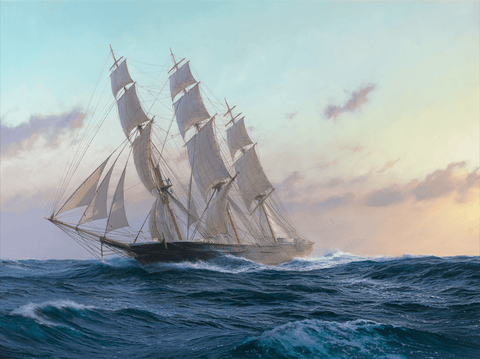
Famed for his spectacular maritime paintings, John Steven Dews is considered one of the foremost living marine artists in the world. Dews’ work continues to earn significant critical acclaim and remains highly desirable among curators, collectors and art historians alike. His paintings frequently appear in major auctions and exhibitions across the globe, often achieving exceptional prices at sale.
Early Life
Once the boy who failed art class, Dews would ultimately rise to the pinnacle of Marine Art. Born in Yorkshire in 1949, Dews recalls drawing his first picture of a boat at just five years old. Raised amid strong seafaring traditions, he and his two brothers frequently visited their grandfather, who served as Assistant Dockmaster at the Port of Hull, spending countless hours observing the docks and ships.
Nautical traditions ran deep within the Dews family, whose maritime heritage stretches back to the 17th century. While both of his brothers eventually pursued careers at sea, Dews himself was rejected by several naval institutions. Instead, he attended Hull Regional College of Art, where he graduated with a focus in Technical Graphics and Illustration.
Burgeoning Artist
After graduating and returning to his childhood home, Dews moved into a derelict farmhouse belonging to a family friend on the northern banks of the Humber Estuary. There, he established a makeshift studio and devoted himself to expressing his lifelong fascination with the sea through painting.
The shifting skies, atmospheric light and rugged waterside scenery provided the perfect setting for the artist’s increasingly lifelike canvases. Dews meticulously studied photographs, model ships, architectural drawings and maritime reference books, while also producing hundreds of pencil sketches that sharpened his skill as a draftsman.
During these formative years, he assembled an astonishing portfolio of work and mounted his first exhibition in 1976. Virtually every painting sold on opening night. The following year, another exhibition in San Francisco also sold out completely, firmly establishing Dews’ early international success.
Since these breakthrough exhibitions, Dews has enjoyed extraordinary acclaim, exhibiting in galleries worldwide while earning numerous prestigious commissions and awards. His fine art, including both limited-edition prints and original paintings, remains highly sought after by collectors.
Maritime Master
In the autumn of 1979, Dews accepted a commission from Amoco to create 12 canvases for its 1980 calendar, depicting the evolution of the ocean-going vessel from Sir Francis Drake’s Golden Hind to modern ships. Though warned that the assignment was nearly impossible to complete within the allotted time, Dews pressed forward, working tirelessly and sleeping only a few hours during the final week. He completed the project in just three months.
As his reputation expanded, Dews organized a major touring fundraising exhibition opened by Charles, Prince of Wales, to support the excavation of Henry VIII’s warship, the Mary Rose. The exhibition traveled to 24 locations throughout the United Kingdom, including the National Maritime Museum, before concluding at Amoco’s headquarters in Chicago.
Further prestigious commissions followed, including The Norland Under Attack During the Falklands Campaign for North Sea Ferries and The Wrecking of The Star of Poland off the Coast of China for the San Francisco Maritime Museum. Dews also became internationally renowned for his yacht portraits and is frequently booked years in advance due to overwhelming demand.
In 1988, the Marine Board of New South Wales commissioned Dews to commemorate the maritime reenactments held for Australia’s Bicentenary celebrations. The New York Yacht Club selected him in 1994 to paint the club’s 150th Birthday Regatta in Newport, Rhode Island. He was later commissioned by the Royal Yacht Squadron to create a painted record of the 2001 America’s Cup Jubilee Regatta, a relationship that continued into the organization’s bicentennial celebrations.
Widely regarded for his dramatic America’s Cup paintings, Dews was eventually commissioned to depict every America’s Cup regatta. His monumental canvas The Battle of Trafalgar achieved a world-record auction price on London’s Bond Street in 2005, selling for more than £95,000 (approximately $170,000 at the time). The masterpiece, one of the largest works Dews ever created, required seven years from commission to completion and was later published as a limited-edition print series across paper and canvas formats.
Values for Dews’ paintings have continued to rise steadily since this landmark sale.
Legacy
An experienced yachtsman himself, Dews brings extraordinary technical knowledge and passion for the sea to every composition. His legendary attention to detail is evident throughout his paintings, from the intricate rigging of ships to the movement of wind, water and sky.
The artist’s mastery of atmosphere and maritime realism has elevated his work among the most celebrated examples of contemporary marine art. The acclaim generated by his prestigious commissions is mirrored in the exceptional auction results his works continue to achieve worldwide.
An original John Steven Dews painting would make an extraordinary addition to any distinguished fine art collection.
Dews, John Steven
Introduction
Famed for his spectacular maritime paintings, John Steven Dews is considered one of the foremost living marine artists in the world. Dews’ work continues to earn significant critical acclaim and remains highly desirable among curators, collectors and art historians alike. His paintings frequently appear in major auctions and exhibitions across the globe, often achieving exceptional prices at sale.
Early Life
Once the boy who failed art class, Dews would ultimately rise to the pinnacle of Marine Art. Born in Yorkshire in 1949, Dews recalls drawing his first picture of a boat at just five years old. Raised amid strong seafaring traditions, he and his two brothers frequently visited their grandfather, who served as Assistant Dockmaster at the Port of Hull, spending countless hours observing the docks and ships.
Nautical traditions ran deep within the Dews family, whose maritime heritage stretches back to the 17th century. While both of his brothers eventually pursued careers at sea, Dews himself was rejected by several naval institutions. Instead, he attended Hull Regional College of Art, where he graduated with a focus in Technical Graphics and Illustration.
Burgeoning Artist
After graduating and returning to his childhood home, Dews moved into a derelict farmhouse belonging to a family friend on the northern banks of the Humber Estuary. There, he established a makeshift studio and devoted himself to expressing his lifelong fascination with the sea through painting.
The shifting skies, atmospheric light and rugged waterside scenery provided the perfect setting for the artist’s increasingly lifelike canvases. Dews meticulously studied photographs, model ships, architectural drawings and maritime reference books, while also producing hundreds of pencil sketches that sharpened his skill as a draftsman.
During these formative years, he assembled an astonishing portfolio of work and mounted his first exhibition in 1976. Virtually every painting sold on opening night. The following year, another exhibition in San Francisco also sold out completely, firmly establishing Dews’ early international success.
Since these breakthrough exhibitions, Dews has enjoyed extraordinary acclaim, exhibiting in galleries worldwide while earning numerous prestigious commissions and awards. His fine art, including both limited-edition prints and original paintings, remains highly sought after by collectors.
Maritime Master
In the autumn of 1979, Dews accepted a commission from Amoco to create 12 canvases for its 1980 calendar, depicting the evolution of the ocean-going vessel from Sir Francis Drake’s Golden Hind to modern ships. Though warned that the assignment was nearly impossible to complete within the allotted time, Dews pressed forward, working tirelessly and sleeping only a few hours during the final week. He completed the project in just three months.
As his reputation expanded, Dews organized a major touring fundraising exhibition opened by Charles, Prince of Wales, to support the excavation of Henry VIII’s warship, the Mary Rose. The exhibition traveled to 24 locations throughout the United Kingdom, including the National Maritime Museum, before concluding at Amoco’s headquarters in Chicago.
Further prestigious commissions followed, including The Norland Under Attack During the Falklands Campaign for North Sea Ferries and The Wrecking of The Star of Poland off the Coast of China for the San Francisco Maritime Museum. Dews also became internationally renowned for his yacht portraits and is frequently booked years in advance due to overwhelming demand.
In 1988, the Marine Board of New South Wales commissioned Dews to commemorate the maritime reenactments held for Australia’s Bicentenary celebrations. The New York Yacht Club selected him in 1994 to paint the club’s 150th Birthday Regatta in Newport, Rhode Island. He was later commissioned by the Royal Yacht Squadron to create a painted record of the 2001 America’s Cup Jubilee Regatta, a relationship that continued into the organization’s bicentennial celebrations.
Widely regarded for his dramatic America’s Cup paintings, Dews was eventually commissioned to depict every America’s Cup regatta. His monumental canvas The Battle of Trafalgar achieved a world-record auction price on London’s Bond Street in 2005, selling for more than £95,000 (approximately $170,000 at the time). The masterpiece, one of the largest works Dews ever created, required seven years from commission to completion and was later published as a limited-edition print series across paper and canvas formats.
Values for Dews’ paintings have continued to rise steadily since this landmark sale.
Legacy
An experienced yachtsman himself, Dews brings extraordinary technical knowledge and passion for the sea to every composition. His legendary attention to detail is evident throughout his paintings, from the intricate rigging of ships to the movement of wind, water and sky.
The artist’s mastery of atmosphere and maritime realism has elevated his work among the most celebrated examples of contemporary marine art. The acclaim generated by his prestigious commissions is mirrored in the exceptional auction results his works continue to achieve worldwide.
An original John Steven Dews painting would make an extraordinary addition to any distinguished fine art collection.

