

Wiggins, Guy
1883–1962
Guy Carleton Wiggins stands among the most celebrated American Impressionists of the 20th century, renowned for his luminous winter cityscapes and atmospheric depictions of New York. Through energetic brushwork, brilliant color harmonies and a distinctly American sensibility, Wiggins helped transform French Impressionist techniques into a uniquely American artistic language.
Often referred to as the “last great American Impressionist,” Wiggins became especially admired for his snow-covered urban scenes, which captured the movement, energy and spirit of early 20th-century Manhattan.
Today, his paintings remain highly sought after by collectors and are held in many of America’s most important museum collections.
|
“Wiggins transformed the bustle of New York into poetry through snow, color and light.” Art historical assessment |
Early Life and Artistic Training
Guy Carleton Wiggins was born in Brooklyn, New York, in 1883 into an artistic household.
His father, Carleton Wiggins, was a respected Barbizon School painter known for pastoral landscapes and cattle scenes.
Under his father’s guidance, Wiggins demonstrated artistic talent from an early age and quickly developed a deep appreciation for landscape painting and atmospheric effects.
He later pursued formal artistic training at the National Academy of Design, where he studied under two of America’s most influential painters: William Merritt Chase and Robert Henri.
These teachers exposed Wiggins to both academic draftsmanship and more progressive approaches to modern painting, helping shape the confident and expressive style that would define his mature work.
American Impressionism
During the early 20th century, Wiggins became one of the key figures in adapting French Impressionism to American subject matter and sensibilities.
At just twenty years old, he achieved a remarkable distinction by becoming the youngest artist represented in the permanent collection of the Metropolitan Museum of Art.
Wiggins also became one of the youngest members of the influential Old Lyme Art Colony in Connecticut, a major center for American Impressionism.
There, he painted alongside leading artists including Childe Hassam and Frank Vincent DuMond while continuing to work closely with his father.
Inspired by the broken brushwork and luminous palettes of French Impressionism, Wiggins nevertheless developed a distinctly American artistic voice.
His paintings emphasized the atmosphere, energy and architecture of modern American cities while retaining the fleeting light effects and painterly spontaneity associated with Impressionist technique.
New York City Snow Scenes
Wiggins became especially celebrated for his iconic winter views of New York City.
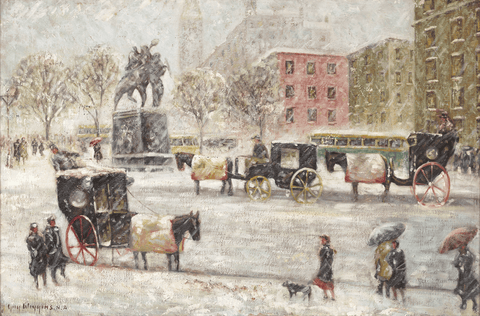
These paintings transformed bustling urban streets into shimmering landscapes of snow, fog and reflected light.
Through energetic brushwork and vibrant color contrasts, Wiggins captured both the dynamism of Manhattan and the quiet beauty created by falling snow.
Among his finest achievements are scenes depicting Fifth Avenue and Midtown boulevards covered in snowstorms, where pedestrians, horse-drawn carriages and automobiles dissolve into atmospheric veils of color and movement.
His celebrated painting Blizzard in Manhattan exemplifies this mature style, presenting a busy New York avenue blanketed in snow while vivid reds, yellows and greens emerge against cool blue and gray tonalities.
The painting’s seven American flags waving above the thoroughfare further reinforce the patriotic energy and distinctly American identity embedded within Wiggins’ urban landscapes.
These winter cityscapes became synonymous with Wiggins’ artistic legacy and remain among the most admired examples of American Impressionism.
Recognition and Legacy
Throughout his career, Wiggins achieved significant professional success and widespread critical acclaim.
He earned numerous awards and honors, including election to the National Academy of Design and the prestigious Norman Wait Harris Bronze Medal from the Art Institute of Chicago.
Collectors and institutions alike admired his ability to combine technical brilliance with emotional immediacy and atmospheric beauty.
Today, Guy Wiggins’ paintings are held in important public collections including the Metropolitan Museum of Art in New York and the Smithsonian American Art Museum in Washington, D.C.
His works continue to captivate collectors through their radiant color, painterly vitality and uniquely American interpretation of Impressionism.
Collectors seeking exceptional examples of American Impressionist painting are invited to explore M.S. Rau’s curated collection of museum-quality fine art and historical masterworks.
Quick Facts
|
Continue Your ExplorationExplore works by Guy Wiggins and other masters of American Impressionism through M.S. Rau’s curated collection of museum-quality fine art and historical masterworks. |
Wiggins, Guy
1883–1962
Guy Carleton Wiggins stands among the most celebrated American Impressionists of the 20th century, renowned for his luminous winter cityscapes and atmospheric depictions of New York. Through energetic brushwork, brilliant color harmonies and a distinctly American sensibility, Wiggins helped transform French Impressionist techniques into a uniquely American artistic language.
Often referred to as the “last great American Impressionist,” Wiggins became especially admired for his snow-covered urban scenes, which captured the movement, energy and spirit of early 20th-century Manhattan.
Today, his paintings remain highly sought after by collectors and are held in many of America’s most important museum collections.
|
“Wiggins transformed the bustle of New York into poetry through snow, color and light.” Art historical assessment |
Early Life and Artistic Training
Guy Carleton Wiggins was born in Brooklyn, New York, in 1883 into an artistic household.
His father, Carleton Wiggins, was a respected Barbizon School painter known for pastoral landscapes and cattle scenes.
Under his father’s guidance, Wiggins demonstrated artistic talent from an early age and quickly developed a deep appreciation for landscape painting and atmospheric effects.
He later pursued formal artistic training at the National Academy of Design, where he studied under two of America’s most influential painters: William Merritt Chase and Robert Henri.
These teachers exposed Wiggins to both academic draftsmanship and more progressive approaches to modern painting, helping shape the confident and expressive style that would define his mature work.
American Impressionism
During the early 20th century, Wiggins became one of the key figures in adapting French Impressionism to American subject matter and sensibilities.
At just twenty years old, he achieved a remarkable distinction by becoming the youngest artist represented in the permanent collection of the Metropolitan Museum of Art.
Wiggins also became one of the youngest members of the influential Old Lyme Art Colony in Connecticut, a major center for American Impressionism.
There, he painted alongside leading artists including Childe Hassam and Frank Vincent DuMond while continuing to work closely with his father.
Inspired by the broken brushwork and luminous palettes of French Impressionism, Wiggins nevertheless developed a distinctly American artistic voice.
His paintings emphasized the atmosphere, energy and architecture of modern American cities while retaining the fleeting light effects and painterly spontaneity associated with Impressionist technique.
New York City Snow Scenes
Wiggins became especially celebrated for his iconic winter views of New York City.
These paintings transformed bustling urban streets into shimmering landscapes of snow, fog and reflected light.
Through energetic brushwork and vibrant color contrasts, Wiggins captured both the dynamism of Manhattan and the quiet beauty created by falling snow.
Among his finest achievements are scenes depicting Fifth Avenue and Midtown boulevards covered in snowstorms, where pedestrians, horse-drawn carriages and automobiles dissolve into atmospheric veils of color and movement.
His celebrated painting Blizzard in Manhattan exemplifies this mature style, presenting a busy New York avenue blanketed in snow while vivid reds, yellows and greens emerge against cool blue and gray tonalities.
The painting’s seven American flags waving above the thoroughfare further reinforce the patriotic energy and distinctly American identity embedded within Wiggins’ urban landscapes.
These winter cityscapes became synonymous with Wiggins’ artistic legacy and remain among the most admired examples of American Impressionism.
Recognition and Legacy
Throughout his career, Wiggins achieved significant professional success and widespread critical acclaim.
He earned numerous awards and honors, including election to the National Academy of Design and the prestigious Norman Wait Harris Bronze Medal from the Art Institute of Chicago.
Collectors and institutions alike admired his ability to combine technical brilliance with emotional immediacy and atmospheric beauty.
Today, Guy Wiggins’ paintings are held in important public collections including the Metropolitan Museum of Art in New York and the Smithsonian American Art Museum in Washington, D.C.
His works continue to captivate collectors through their radiant color, painterly vitality and uniquely American interpretation of Impressionism.
Collectors seeking exceptional examples of American Impressionist painting are invited to explore M.S. Rau’s curated collection of museum-quality fine art and historical masterworks.
Quick Facts
|
Continue Your ExplorationExplore works by Guy Wiggins and other masters of American Impressionism through M.S. Rau’s curated collection of museum-quality fine art and historical masterworks. |

