
Dufy, Raoul

|
“...One must meditate about pleasure. Dufy is pleasure.” Gertrude Stein, 1946 |
Introduction
French Fauvist artist Raoul Dufy (1877–1953) is celebrated for his whimsical, uniquely stylized paintings that are immediately recognizable for their vibrant palettes and jubilant subjects. The artist’s explosive use of color and spontaneous, playful lines imbue his work with an unmistakable sense of joy and optimism.
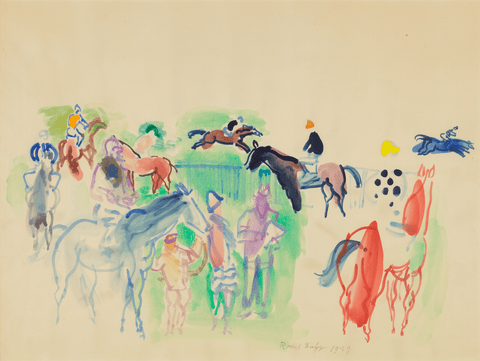
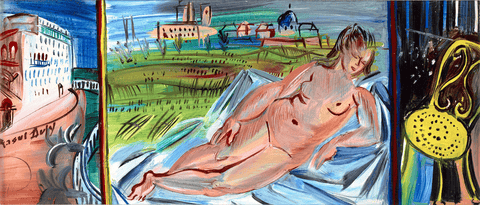
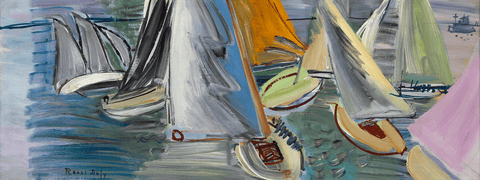
Using “stenographic” outlines to define the figures and objects in his compositions, Dufy applied delicate washes of oil paint that often resemble watercolor or gouache, enhancing their airy sense of joie de vivre. Appropriately, his subjects were almost exclusively devoted to scenes of leisure and pleasure, including sailing regattas, chic gatherings, views of the French Riviera, horse races, lavish interiors and seaside landscapes.
Early Life and Education
Born in 1877 in Le Havre, Normandy, Raoul Dufy was the eldest of nine children. As a young artist, he enrolled in evening art classes, where he studied under a former pupil of the Neoclassical master Jean-Auguste-Dominique Ingres. After completing his military service, Dufy secured admission to Paris’ École Nationale Supérieure des Beaux-Arts, where he befriended fellow student and future Cubist painter Georges Braque.
Artistic Development and Fauvism
Initially painting in a style inspired by Impressionist Art and artists such as Claude Monet and Camille Pissarro, Dufy quickly gained entrée into the Parisian art world, exhibiting at the Salon des Indépendants, the Berthe Weill Gallery and the Exhibition of French Artists.
The year 1905 proved transformative for Dufy. It was then that he first encountered the work of Henri Matisse, an experience that inspired him to fully embrace the emotional power of color and move toward Modern Art and Fauvism. Les fauves, French for “wild beasts,” was an avant-garde movement loosely associated with artists such as Henri Matisse, Albert Marquet and Georges Braque and characterized by bold, non-naturalistic color palettes and expressive brushwork.
Dufy’s exuberant compositions and radiant palette soon established him as one of the movement’s most distinctive voices. His paintings captured the pleasures of modern French life with a uniquely decorative sensibility that blended spontaneity with elegance.
Design Work and Major Commissions
For the next several decades, Dufy worked not only as a painter, but also as a celebrated designer. He explored textile design, printmaking, set design, tapestries and ceramics, all executed in his signature decorative style. His understanding of ornamental design profoundly shaped the evolution of his painting technique, which became increasingly fluid and expressive around 1920.
The artist undertook several important commissions throughout his career, including the monumental La Fée Électricité for the 1937 Exposition Internationale. Now housed in the National Museum of Modern Art in Paris, the masterpiece spans approximately 6,500 square feet and remains one of the largest paintings ever created.
Later Years and Legacy
The French artist continued to exhibit and receive accolades both in France and internationally. In 1952, Dufy was awarded the Grand Prize for Painting at the prestigious Venice Biennale, a significant late-career honor.
By this time, however, the artist suffered severely from arthritis, particularly in his hands, making it increasingly painful to paint. After undergoing experimental treatments, Dufy ultimately died of intestinal bleeding in March 1953 in Forcalquier, France.
Raoul also served as a mentor to his younger brother Jean Dufy (1888–1964), who followed in his footsteps as an artist and stylistically echoed Raoul’s distinctive decorative approach to Fauvism.
Today, Raoul Dufy’s legacy is most closely associated with his beloved paintings, which reside in the collections of major museums around the world. His design work occasionally reemerges in important exhibitions, such as the Metropolitan Museum of Art’s 2007 exhibition Poiret: King of Fashion, which featured textiles designed by Dufy.
Dufy’s work remains highly coveted by collectors worldwide. M.S. Rau proudly offers a curated selection of fine art by renowned artists, including exceptional works by Raoul Dufy. For more information, please contact us today.
Dufy, Raoul
|
“...One must meditate about pleasure. Dufy is pleasure.” Gertrude Stein, 1946 |
Introduction
French Fauvist artist Raoul Dufy (1877–1953) is celebrated for his whimsical, uniquely stylized paintings that are immediately recognizable for their vibrant palettes and jubilant subjects. The artist’s explosive use of color and spontaneous, playful lines imbue his work with an unmistakable sense of joy and optimism.
Using “stenographic” outlines to define the figures and objects in his compositions, Dufy applied delicate washes of oil paint that often resemble watercolor or gouache, enhancing their airy sense of joie de vivre. Appropriately, his subjects were almost exclusively devoted to scenes of leisure and pleasure, including sailing regattas, chic gatherings, views of the French Riviera, horse races, lavish interiors and seaside landscapes.
Early Life and Education
Born in 1877 in Le Havre, Normandy, Raoul Dufy was the eldest of nine children. As a young artist, he enrolled in evening art classes, where he studied under a former pupil of the Neoclassical master Jean-Auguste-Dominique Ingres. After completing his military service, Dufy secured admission to Paris’ École Nationale Supérieure des Beaux-Arts, where he befriended fellow student and future Cubist painter Georges Braque.
Artistic Development and Fauvism
Initially painting in a style inspired by Impressionist Art and artists such as Claude Monet and Camille Pissarro, Dufy quickly gained entrée into the Parisian art world, exhibiting at the Salon des Indépendants, the Berthe Weill Gallery and the Exhibition of French Artists.
The year 1905 proved transformative for Dufy. It was then that he first encountered the work of Henri Matisse, an experience that inspired him to fully embrace the emotional power of color and move toward Modern Art and Fauvism. Les fauves, French for “wild beasts,” was an avant-garde movement loosely associated with artists such as Henri Matisse, Albert Marquet and Georges Braque and characterized by bold, non-naturalistic color palettes and expressive brushwork.
Dufy’s exuberant compositions and radiant palette soon established him as one of the movement’s most distinctive voices. His paintings captured the pleasures of modern French life with a uniquely decorative sensibility that blended spontaneity with elegance.
Design Work and Major Commissions
For the next several decades, Dufy worked not only as a painter, but also as a celebrated designer. He explored textile design, printmaking, set design, tapestries and ceramics, all executed in his signature decorative style. His understanding of ornamental design profoundly shaped the evolution of his painting technique, which became increasingly fluid and expressive around 1920.
The artist undertook several important commissions throughout his career, including the monumental La Fée Électricité for the 1937 Exposition Internationale. Now housed in the National Museum of Modern Art in Paris, the masterpiece spans approximately 6,500 square feet and remains one of the largest paintings ever created.
Later Years and Legacy
The French artist continued to exhibit and receive accolades both in France and internationally. In 1952, Dufy was awarded the Grand Prize for Painting at the prestigious Venice Biennale, a significant late-career honor.
By this time, however, the artist suffered severely from arthritis, particularly in his hands, making it increasingly painful to paint. After undergoing experimental treatments, Dufy ultimately died of intestinal bleeding in March 1953 in Forcalquier, France.
Raoul also served as a mentor to his younger brother Jean Dufy (1888–1964), who followed in his footsteps as an artist and stylistically echoed Raoul’s distinctive decorative approach to Fauvism.
Today, Raoul Dufy’s legacy is most closely associated with his beloved paintings, which reside in the collections of major museums around the world. His design work occasionally reemerges in important exhibitions, such as the Metropolitan Museum of Art’s 2007 exhibition Poiret: King of Fashion, which featured textiles designed by Dufy.
Dufy’s work remains highly coveted by collectors worldwide. M.S. Rau proudly offers a curated selection of fine art by renowned artists, including exceptional works by Raoul Dufy. For more information, please contact us today.


