


M.S. Rau is committed to offering fine art of the highest caliber and we seek paintings and sculpture by historically renowned artists, often with impressive provenance. The large majority of our works of art come from private. . .
Buy with Confidence
At M.S. Rau, we are committed to building a long-term, rewarding relationship with each and every client. That’s why your purchase is backed by our 125% guarantee.
Learn MoreCouple et nature morte à l’ananas devant Saint-Paul by Marc Chagall
- This exceptional painting epitomizes why Chagall is one of art history's most beloved colorists
- The landscape depicts Chagall's beloved home along the Côte d'Azur, Saint-Paul-de-Vence
- This work also unites several other iconic Chagall motifs, including embracing lovers and flowers
- Chagall's works belong to prestigious museums around the globe including the Museum of Modern Art in New York
- Get complete item description here
Price Upon Request
Item No.
32-2045
To speak to one of our experts, call 1-888-711-8084
Description
Marc Chagall
1887-1985 | Russian
Couple et nature morte à l'ananas devant Saint-Paul
(Couple and still life with pineapple in front of Saint-Paul)
Stamped with signature "Chagall" (lower left)
Gouache, tempera, pastel and graphite on paper
This masterful gouache vividly captures some of Marc Chagall's most iconic motifs in his signature dreamlike style. Painted in 1978, this work embodies the extraordinary significance of Chagall’s final decades, often referred to as his “Mediterranean. . .
1887-1985 | Russian
Couple et nature morte à l'ananas devant Saint-Paul
(Couple and still life with pineapple in front of Saint-Paul)
Stamped with signature "Chagall" (lower left)
Gouache, tempera, pastel and graphite on paper
This masterful gouache vividly captures some of Marc Chagall's most iconic motifs in his signature dreamlike style. Painted in 1978, this work embodies the extraordinary significance of Chagall’s final decades, often referred to as his “Mediterranean. . .
Read More
Marc Chagall
1887-1985 | Russian
Couple et nature morte à l'ananas devant Saint-Paul
(Couple and still life with pineapple in front of Saint-Paul)
Stamped with signature "Chagall" (lower left)
Gouache, tempera, pastel and graphite on paper
This masterful gouache vividly captures some of Marc Chagall's most iconic motifs in his signature dreamlike style. Painted in 1978, this work embodies the extraordinary significance of Chagall’s final decades, often referred to as his “Mediterranean Renaissance.”
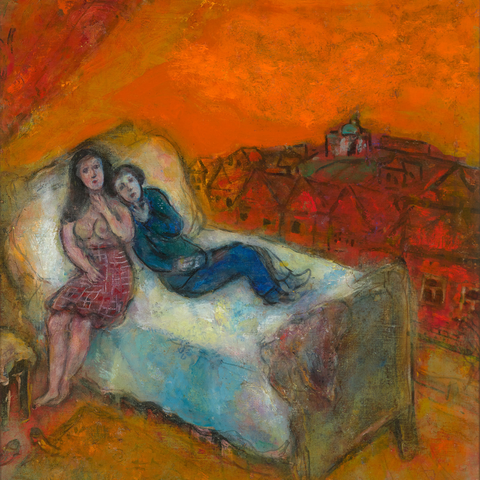
In 1966, Chagall moved to the village of Saint-Paul-de-Vence in Provence with his wife Vava, where he would remain until his death in 1985. During this period, Chagall found great inspiration in the brilliant light of the Côte d'Azur, and his color palette became even more vibrant and bold, illustrated beautifully in this work. The picturesque medieval architecture of St. Paul-de-Vence—seen here under a gleaming crescent moon—also became the artist’s new recurring symbol for home.
This magnificent painting also features many other signature Chagall motifs. A pair of his famous lovers embraces in the foreground, as a still life with fruit, a smiling donkey and an exuberant floral bouquet hover overhead. Quintessential of his best works, the overall effect is kaleidoscopic, delightfully surreal and full of nostalgia and hope.
Chagall’s later works are characterized by a rich use of jewel tones and bright colors and a turn toward even more personal and introspective subjects. Known especially for his bold blues, Chagall employs this striking hue here to dazzling effect, uniting all of the elements of his dreamlike landscape. Even in the last decade of his long life, Chagall continued to paint fervently, and these works are some of the most desirable and sought-after in his oeuvre.
Marc Chagall was born in Vitebsk, Russia, to a large, close-knit Jewish family of herring merchants. He began studying painting in 1906 under the famed artist Yehuda Pen. In 1907, he moved to St. Petersburg and joined the school of the Society of Art Supporters. In 1910, Chagall relocated to Paris to be near the art community of the Montparnasse district, and he would eventually become a French citizen. Amongst the turmoil of the 20th century, including the Soviet regime and the outbreak of WWII, Chagall would continue to move between Russia, France and the United States throughout his life.
Chagall died at the age of 97 in Saint-Paul de Vence, France, in 1985, leaving behind an incredible body of work that continues to demand the highest attention in the art world. Today, his works belong to the collections of prestigious museums across the globe, including the Museum of Modern Art in New York, the Centre Pompidou in Paris, Tate Modern in London and the Art Institute of Chicago.
This work is accompanied by its certificate of authenticity issued by the Comité Marc Chagall.
Circa 1978
Paper: 20" high x 16 1/4" wide (50.80 x 41.28 cm)
Frame: 35 1/8" high x 31 3/4" wide x 2 1/2" deep (89.22 x 80.77 x 6.35 cm)
Provenance:
Estate of the artist
M.S. Rau, New Orleans
1887-1985 | Russian
Couple et nature morte à l'ananas devant Saint-Paul
(Couple and still life with pineapple in front of Saint-Paul)
Stamped with signature "Chagall" (lower left)
Gouache, tempera, pastel and graphite on paper
This masterful gouache vividly captures some of Marc Chagall's most iconic motifs in his signature dreamlike style. Painted in 1978, this work embodies the extraordinary significance of Chagall’s final decades, often referred to as his “Mediterranean Renaissance.”
In 1966, Chagall moved to the village of Saint-Paul-de-Vence in Provence with his wife Vava, where he would remain until his death in 1985. During this period, Chagall found great inspiration in the brilliant light of the Côte d'Azur, and his color palette became even more vibrant and bold, illustrated beautifully in this work. The picturesque medieval architecture of St. Paul-de-Vence—seen here under a gleaming crescent moon—also became the artist’s new recurring symbol for home.
This magnificent painting also features many other signature Chagall motifs. A pair of his famous lovers embraces in the foreground, as a still life with fruit, a smiling donkey and an exuberant floral bouquet hover overhead. Quintessential of his best works, the overall effect is kaleidoscopic, delightfully surreal and full of nostalgia and hope.
Chagall’s later works are characterized by a rich use of jewel tones and bright colors and a turn toward even more personal and introspective subjects. Known especially for his bold blues, Chagall employs this striking hue here to dazzling effect, uniting all of the elements of his dreamlike landscape. Even in the last decade of his long life, Chagall continued to paint fervently, and these works are some of the most desirable and sought-after in his oeuvre.
Marc Chagall was born in Vitebsk, Russia, to a large, close-knit Jewish family of herring merchants. He began studying painting in 1906 under the famed artist Yehuda Pen. In 1907, he moved to St. Petersburg and joined the school of the Society of Art Supporters. In 1910, Chagall relocated to Paris to be near the art community of the Montparnasse district, and he would eventually become a French citizen. Amongst the turmoil of the 20th century, including the Soviet regime and the outbreak of WWII, Chagall would continue to move between Russia, France and the United States throughout his life.
Chagall died at the age of 97 in Saint-Paul de Vence, France, in 1985, leaving behind an incredible body of work that continues to demand the highest attention in the art world. Today, his works belong to the collections of prestigious museums across the globe, including the Museum of Modern Art in New York, the Centre Pompidou in Paris, Tate Modern in London and the Art Institute of Chicago.
This work is accompanied by its certificate of authenticity issued by the Comité Marc Chagall.
Circa 1978
Paper: 20" high x 16 1/4" wide (50.80 x 41.28 cm)
Frame: 35 1/8" high x 31 3/4" wide x 2 1/2" deep (89.22 x 80.77 x 6.35 cm)
Provenance:
Estate of the artist
M.S. Rau, New Orleans
Read Less
Specifications


| Maker: | Chagall, Marc |
| Period: | 1919-Present |
| Origin: | France |
| Type: | Paintings |
| Style: | Modernism |
| Depth: | 2.5 in. (6.35 cm) |
| Width: | 31.8 in. (80.77 cm) |
| Height: | 35.13 in. (89.22 cm) |
| Canvas Width: | 16.250 in. (41.28 cm) |
| Canvas Height: | 20.000 in. (50.8 cm) |
Discover More

Chagall, Marc
Introduction: One of the most influential painters of the twentieth century, Marc Chagall defied the expectations of the century's art movements. His poetic, expressive work could not be limited to one genre— he...
Read More
5 Artists Who Used Color to Redefine Modern Art
Roses are red, violets are blue… but what if they’re not? At the turn of the 20th century, the world of art experienced a radical transformation in the way color was perceived and...
Read More
Buy with Confidence
At M.S. Rau, we are committed to building a long-term, rewarding relationship with each and every client. That’s why your purchase is backed by our 125% guarantee.
Learn More


