


M.S. Rau is committed to offering fine art of the highest caliber and we seek paintings and sculpture by historically renowned artists, often with impressive provenance. The large majority of our works of art come from private. . .
Buy with Confidence
At M.S. Rau, we are committed to building a long-term, rewarding relationship with each and every client. That’s why your purchase is backed by our 125% guarantee.
Learn MoreThe Battle of Anghiari by Enrico Bosi
- This exceptional pietre dure was executed by the Florentine artisan Enrico Bosi
- It is based on a lost painting by Leonardo da Vinci, which was later copied by Peter Paul Rubens
- The subject is the 1440 Battle of Anghiari between the Italian League and the Duchy of Milan
- The meticulously cut, vibrant hardstones create the perfect trompe l'oeil effect
- Get complete item description here
$645,000
Item No.
32-1519
To speak to one of our experts, call 1-888-711-8084
Description
Enrico Bosi
fl.1850-1865 | Italian
The Battle of Anghiari
Maker's label inscribed "H. Bosi / Firenze" (en verso)
Pietre dure
Based on a lost painting by Leonardo da Vinci, which was later copied by Peter Paul Rubens, this exceptional pietre dure was executed by Enrico Bosi. The artisan was renowned for the realism of his plaques, and this scene is particularly impactful, evoking the drama of the 1440 battle between the Italian. . .
fl.1850-1865 | Italian
The Battle of Anghiari
Maker's label inscribed "H. Bosi / Firenze" (en verso)
Pietre dure
Based on a lost painting by Leonardo da Vinci, which was later copied by Peter Paul Rubens, this exceptional pietre dure was executed by Enrico Bosi. The artisan was renowned for the realism of his plaques, and this scene is particularly impactful, evoking the drama of the 1440 battle between the Italian. . .
Read More
Enrico Bosi
fl.1850-1865 | Italian
The Battle of Anghiari
Maker's label inscribed "H. Bosi / Firenze" (en verso)
Pietre dure
Based on a lost painting by Leonardo da Vinci, which was later copied by Peter Paul Rubens, this exceptional pietre dure was executed by Enrico Bosi. The artisan was renowned for the realism of his plaques, and this scene is particularly impactful, evoking the drama of the 1440 battle between the Italian League and the Republic of Milan. The delicacy of Bosi’s choice of stones, including onyx, jasper and agate, and the precision of their cuts make it a true masterpiece. Each piece is carefully chosen for both its color and pattern to perfectly convey the mood and movement of the scene. The result is a work of such cohesion as to have the perfect trompe l'oeil effect.
The pietre dure takes its inspiration from the painting of the same name by the legendary Renaissance painter Leonardo da Vinci; though the painting, completed in 1505, has been lost, the work is known from an engraving of 1553 by Lorenzo Zacchia, which was later copied by Peter Paul Rubens. This drawing, dating to 1603, is in the collection of the Musée du Louvre (Paris). Bosi succeeds in capturing the fury and intense emotions that were, in all likelihood, present in the original by da Vinci; likewise, the power and energy of his horses are evocative of da Vinci's well-known drawn studies of the animal. Overall, it is a stunning work of art, evoking one of the most famous subjects of Italian art in one of its most ancient art forms.
The art of pietre dure developed from the ancient art of opus sectile, where materials were cut and inlaid into walls and floors to form a decorative pattern. Florentine craftsmen revived the art during the Renaissance, and the first known hard stone workshop was established by the Medici family in 1588. Quickly growing in popularity, the art was also practiced in courts throughout Europe, and most especially in the courts of Naples, Madrid, Prague and Paris.
The meticulous technique requires that fine marbles and stones be carefully and artfully inlaid into a stone base. The technique was both expensive and time-consuming, requiring not only precious materials but also highly skilled craftsmen. As a result, true marble and stone pietre dure works such as this are very rare and highly collectible.
Enrico Bosi was a particularly inspired maker of pietre dure plaques. His extensive workshop in Florence, which employed a remarkable 36 artisans in total, was frequented for many decades by both local and international clientele in search of the luxury objects for which he was renowned. King Victor Emmanuel II of Italy was a particularly notable client, having commissioned from Bosi a monumental cabinet for the Pitti Palace in 1861.
Circa 1860
Plaque: 30" high x 39 3/4" wide (76.20 x 100.97 cm)
Frame: 49 1/2" high x 59 1/8" wide x 5 1/2" deep (125.73 x 150.18 x 13.97 cm)
Provenance:
Martin-Desbenoit Sale, Versailles, October 11, 1981, lot 123
Private Collection, Paris
M.S. Rau, New Orleans
Private Collection, New Orleans
M.S. Rau, New Orleans
fl.1850-1865 | Italian
The Battle of Anghiari
Maker's label inscribed "H. Bosi / Firenze" (en verso)
Pietre dure
Based on a lost painting by Leonardo da Vinci, which was later copied by Peter Paul Rubens, this exceptional pietre dure was executed by Enrico Bosi. The artisan was renowned for the realism of his plaques, and this scene is particularly impactful, evoking the drama of the 1440 battle between the Italian League and the Republic of Milan. The delicacy of Bosi’s choice of stones, including onyx, jasper and agate, and the precision of their cuts make it a true masterpiece. Each piece is carefully chosen for both its color and pattern to perfectly convey the mood and movement of the scene. The result is a work of such cohesion as to have the perfect trompe l'oeil effect.
The pietre dure takes its inspiration from the painting of the same name by the legendary Renaissance painter Leonardo da Vinci; though the painting, completed in 1505, has been lost, the work is known from an engraving of 1553 by Lorenzo Zacchia, which was later copied by Peter Paul Rubens. This drawing, dating to 1603, is in the collection of the Musée du Louvre (Paris). Bosi succeeds in capturing the fury and intense emotions that were, in all likelihood, present in the original by da Vinci; likewise, the power and energy of his horses are evocative of da Vinci's well-known drawn studies of the animal. Overall, it is a stunning work of art, evoking one of the most famous subjects of Italian art in one of its most ancient art forms.
The art of pietre dure developed from the ancient art of opus sectile, where materials were cut and inlaid into walls and floors to form a decorative pattern. Florentine craftsmen revived the art during the Renaissance, and the first known hard stone workshop was established by the Medici family in 1588. Quickly growing in popularity, the art was also practiced in courts throughout Europe, and most especially in the courts of Naples, Madrid, Prague and Paris.
The meticulous technique requires that fine marbles and stones be carefully and artfully inlaid into a stone base. The technique was both expensive and time-consuming, requiring not only precious materials but also highly skilled craftsmen. As a result, true marble and stone pietre dure works such as this are very rare and highly collectible.
Enrico Bosi was a particularly inspired maker of pietre dure plaques. His extensive workshop in Florence, which employed a remarkable 36 artisans in total, was frequented for many decades by both local and international clientele in search of the luxury objects for which he was renowned. King Victor Emmanuel II of Italy was a particularly notable client, having commissioned from Bosi a monumental cabinet for the Pitti Palace in 1861.
Circa 1860
Plaque: 30" high x 39 3/4" wide (76.20 x 100.97 cm)
Frame: 49 1/2" high x 59 1/8" wide x 5 1/2" deep (125.73 x 150.18 x 13.97 cm)
Provenance:
Martin-Desbenoit Sale, Versailles, October 11, 1981, lot 123
Private Collection, Paris
M.S. Rau, New Orleans
Private Collection, New Orleans
M.S. Rau, New Orleans
Read Less
Specifications


| Maker: | Bosi, Enrico |
| Period: | 1816-1918 |
| Origin: | Italy |
| Type: | Other Fine Art |
| Style: | Renaissance |
| Depth: | 5.5 in. (13.97 cm) |
| Width: | 59.13 in. (150.18 cm) |
| Height: | 49.5 in. (125.73 cm) |
| Canvas Width: | 39.750 in. (100.97 cm) |
| Canvas Height: | 30.000 in. (76.2 cm) |
Discover More


Expert Insights: Pietre Dure by Enrico Bosi
Based on a lost painting by Leonardo da Vinci, which was later copied by Peter Paul Rubens, this exceptional pietre dure was executed by Enrico Bosi. The artisan was renowned for the...
Read More
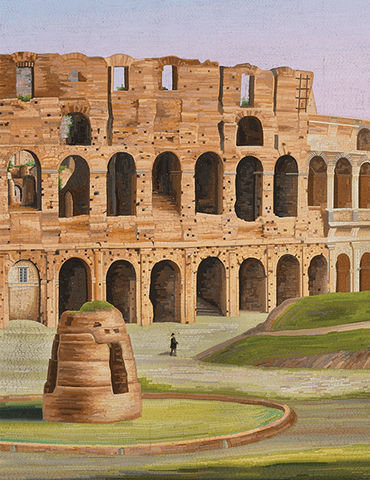
Pictures Set in Stone: Micromosaics and Pietre Dure
A jeweler’s precision and an artist’s eye make micromosaic and pietre dure two of the most fascinating techniques in the decorative arts. It requires incredible skill to thoughtfully combine hundreds of pieces of...
Read More
Buy with Confidence
At M.S. Rau, we are committed to building a long-term, rewarding relationship with each and every client. That’s why your purchase is backed by our 125% guarantee.
Learn More


