The Great Ruby Deception
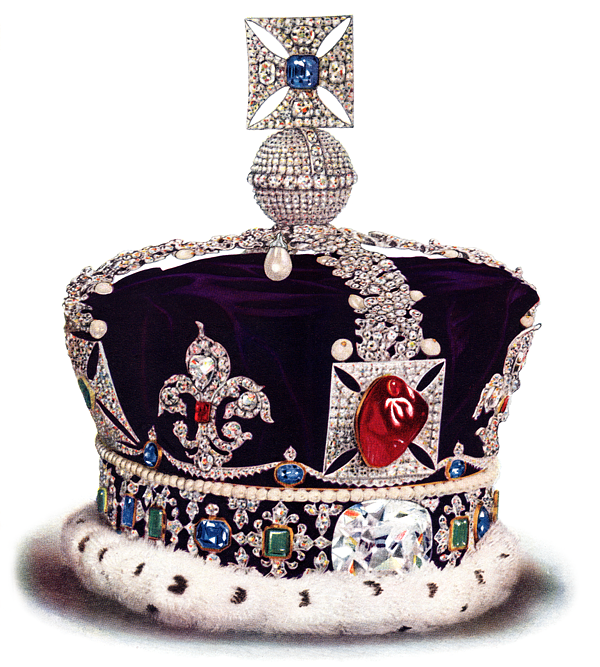
Shining at the center of Britain’s Imperial State Crown is a massive cabochon gemstone, glowing with a deep, captivating red hue. It seems only natural to assume that the famed “Black Prince’s Ruby” is exactly what its name suggests: a monumental ruby serving as the centerpiece to one of the world’s most iconic crowns. For centuries, this dazzling gem was indeed believed to be a ruby. Yet, upon closer examination, it reveals itself as one of the oldest and most historically significant spinels in existence.

| Imperial State Crown of the United Kingdom. Source. |
Until the late 18th century, all red gemstones were simply called rubies. It was only with advances in crystallography and chemistry that spinel was differentiated from true ruby, revealing the “Black Prince’s Ruby” as an imposter, though no less remarkable in its own right.
Ancient Origins and the "Balas Ruby" Era
In medieval Europe, traders lacked the means to distinguish gemstones by chemical makeup, but the brilliant colors and rarity of spinels caused them to be called balas rubies. For centuries, the finest of these red gems came from mines across Central and Southeast Asia, with Sri Lanka, Myanmar and Badakhshan producing exceptionally large and vividly colored crystals. The name “balas” is derived from Balascia, an early name for Badakhshan, an area well known for its ancient and productive mines.

| Untreated Burma Spinel Ring, 10.25 Carats. M.S. Rau. |
Badakhshan’s ruby and spinel mines were noted by early explorers and geographers such as Istakhri (951 CE), Ibn Hawqal (978 CE) and Al-Thaʿālibī (961–1038 CE). The region in modern Afghanistan was also a key stop on the Silk Road, serving as a hub for spinels to be distributed across the continent. By 1300 CE, even Marco Polo described these famed mines, writing, “The stones are dug on the king’s account, and no one else dares dig in that mountain on pain of forfeiture of life as well as goods; nor may anyone carry the stones out of the kingdom.”
In both East and West, these brilliant red spinels were reserved for royalty, traveling along trade routes through Persia and Venice before entering the great treasuries of Europe. By the 14th century, they adorned some of the world’s most famous crowns and regalia.
Among the most celebrated examples are those set into the Imperial Crown of England, the Imperial Crown of Russia and the Imperial Crown of Austria, along with countless treasures preserved in royal collections across Europe and Asia.
Famous Royal Spinels

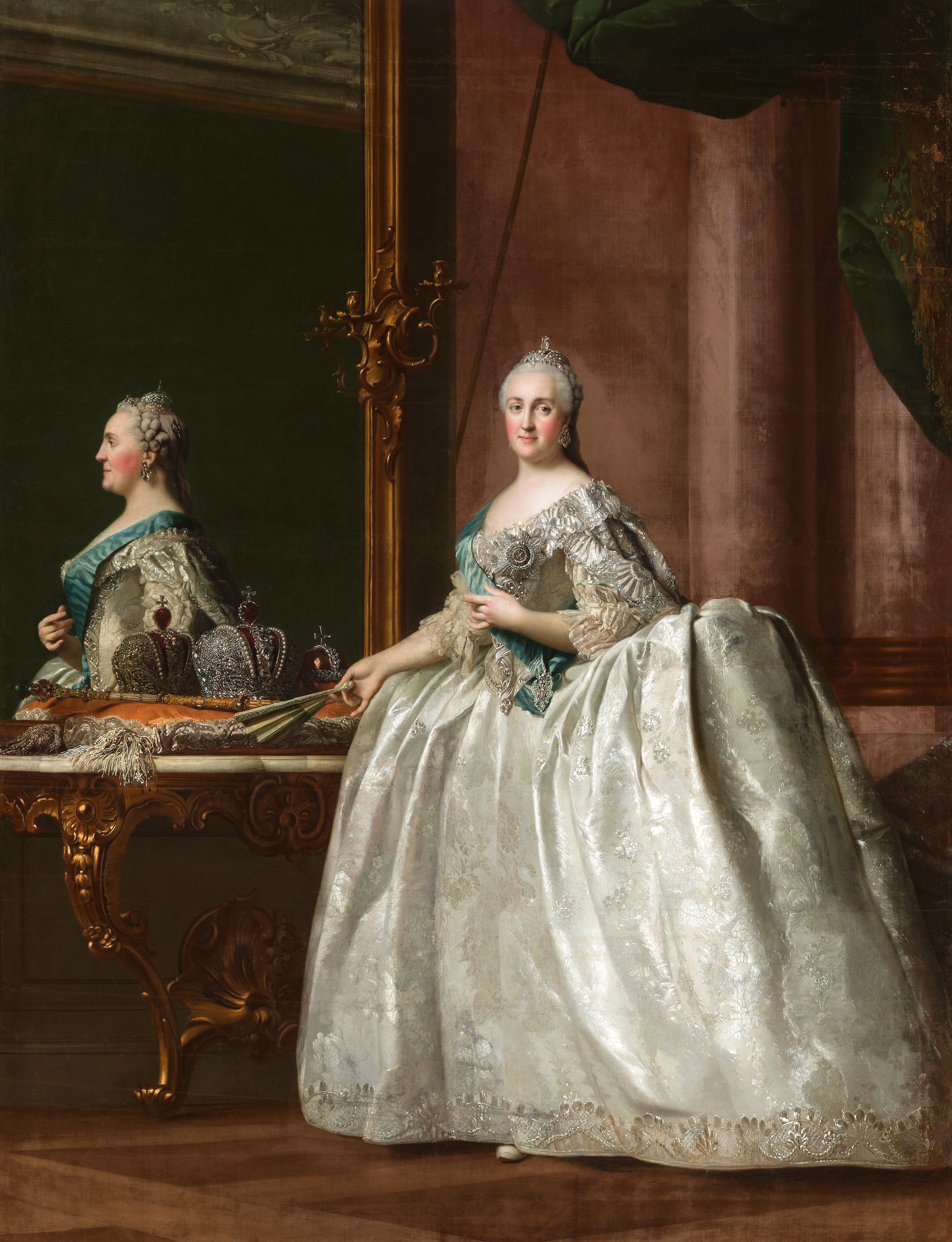
| Catherine II in Front of a Mirror by Vigilius Eriksen. Oil on canvas. Circa 1762-64. Hermitage Museum. Source. The nearly 400-carat red spinel adorning the Great Imperial Crown of Russia can be seen to her left. |
The Black Prince's Ruby
This monumental spinel is among the most famous examples of the gemstone, first appearing in historical records in 14th-century Spain. Owned by Abū Sa'īd, a Muslim prince of Granada, the gem was seized by Don Pedro of Castile after the prince’s murder. It later passed to Edward, the Black Prince of England, who took the spinel in payment for aiding Don Pedro at the Battle of Nájera. Once in English hands, it adorned monarchs in both battle and ceremony, including Henry V at the Battle of Agincourt in 1415.
During the Interregnum, Oliver Cromwell abolished the monarchy and ordered the royal crowns dismantled, their gold melted down and many gems sold. How the Black Prince’s Ruby survived this upheaval remains uncertain, but by the Restoration, it had reemerged in the royal collection.

| Coronation Portrait of Queen Victoria by Sir George Hayter. Oil on canvas. Circa 1838-40. The Royal Collection. Source. The Black Prince’s Ruby can be seen in the Imperial State Crown. |
For her 1838 coronation, Queen Victoria had the iconic gemstone prominently mounted in the Imperial State Crown by Rundell & Bridge. This crown was remade in 1937 for George VI by Garrard & Co. to its current design, with the Black Prince’s Ruby remaining the focal point.
Today, the 140-carat vivid red spinel is a highlight of the British Crown Jewels, displayed at the Tower of London. Its reverse bears a plaquette commemorating the crown’s storied history.
The Timur Ruby
The Timur Ruby, also called Khiraj-i-alam (“Tribute to the World”), is a monumental 352.54-carat polished red gemstone, which was widely regarded as the largest known ruby in the world. Or so it was until 1851, when it was revealed to be a spinel.

| The Timur Ruby in the Royal Collection. |
This gemstone took its name from the legendary conqueror Timur, who was believed to have taken the stone when he sacked Delhi in 1398, though modern research suggests it may never have passed through his hands. What is certain is that the gem came into the possession of Shah Abbas I, the Safavid Emperor of Persia, who gifted it to the Mughal Emperor Jahangir in 1612.
Jahangir had his own name and that of his father, Akbar the Great, engraved upon it, famously telling his wife, who disapproved, “This jewel will more certainly hand down my name to posterity than any written history.”
The stone passed through the treasuries of successive Mughal emperors, Shah Jahan, Aurangzeb and Farrukhsiyar, who added their own names to its inscription. In 1739, Nader Shah of Iran stormed Delhi, seizing the Mughal treasury and adding his own carving. The final inscription came from Ahmad Shah Durrani, Nader Shah’s commander, who, after his leader’s assassination in 1747, took the stone to help establish the Kingdom of Afghanistan.

| Painting of Maharaja Sher Singh by August Schoefft. Oil on panel. Circa 1841-42. The Toor Collection. The Maharaja is wearing both the Timur Ruby and the Koh-i-Noor Diamond. |
In 1810, it returned to India when Ahmad Shah’s grandson, Shah Shujah, fled to the Punjab. By 1813, it was in the hands of Maharaja Ranjit Singh of the Sikh Empire. After his death, it passed to his sons Sher Singh and then the young Duleep Singh, until 1849, when the British East India Company annexed the Punjab and seized the Timur Ruby along with the Koh-i-Noor Diamond.
Taken to London, the spinel was presented to Queen Victoria, who had Garrard & Co. mount it in a necklace in 1853. Today, it remains part of the Royal Collection, a polished red witness to centuries of conquest, ceremony and contested ownership.
Scientific Discovery: Spinel's True Identity

| Victorian Pink Spinel Pendant, 2.50 Carats. Late 19th century. M.S. Rau. |
So how did spinels deceive the world's most distinguished jewelers? Cut spinels exhibit the same intense crimson saturation, brilliant luster and exceptional light refraction that characterizes the finest Burmese rubies. With comparable hardness ratings, their distinction is nearly impossible without advanced testing.
The breakthrough came in 1783, when mineralogist Jean-Baptiste Louis Romé de l’Isle applied crystallography to separate the two. He demonstrated that rubies crystallize in the hexagonal system, while spinels belong to the cubic system. This discovery laid the foundations of modern gemology.
Unlike ruby, spinel typically produces octahedral crystals resembling two pyramids joined at their bases. These pointed octahedral forms may have inspired the name “spinel,” derived from the Latin spina, meaning “thorn.” As spinel crystals grow, their pyramids can sometimes rotate slightly, creating flattened or skewed forms.
It was not until the 19th century that chemical analysis confirmed spinel as magnesium aluminum oxide (MgAl₂O₄), fully differentiating it from ruby, which is aluminum oxide (Al₂O₃).

| Unheated Ceylon Spinel Ring, 22.33 Carats. M.S. Rau. |
Optically, spinel is singly refractive, like diamond, allowing it to display consistent, vibrant color from all angles along with exceptional transparency and brilliance. Ruby, in contrast, is doubly refractive, splitting light within the stone and producing subtle variations such as purplish-red or orangey-red tones depending on the viewing angle. Both gems can fluoresce under ultraviolet light: spinel often emits a soft pinkish glow, whereas ruby tends toward bluish fluorescence.
Spinel can also exhibit rare phenomena shared with ruby, including color change under different lighting and asterism, a star-like effect visible in cabochon cuts. Inclusions, which are common in both gems, may appear in spinel as striking patterns that resemble fingerprints. These distinctive physical and optical properties ultimately allowed gemologists to separate spinel’s identity from that of ruby, clarifying centuries of confusion.
The Color Spectrum of Spinel
Spinel is celebrated for its remarkable range of colors beyond red, each hue prized for its brilliance and purity.

| Purple Spinel Ring, 14.30 Carats. M.S. Rau. |
Spinel appears in stunning blues, including cobalt-rich varieties that range from vivid sky-blue to deep cerulean. These blue spinels are less common than red stones and are highly valued for their striking, gem-quality color. Pink spinels, another popular variety, range from delicate pastel tones to vivid, almost neon hues. Other rare colors include purple, orange, lavender and striking black.
The Modern Spinel
Though now distinguished from rubies, this stone is far from second-rate. Contemporary jewelers are drawn to its immense beauty, much like history's royals. Faceted and cabochon spinels are commonly featured in rings, necklaces, earrings and other fine jewelry. Their combination of durability and vibrant hues makes them an appealing alternative to more familiar gemstones such as rubies and sapphires.

| Red Spinel and Colored Sapphire Necklace. M.S. Rau. |
In recent decades, market recognition of spinel has grown steadily. Collectors and designers alike appreciate its historical significance and striking beauty. From high jewelry collections to modern statement pieces, spinel continues to captivate connoisseurs seeking both rarity and elegance.
For the finest examples, explore spinel jewelry at M.S. Rau!