

Calder, Alexander
1898 - 1976
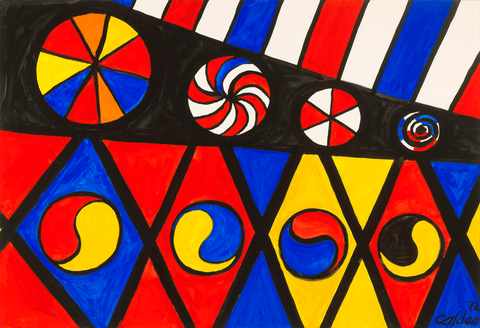
Alexander Calder transformed the trajectory of 20th-century art through his revolutionary approach to sculpture and movement. His kinetic works, which Marcel Duchamp termed "mobiles," fundamentally altered the contemporary understanding of sculptural possibilities, while his monumental "stabiles" redefined the relationship between art and public space.
Early Life
Born in Lawnton, Pennsylvania, Calder was born into an extraordinary artistic lineage. His father, Alexander Stirling Calder, created numerous public sculptures, including the Swann Memorial Fountain in Philadelphia, while his grandfather, Alexander Milne Calder, executed the architectural sculptures of Philadelphia City Hall. His mother, Nanette Lederer Calder, worked as a professional portrait painter.
Perhaps surprisingly, Calder initially pursued mechanical engineering at Stevens Institute of Technology, graduating in 1919. This technical foundation proved invaluable, informing the precise balance and mathematical calculations that would later distinguish his kinetic sculptures. Following his engineering studies, Calder worked various jobs, including as a hydraulics engineer and automotive engineer, experiences that enhanced his understanding of motion and mechanics.
Artistic Inspiration
In 1923, Calder enrolled at the Art Students League in New York, studying under John Sloan, George Luks and Boardman Robinson. His position as an illustrator at the National Police Gazette provided unique opportunities to sketch the Ringling Bros. and Barnum & Bailey Circus, allowing him to develop an acute eye for capturing movement. These circus drawings, executed rapidly and with remarkable precision, demonstrated his ability to distill complex motion into essential lines, a hallmark of his later work.
Move to Paris
Calder's artistic evolution accelerated following his move to Paris in 1926. Living in Montparnasse, he became part of an extraordinary artistic milieu that included Joan Miró, Fernand Léger and Piet Mondrian. It was during this period that he created his groundbreaking Cirque Calder (1926-1931), a miniature circus featuring over 70 articulated figures and animals. This work represented a crucial bridge between his early figurative pieces and later abstract sculptures.
The early 1930s marked a further transformative period in Calder's artistic development. A 1930 visit to Mondrian's studio proved pivotal, inspiring Calder to embrace abstraction. His first abstract sculptures were mechanized by small motors, but by 1932, he had begun creating works that moved freely in air currents. The first exhibition of these revolutionary mobiles was held at Galerie Vignon in 1932, curated by Marcel Duchamp.
Embrace of Abstract Expressionism
Calder's return to America in 1933 coincided with the rise of abstract expressionism. He established a studio in Roxbury, Connecticut, where he began creating increasingly larger works. His first retrospective at the Museum of Modern Art in 1943 positioned him as a leading figure in American modernism. The exhibition, organized by James Johnson Sweeney and Marcel Duchamp, included an unprecedented 100 works and established Calder's international reputation.
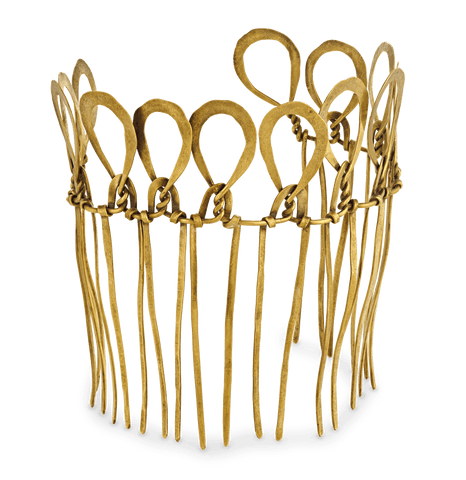
In addition to his sculptural innovations, Calder created over 1,800 pieces of jewelry throughout his career. These unique works, never commercially produced, were given as gifts to friends including Georgia O'Keeffe and Peggy Guggenheim. Each piece demonstrated the same careful attention to movement and balance that characterized his larger works. The Metropolitan Museum of Art's 2008 exhibition, Calder Jewelry, highlighted these intimate creations, many featuring precious and found materials integrated with the same innovative spirit as his mobiles.
Height of his Creative Output
Calder's influence extended internationally through major commissions, including .125 (1957) for John F. Kennedy International Airport, Spirale (1958) for UNESCO in Paris and La Grande Vitesse (1969) for Grand Rapids, Michigan—the first public artwork funded by the National Endowment for the Arts. His monumental works grace public spaces across five continents, from Jerusalem to Mexico City.
Lasting Legacy
Calder's works reside in esteemed private collection and over 90 public collections worldwide, including the Centre Georges Pompidou in Paris, the Museo Nacional Centro de Arte Reina Sofía in Madrid and the National Gallery of Art in Washington, D.C. His large-scale installations continue to define civic spaces globally, demonstrating art's capacity to transform public environments. In addition, his legacy is perhaps best preserved through the Calder Foundation, established in 1987. This organization maintains his legacy through rigorous scholarship and conservation efforts and ensures that future generations can experience Calder's innovations firsthand.
Calder, Alexander
1898 - 1976
Alexander Calder transformed the trajectory of 20th-century art through his revolutionary approach to sculpture and movement. His kinetic works, which Marcel Duchamp termed "mobiles," fundamentally altered the contemporary understanding of sculptural possibilities, while his monumental "stabiles" redefined the relationship between art and public space.
Early Life
Born in Lawnton, Pennsylvania, Calder was born into an extraordinary artistic lineage. His father, Alexander Stirling Calder, created numerous public sculptures, including the Swann Memorial Fountain in Philadelphia, while his grandfather, Alexander Milne Calder, executed the architectural sculptures of Philadelphia City Hall. His mother, Nanette Lederer Calder, worked as a professional portrait painter.
Perhaps surprisingly, Calder initially pursued mechanical engineering at Stevens Institute of Technology, graduating in 1919. This technical foundation proved invaluable, informing the precise balance and mathematical calculations that would later distinguish his kinetic sculptures. Following his engineering studies, Calder worked various jobs, including as a hydraulics engineer and automotive engineer, experiences that enhanced his understanding of motion and mechanics.
Artistic Inspiration
In 1923, Calder enrolled at the Art Students League in New York, studying under John Sloan, George Luks and Boardman Robinson. His position as an illustrator at the National Police Gazette provided unique opportunities to sketch the Ringling Bros. and Barnum & Bailey Circus, allowing him to develop an acute eye for capturing movement. These circus drawings, executed rapidly and with remarkable precision, demonstrated his ability to distill complex motion into essential lines, a hallmark of his later work.
Move to Paris
Calder's artistic evolution accelerated following his move to Paris in 1926. Living in Montparnasse, he became part of an extraordinary artistic milieu that included Joan Miró, Fernand Léger and Piet Mondrian. It was during this period that he created his groundbreaking Cirque Calder (1926-1931), a miniature circus featuring over 70 articulated figures and animals. This work represented a crucial bridge between his early figurative pieces and later abstract sculptures.
The early 1930s marked a further transformative period in Calder's artistic development. A 1930 visit to Mondrian's studio proved pivotal, inspiring Calder to embrace abstraction. His first abstract sculptures were mechanized by small motors, but by 1932, he had begun creating works that moved freely in air currents. The first exhibition of these revolutionary mobiles was held at Galerie Vignon in 1932, curated by Marcel Duchamp.
Embrace of Abstract Expressionism
Calder's return to America in 1933 coincided with the rise of abstract expressionism. He established a studio in Roxbury, Connecticut, where he began creating increasingly larger works. His first retrospective at the Museum of Modern Art in 1943 positioned him as a leading figure in American modernism. The exhibition, organized by James Johnson Sweeney and Marcel Duchamp, included an unprecedented 100 works and established Calder's international reputation.
In addition to his sculptural innovations, Calder created over 1,800 pieces of jewelry throughout his career. These unique works, never commercially produced, were given as gifts to friends including Georgia O'Keeffe and Peggy Guggenheim. Each piece demonstrated the same careful attention to movement and balance that characterized his larger works. The Metropolitan Museum of Art's 2008 exhibition, Calder Jewelry, highlighted these intimate creations, many featuring precious and found materials integrated with the same innovative spirit as his mobiles.
Height of his Creative Output
Calder's influence extended internationally through major commissions, including .125 (1957) for John F. Kennedy International Airport, Spirale (1958) for UNESCO in Paris and La Grande Vitesse (1969) for Grand Rapids, Michigan—the first public artwork funded by the National Endowment for the Arts. His monumental works grace public spaces across five continents, from Jerusalem to Mexico City.
Lasting Legacy
Calder's works reside in esteemed private collection and over 90 public collections worldwide, including the Centre Georges Pompidou in Paris, the Museo Nacional Centro de Arte Reina Sofía in Madrid and the National Gallery of Art in Washington, D.C. His large-scale installations continue to define civic spaces globally, demonstrating art's capacity to transform public environments. In addition, his legacy is perhaps best preserved through the Calder Foundation, established in 1987. This organization maintains his legacy through rigorous scholarship and conservation efforts and ensures that future generations can experience Calder's innovations firsthand.

