

Delvaux, Paul
|
“Youthful impressions, fixed once and for all in the mind, influence you all your life.” Paul Delvaux |
Introduction
Paul Delvaux occupies a singular position in 20th-century art as a painter whose dreamlike, elegiac compositions defy conventional classification. Though often associated with Surrealism, Delvaux’s mature style emerged not from allegiance to any particular movement. The artist rejected classification and distanced himself from the so-called “isms” that defined much of modern art.
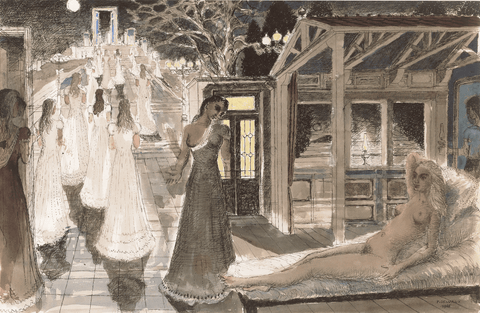
Instead, Delvaux developed a deeply personal and poetic visual language. His enigmatic canvases are populated with distant, trance-like women, skeletal figures, classical architecture and silent railway stations — compositions that conjure a world suspended between antiquity and modernity, reverie and reality.
Early Life and Formative Impressions
Paul Delvaux was born in 1897 in Antheit, a village in the Belgian province of Liège, though he was raised in Brussels within the confines of a proper bourgeois household. His mother, Laure Jamotte, was a formidable and controlling figure whose influence reverberated throughout his life and art. The aloof, enigmatic women who populate his paintings can often be traced to this maternal presence: distant yet omnipresent, desired yet inaccessible.
While his father, a successful barrister, expected him to pursue a legal career, Delvaux’s encouraging aunts nurtured his fascination with literature and music. His early education emphasized the classics, and he developed a deep admiration for Homer’s Odyssey as well as the science fiction writings of Jules Verne. These literary influences would later reemerge in his mythological imagery and fantastical tableaux.
Another formative influence was the human skeleton displayed in a glass cabinet during his music lessons — a silent observer that would later haunt many of his most iconic compositions. Delvaux did not view the skeleton as macabre; rather, he saw it as elegant, radiant and enduring. To him, it represented less a symbol of death than a metaphorical structure underlying life itself.
Throughout his youth, Delvaux faced immense pressure to conform to bourgeois expectations. His admission into the Académie Royale des Beaux-Arts was negotiated as a compromise: he was permitted to study architecture rather than painting. Although this training gave him a strong command of classical perspective and structure, he struggled with mathematics and eventually failed a critical examination. Only after painter Franz Courtens recognized his talent and persuaded his parents was Delvaux finally allowed to study fine art.
Academic Training and Artistic Uncertainty
At last free to pursue his artistic ambitions, Delvaux enrolled at the Académie Royale des Beaux-Arts in Brussels, where he studied under influential artists including Constant Montald, Jean Delville and Alfred Bastien. His early works consisted largely of naturalistic landscapes and city scenes, though his teachers’ stylistic tendencies gradually shaped his evolving aesthetic.
From Montald, Delvaux absorbed the ethereal idealism associated with Pierre Puvis de Chavannes, while Delville’s Symbolist sensibilities introduced him to more metaphysical and esoteric themes. Despite these influences, the 1920s and early 1930s were marked by artistic uncertainty. Delvaux experimented with Neo-Impressionism and Expressionism but struggled to establish a truly distinctive voice.
A major turning point came during a visit to the Spitzner Museum in Brussels, where he encountered wax anatomical models and bizarre medical displays, including a sleeping Venus figure whose eerie serenity deeply captivated him. The motif would soon become central to his mature work.
Because Delvaux’s possessive mother had warned him against women during his youth, he developed a lifelong emotional wariness that complicated his relationships. Fascinated and mystified by women, he frequently placed them upon an unattainable pedestal. The women in his paintings — idealized, youthful and often nude — embody both desire and distance.
At age 30, Delvaux fell deeply in love with Anne-Marie “Tam” de Martelaere. His mother disapproved of the relationship and forced him to sever all contact. Following this heartbreak, his paintings assumed an increasingly lonely and detached atmosphere. Shortly afterward, in 1932, his mother died.
Still plagued by insecurity and critical rejection, Delvaux destroyed many of his early paintings, both to reuse the canvases and as an act of artistic self-censorship that delayed the full emergence of his mature style.
Discovery of Style and Surrealist Echoes
By the 1930s, Delvaux had encountered the metaphysical paintings of Giorgio de Chirico. De Chirico’s deserted piazzas, elongated shadows and eerie stillness profoundly influenced him, encouraging a move away from naturalism toward a more psychologically charged visual language.
Delvaux began depicting somnambulant women set against silent architecture, fading daylight and distant trains — one of the artist’s lifelong fascinations. These recurring motifs formed a dreamlike world that feels simultaneously timeless and estranged.
Around the same time, Delvaux met René Magritte, whose deadpan juxtapositions and quietly surreal imagery also left an impression on him. Although the two artists maintained a respectful yet uneasy rapport, Delvaux remained fiercely independent and refused formal affiliation with Surrealism. He also rejected psychoanalytic interpretations of his work, insisting instead that imagination itself was paramount.
|
“The story of the painting is not important.” Paul Delvaux |
In 1934, Delvaux exhibited alongside Salvador Dalí, Giorgio de Chirico and René Magritte in Minotaure at the Palais des Beaux-Arts de Bruxelles. Two years later, he and Magritte held separate but successful exhibitions at the same institution.
In 1937, Delvaux married Suzanne Purnal, though he later suggested the marriage was largely one of convenience. It is possible he never stopped longing for Tam.
Following the German occupation of Belgium in 1940, Delvaux withdrew from public exhibitions and retreated into a more private artistic world. His wartime paintings often express quiet anguish beneath their calm surfaces. Most notably, Sleeping Venus (1944), now in the Tate collection, juxtaposes a serene reclining goddess against figures of women wailing in distress.
|
“I wanted to express this anguish in the picture, contrasted with the calm of the Venus.” Paul Delvaux |
Postwar Recognition and Legacy
The end of World War II marked a new phase in Delvaux’s artistic career. Having continued to paint throughout the occupation, he entered the postwar period with renewed creative momentum. In January 1945, a major retrospective at the Palais des Beaux-Arts in Brussels showcased 57 large-scale works. Critics remained divided: some praised his evocative dreamscapes, while others found their unsettling stillness deeply perplexing.
His international reputation steadily expanded. In 1947, the Julien Levy Gallery in New York hosted a solo exhibition that received widespread attention, despite U.S. customs officials seizing two paintings deemed “obscene,” damaging one in the process.
Though reactions in both the United States and France were often mixed, Delvaux became increasingly renowned for his unconventional imagery. His contributions to the 1954 Venice Biennale, including religious and skeletal themes, even provoked outrage from Cardinal Roncalli — the future Pope John XXIII — who condemned the works as heretical. Similarly, a 1962 retrospective in Ostend was banned to minors because of perceived indecency.
In August 1947, Delvaux unexpectedly reunited with Anne-Marie “Tam” de Martelaere at a Brussels newsstand, nearly two decades after his mother had forbidden their relationship. Still deeply in love, the two rekindled their bond. Delvaux soon divorced his first wife, and he and Tam married in 1952.
The couple remained inseparable for the next four decades, with Tam serving not only as Delvaux’s lifelong muse but also as his emotional anchor. Her death in 1989 devastated the artist; he never painted again and died five years later in 1994.
Today, Delvaux’s influence continues through the Paul Delvaux Foundation and Museum in St. Idesbald, established during his lifetime. His poetic and enigmatic imagery has influenced filmmakers, composers and writers ranging from David Lynch to Tōru Takemitsu and J.G. Ballard.
His work remains one of the most distinctive and haunting contributions to Modern Art, not meant to be solved, but experienced.
Delvaux, Paul
|
“Youthful impressions, fixed once and for all in the mind, influence you all your life.” Paul Delvaux |
Introduction
Paul Delvaux occupies a singular position in 20th-century art as a painter whose dreamlike, elegiac compositions defy conventional classification. Though often associated with Surrealism, Delvaux’s mature style emerged not from allegiance to any particular movement. The artist rejected classification and distanced himself from the so-called “isms” that defined much of modern art.
Instead, Delvaux developed a deeply personal and poetic visual language. His enigmatic canvases are populated with distant, trance-like women, skeletal figures, classical architecture and silent railway stations — compositions that conjure a world suspended between antiquity and modernity, reverie and reality.
Early Life and Formative Impressions
Paul Delvaux was born in 1897 in Antheit, a village in the Belgian province of Liège, though he was raised in Brussels within the confines of a proper bourgeois household. His mother, Laure Jamotte, was a formidable and controlling figure whose influence reverberated throughout his life and art. The aloof, enigmatic women who populate his paintings can often be traced to this maternal presence: distant yet omnipresent, desired yet inaccessible.
While his father, a successful barrister, expected him to pursue a legal career, Delvaux’s encouraging aunts nurtured his fascination with literature and music. His early education emphasized the classics, and he developed a deep admiration for Homer’s Odyssey as well as the science fiction writings of Jules Verne. These literary influences would later reemerge in his mythological imagery and fantastical tableaux.
Another formative influence was the human skeleton displayed in a glass cabinet during his music lessons — a silent observer that would later haunt many of his most iconic compositions. Delvaux did not view the skeleton as macabre; rather, he saw it as elegant, radiant and enduring. To him, it represented less a symbol of death than a metaphorical structure underlying life itself.
Throughout his youth, Delvaux faced immense pressure to conform to bourgeois expectations. His admission into the Académie Royale des Beaux-Arts was negotiated as a compromise: he was permitted to study architecture rather than painting. Although this training gave him a strong command of classical perspective and structure, he struggled with mathematics and eventually failed a critical examination. Only after painter Franz Courtens recognized his talent and persuaded his parents was Delvaux finally allowed to study fine art.
Academic Training and Artistic Uncertainty
At last free to pursue his artistic ambitions, Delvaux enrolled at the Académie Royale des Beaux-Arts in Brussels, where he studied under influential artists including Constant Montald, Jean Delville and Alfred Bastien. His early works consisted largely of naturalistic landscapes and city scenes, though his teachers’ stylistic tendencies gradually shaped his evolving aesthetic.
From Montald, Delvaux absorbed the ethereal idealism associated with Pierre Puvis de Chavannes, while Delville’s Symbolist sensibilities introduced him to more metaphysical and esoteric themes. Despite these influences, the 1920s and early 1930s were marked by artistic uncertainty. Delvaux experimented with Neo-Impressionism and Expressionism but struggled to establish a truly distinctive voice.
A major turning point came during a visit to the Spitzner Museum in Brussels, where he encountered wax anatomical models and bizarre medical displays, including a sleeping Venus figure whose eerie serenity deeply captivated him. The motif would soon become central to his mature work.
Because Delvaux’s possessive mother had warned him against women during his youth, he developed a lifelong emotional wariness that complicated his relationships. Fascinated and mystified by women, he frequently placed them upon an unattainable pedestal. The women in his paintings — idealized, youthful and often nude — embody both desire and distance.
At age 30, Delvaux fell deeply in love with Anne-Marie “Tam” de Martelaere. His mother disapproved of the relationship and forced him to sever all contact. Following this heartbreak, his paintings assumed an increasingly lonely and detached atmosphere. Shortly afterward, in 1932, his mother died.
Still plagued by insecurity and critical rejection, Delvaux destroyed many of his early paintings, both to reuse the canvases and as an act of artistic self-censorship that delayed the full emergence of his mature style.
Discovery of Style and Surrealist Echoes
By the 1930s, Delvaux had encountered the metaphysical paintings of Giorgio de Chirico. De Chirico’s deserted piazzas, elongated shadows and eerie stillness profoundly influenced him, encouraging a move away from naturalism toward a more psychologically charged visual language.
Delvaux began depicting somnambulant women set against silent architecture, fading daylight and distant trains — one of the artist’s lifelong fascinations. These recurring motifs formed a dreamlike world that feels simultaneously timeless and estranged.
Around the same time, Delvaux met René Magritte, whose deadpan juxtapositions and quietly surreal imagery also left an impression on him. Although the two artists maintained a respectful yet uneasy rapport, Delvaux remained fiercely independent and refused formal affiliation with Surrealism. He also rejected psychoanalytic interpretations of his work, insisting instead that imagination itself was paramount.
|
“The story of the painting is not important.” Paul Delvaux |
In 1934, Delvaux exhibited alongside Salvador Dalí, Giorgio de Chirico and René Magritte in Minotaure at the Palais des Beaux-Arts de Bruxelles. Two years later, he and Magritte held separate but successful exhibitions at the same institution.
In 1937, Delvaux married Suzanne Purnal, though he later suggested the marriage was largely one of convenience. It is possible he never stopped longing for Tam.
Following the German occupation of Belgium in 1940, Delvaux withdrew from public exhibitions and retreated into a more private artistic world. His wartime paintings often express quiet anguish beneath their calm surfaces. Most notably, Sleeping Venus (1944), now in the Tate collection, juxtaposes a serene reclining goddess against figures of women wailing in distress.
|
“I wanted to express this anguish in the picture, contrasted with the calm of the Venus.” Paul Delvaux |
Postwar Recognition and Legacy
The end of World War II marked a new phase in Delvaux’s artistic career. Having continued to paint throughout the occupation, he entered the postwar period with renewed creative momentum. In January 1945, a major retrospective at the Palais des Beaux-Arts in Brussels showcased 57 large-scale works. Critics remained divided: some praised his evocative dreamscapes, while others found their unsettling stillness deeply perplexing.
His international reputation steadily expanded. In 1947, the Julien Levy Gallery in New York hosted a solo exhibition that received widespread attention, despite U.S. customs officials seizing two paintings deemed “obscene,” damaging one in the process.
Though reactions in both the United States and France were often mixed, Delvaux became increasingly renowned for his unconventional imagery. His contributions to the 1954 Venice Biennale, including religious and skeletal themes, even provoked outrage from Cardinal Roncalli — the future Pope John XXIII — who condemned the works as heretical. Similarly, a 1962 retrospective in Ostend was banned to minors because of perceived indecency.
In August 1947, Delvaux unexpectedly reunited with Anne-Marie “Tam” de Martelaere at a Brussels newsstand, nearly two decades after his mother had forbidden their relationship. Still deeply in love, the two rekindled their bond. Delvaux soon divorced his first wife, and he and Tam married in 1952.
The couple remained inseparable for the next four decades, with Tam serving not only as Delvaux’s lifelong muse but also as his emotional anchor. Her death in 1989 devastated the artist; he never painted again and died five years later in 1994.
Today, Delvaux’s influence continues through the Paul Delvaux Foundation and Museum in St. Idesbald, established during his lifetime. His poetic and enigmatic imagery has influenced filmmakers, composers and writers ranging from David Lynch to Tōru Takemitsu and J.G. Ballard.
His work remains one of the most distinctive and haunting contributions to Modern Art, not meant to be solved, but experienced.

