

Quick Glance:
- Dutch Golden Age still lifes transformed everyday objects into coded symbols about wealth, mortality and the passage of time.
- Artists used skulls, wilting flowers, tipped glasses and luxury imports to explore both earthly pleasure and human fragility.
- Global trade deeply shaped the genre, filling paintings with coveted imports like Chinese porcelain, Turkish carpets and exotic fruit.
- Vanitas and memento mori paintings reminded viewers that beauty, knowledge, wealth and indulgence are temporary, making still life one of the most philosophical genres in Western art.
Symbols in Still Life
Packed with motifs and meaning, Pieter Claesz’s still life is loud with symbolism as he fills the canvas with a skull surrounded by a hastily tipped glass, an oil lamp emitting a plume of smoke from recently being snuffed and a lone quill once dipped in ink.

Still Life with a Skull and a Writing Quill by Pieter Claesz. Oil on panel. 1628. The Metropolitan Museum of Art. Source.
The Dutch Golden Age is filled with still lifes similar to Claesz’s Still Life with a Skull and a Writing Quill. One reason for the rising popularity of this form of painting was the newly established trade routes with Africa, Asia and America. This new emphasis on collecting objects trickled down and influenced artists. Many of these works were filled with depictions of foreign goods. One example of this is Still Life with Fruit, Glassware, and a Wanli Bowl by Willem Kalf.

Still Life with Fruit, Glassware, and a Wanli Bowl, Willem Kalf, 1659, Metropolitan Museum of Art, New York. Source.
This piece by Kalf centers a Chinese porcelain bowl and a Turkish carpet placed haphazardly on a table in a subtle display of wealth and connection alongside other more common still life subjects like fruit. Just having these objects in someone’s possession symbolized their high status and wealth as they were “luxurious imports.” Above all, the Dutch people were enamored by these new items, as they gave them a glimpse into other parts of the world unexplored by them.
Memento mori and vanitas paintings, like Claesz’s piece, are rich in symbolism and also rose to prominence during this era. While some painters reveled in imports and status symbols, others took a more morbid and realistic approach that everyone could relate to by reminding the viewer of their mortality.
An artist who took a more subtle approach to this symbolism is Clara Peeters, in her piece, A presumed self-portrait with a lavish display of objects in a vanitas still life and a still life of flowers in a glass vase.

A presumed self-portrait with a lavish display of objects in a vanitas still life and a still life of flowers in a glass vase by Clara Peeters. Oil on panel. Circa 1607–1621. Private collection. Source.
This piece is a fabulous example of a still life being a coded visual language, rich with meaning and moral weight. The most prominent vanitas symbols in this piece include the wilting flowers and the watch in her hands. These two props remind the viewer of the inevitability of aging and of a person's finite existence.
When new trade routes appeared in the Dutch Golden Age, something even more interesting than a window into foreign life appeared... artists allowed for a new language to be born: the language of the still life. By examining these pieces, viewers can understand the coded dialogue embedded in still life paintings and allow it to transform how they see the genre. This new understanding can help to see why collectors continue to gravitate towards still lifes even centuries later.
What Is Symbolism in Art? Finding Meaning in Everyday Objects.
Symbolism, defined in the art world, is the use of objects, colors and compositional choices to convey ideas beyond their literal appearance. What genre of painting highlights these elements? Still life. Here, artists were able to use the everyday object as a moral messenger.
Factors of life in the 17th-century Netherlands were a large influence on the genre. The rise of Calvinism during the Dutch Golden Age pushed for a focus on tolerance, domestic life, and hard work. Calvinism, in addition to frequent plague outbreaks, also contributed to an uptick in concerns about mortality. The expansion of artistic subjects and genres was also tied to the rise of a mercantile middle class, enriched by trade through the Dutch East India Company and, later, the Dutch West India Company. With the combination of these factors, the Dutch still life was born to help express the conflicting emotions of this period.
Viewers can easily spot these influences in works by popular still life artists at the time, such as Pieter Claesz, Willem Kalf and Jan Davidsz de Heem.
The painting, Vanitas Still Life with the Spinario by Pieter Claesz, shows influences of the widespread philosophical anxiety plaguing Dutch minds at the time.
Pieter Claesz was born circa 1597 in Berchem and later moved to Haarlem, where he pursued his career in art. He became one of the most important Dutch Golden Age still life painters and joined the Haarlem Guild of Saint Luke, where he was listed as a master painter in 1634.
Surrounded by symbols of earthly interests—knowledge, art and music—the skull at the center of Claesz’s composition reminds viewers that death remains inevitable. The inevitability of the end of life, the skull, is at the center of the piece here and remains despite its surroundings. The extinguished oil lamp blending into the background also fills the composition with Vanitas meaning, that life will eventually fade away. The lute and violin also command attention in this piece by signaling a life well lived.

Vanitas Still Life with the Spinario by Pieter Claesz. Oil on panel. 1628. Rijksmuseum. Source.
Similarly, Willem Kalf also explored these topics in his piece, Still Life. Kalf was born in 1619 and painted in Paris and Rotterdam. He was also a member of Saint Luke’s Guild in Amsterdam. It is thought that Kalf was a student of Hendrik Gerritsz. While he did not continue his career as an artist until his death in 1693, he was still involved in the community as an art dealer.

Still Life by Willem Kalf. Oil on canvas. Circa 1660. National Gallery of Art. Source.
Kalf takes a dark and moody approach to still life compositions by using a chiaroscuro technique. The darkness juxtaposed with the lightness and luminescence of his subjects gives his pieces a dreamlike feel.
Unlike Claesz, Kalf is focused on showcasing the excitement behind trade by often featuring Chinese porcelain in his works. This work is no exception as its bright color and central location draw the viewer's eye directly to it. There is also a Turkish rug covering the table in this piece. Not only does the addition of this rug allow for Kalf to show his technical skill in rendering the designs and the folds, but it also allows him to show his wealth in being able to collect these coveted imports.
While his compositions most often revel in earthly pleasures, there is the addition of rotting peaches at the forefront of this piece. This subject reminds the viewer of the prevalence of Vanitas paintings, especially during the Dutch Golden Age. The peaches serve as a reminder that time is actively passing.
These subjects beautifully combine in this stunning, packed composition, A pronk still life with luxurious objects and exotic fruits by Jan Davidsz de Heem. Born in Utrecht in 1606, de Heem painted simple still lifes for a small list of clients through his 20s. Circa 1635, de Heem moved to Antwerp and became inspired by Peter Paul Rubens, and started to experiment with Flemish Baroque influences. These surroundings led to his now unmistakable style.

A pie and a partly peeled lemon with crayfish and shrimp in a kraak porcelain bowl, fruit and ewer on a table by Jan Davidsz de Heem. Oil on canvas. 1649. Private collection. Source.
Like Kalf, de Heem also showcases the importance and luxury of trade during the Dutch Golden Age through his still life. A Chinese porcelain bowl and a German roemer glass are expertly woven into this decadent composition amongst fresh fruits, silver, and luscious greenery. While this piece does not have a flagrant reminder of death, the piece centers on a half-eaten pie; the other fanciful items surround the pie mockingly. The Roemer glass is also only half full, possibly to remind the viewer of the limits of earthly pleasure. Another small reminder of this is the one spoiled green grape peeking out from the basket, reminding the viewer of the fragility of life.
What Is Vanitas?
Vanitas is a specific type of still life painting that uses everyday objects to meditate on the brevity of life and the futility of earthly pleasures. The term comes from the Latin phrase, "vanitas vanitatum," meaning vanity of vanities. According to the Tate, "The term originally comes from the opening lines of the Book of Ecclesiastes in the Bible: ‘Vanity of vanities, saith the Preacher, vanity of vanities, all is vanity.’

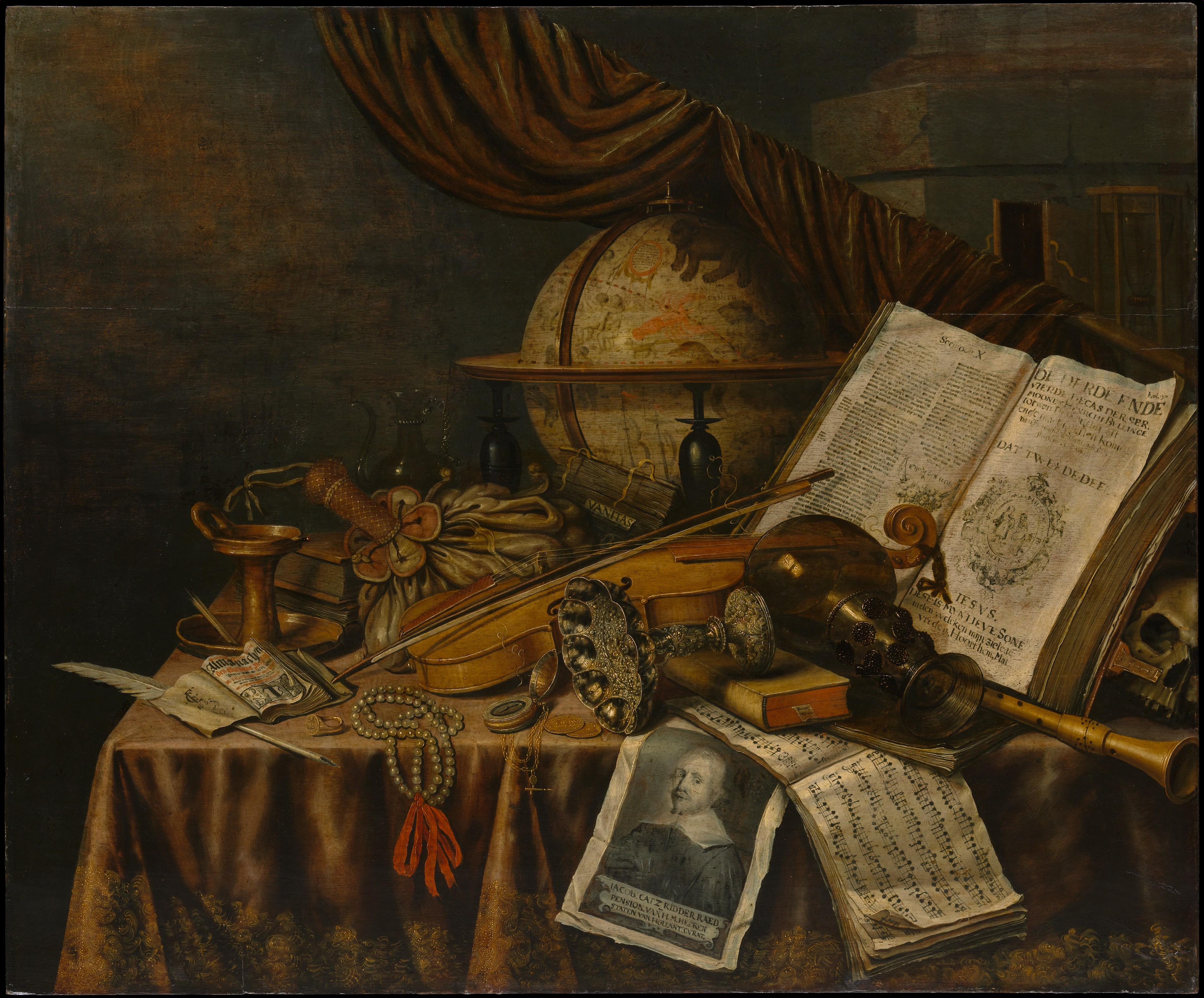
Vanitas Still Life by Edwaert Collier. Oil on panel. 1662. Metropolitan Museum of Art. Source.
While symbolism shrouds the objects featured in the Dutch Golden Age’s still lifes, there are a few that are a part of the canonical vanitas vocabulary. The most common are skulls, extinguished candles, hourglasses, watches, soap bubbles, wilting flowers, overturned vessels—all ephemeral items. Flowers will eventually wilt, the sand in an hourglass will run out, soap bubbles will pop, the smoke from a candle will fan out, a watch will count down the time, vessels will empty and lastly, all that will be left to the viewer will be their skeleton.

Vanitas Still Life by Jacques de Gheyn II. Oil on panel. 1603. The Metropolitan Museum of Art. Source.
Vanitas paintings remind viewers that beauty, wealth and pleasure are transient. The passage of time is rendered into an oil painting; here, beauty and essence are forever captured in an image.
What is Memento Mori?
According to the Tate, “A memento mori is an artwork designed to remind the viewer of their mortality and of the shortness and fragility of human life.” While this is a common artwork genre, it is also a philosophical mindset. Meanwhile, “vanitas” is specific to a type of artwork.
Similarly, memento mori pieces focus on the inevitability of death, while Vanitas paintings also feature other symbols critiquing humanity's obsession with indulgence and its uselessness in the eyes of death.
The most direct memento mori symbol is a skull. Most compositions in these pieces are anchored around the feature. For example, skulls were one of Claesz’s most common subjects. His compositions were often built around them, redirecting the viewer to ponder their mortality. He painted these beautifully detailed pieces as if at the center of his life and belongings was the reminder that death was imminent.

Vanitas Still Life by Pieter Claesz. Oil on panel. 1632. Mauritshuis. Source.
While today these works might invoke emotions of sadness and despair, in the days of the Dutch Golden Age, these pieces were approached in a more philosophical way. Not only did they remind the owner of the pleasure of living, but they also highlighted the items in their homes and reframed them with moral meaning rather than just belongings.
Still Life Symbolism Guide: What Each Object Means
To fully understand the message of these still lifes, there are a few universal symbols used. Fruit often symbolizes abundance. Citrus had an association with the luxury and exotic trade routes of the Dutch Golden Age. While abundance is one way to interpret the subjects, they are also often displayed with signs of decay and aging to show the passage of time.

Still Life with Lobster and Fruit by Abraham van Beyeren. Oil on panel. Circa 1650. The Metropolitan Museum of Art. Source.
Flowers are also a common still life subject, showcasing beauty and transience. Some flowers are even depicted as wilting to highlight their impermanent nature. Specific blooms even carry specific meanings. For example, roses are for love, and poppies are for sleep and death.

Still Life with Flowers by Jean-Baptiste Monnoyer. Oil on canvas. 17th century. M.S. Rau.
Food and drinks are associated with earthly pleasures and their limits. This is often depicted through half-consumed meals and tipped glasses. The message: indulgence has its limits. Shells and coins also depict wealth and the needlessness of the material world.

Still Life with Oysters, a Silver Tazza, and Glassware by Willem Claesz Heda. Oil on panel. 1635. The Metropolitan Museum of Art. Source.
Books and other papers are included to show the wealth of knowledge and scholarship the owner has and remind them of the vanity of intellectual achievements. Similarly, musical instruments are symbolic of fleeting pleasure but also the harmony of a life well lived.
Candles are also portrayed in different formats—changing the meaning each time. The candle with a flame represents life, while an extinguished flame represents death. Also representing death are clocks and skulls. Here, the viewer can see the physical aftermath of death in addition to the metaphorical clock of life slowly ticking down.
Still Life Then and Now
Still life is more than just a decorative genre; it is one of the most philosophically loaded genres in the Western tradition. The effectiveness of still lifes makes them still just as popular today.

Panier de poires et théière by Bernard Buffet. Oil on canvas. Dated 1996. M.S. Rau.
Then and now, still life painters have used ordinary objects to pose extraordinary questions. Echoing the painters of 17th-century Amsterdam in modern art are artists like Andy Warhol, Picasso and Braque.
These questions have only become more complex since the Dutch Golden Age. For example, Warhol used common objects as a commentary on mass consumerism. Items such as a branded can of Campbell’s soup or a Brillo soap pad box became a symbol for the tribulations of capitalism.

Warholed by Patrick Hughes. Oil on panel. M.S. Rau.
These iconic pieces also became a cornerstone in collections as the appeal came from the intimacy of the scale, the richness of the surface, and the intellectual reward of decoding the symbolic content that comes as a reward from looking closely at a piece.
While still lifes are still popular, the memento mori painting is still alive and well! One great example of this is Damien Hirst’s For the Love of God. Hirst used a platinum cast of an 18th-century human skull and encrusted it with flawless diamonds and human teeth—a very sparkly reminder that life is finite.
Art historian Rudi Fuchs applied a different memento mori philosophy to this piece: “It proclaims victory over decay. At the same time, it represents death as something infinitely more relentless. Compared to the tearful sadness of a vanitas scene, the diamond skull is glory itself.”
M.S. Rau holds a special place in this tradition. Our collection is a continuation of serious still life collecting. Here, we invite the reader to engage with these works not merely as decoration, but as objects of philosophical depth and historical significance.
Works Cited
Down, Lee. “Symbolism in Art: Unlocking Hidden Meanings.” Arts Artists Artwork. Accessed May 6, 2026.
“Dutch Golden Age Painting.” The Art Story. Accessed May 6, 2026.
Fiore, Julia. “In Dutch Still Lifes, Dark Secrets Hide behind Exotic Delicacies.” Artsy, September 4, 2018.
Kirpalov, Anastasiia. “The Evolution of Still Life from Baroque Art to Modern Minimalism.” The Collector, June 17, 2025.
Liedtke, Walter A. “Still-Life Painting in Northern Europe, 1600–1800 - the Metropolitan Museum of Art.” The MET, October 1, 2003.
“Memento Mori.” Tate, January 1, 1997.
Parker, Charles H. “The Legacies of Calvinism in the Dutch Empire.” Aeon, September 9, 2022.
“Pieter Claesz.” National Gallery of Art. Accessed May 7, 2026.
Pound, Cath. “These Lush 17th-Century Paintings Were Striking Reminders of Mortality.” Artsy, October 28, 2019.
Schweiger, Hannah. “A Feast for the Eyes: Jan Davidsz. de Heem’s Luxurious Still Life Is Still ‘Good-Enough to Eat’, 350 Years Later.” Christie’s, May 27, 2025.
Sterling, Bruce. “For the Love of God, It’s Damien Hirst.” Wired, January 17, 2011.
“Vanitas.” Tate, January 1, 1970.
“Willem Kalf.” National Gallery of Art. Accessed May 7, 2026.
Wintle, Michael J. “Netherlands - Trade, Art, Science.” Britannica, May 6, 2026.
“Women Artists of the Dutch Golden Age.” National Museum of Women in the Arts, October 11, 2019.


.jpg)
_-_Vanitas_Still_Life_-_1603.jpg#/media/File:Vanitas_Still_Life_MET_DP143209.jpg)


