

Le Sidaner, Henri
Introduction
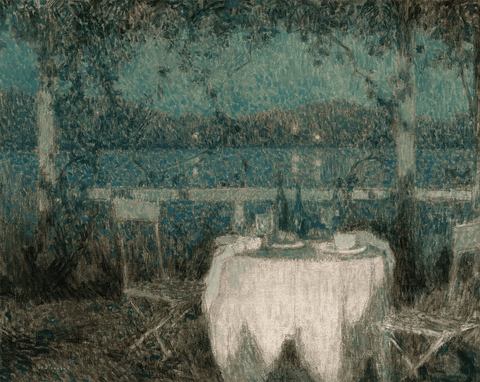
Henri Le Sidaner (1862–1939) stands among the most important Post-Impressionist painters of the late 19th and early 20th centuries. Known for his twilight scenes, he captured the transition from day to night with a remarkable dream-like quality. His softly luminous views of gardens, quiet streets and tables laid for unseen guests remain among the most evocative images in French painting of the period.
Early Life
Henri Eugène Augustin Le Sidaner was born on August 7, 1862, in Port Louis, Mauritius, where his father, Jean Marie Le Sidaner — a Breton from Saint-Malo — worked as a ship inspector for Lloyd’s of London. In 1872, the family relocated to Dunkirk, where his father later became a maritime broker.
His mother, Amélie Henrietta Robberechts, encouraged the artistic interests of her children, and Henri demonstrated an early aptitude for drawing. He attended the Collège et Lycée Notre-Dame des Dunes, where he formed a lasting friendship with the painter Eugène Chigot.
By 1877, Le Sidaner had begun formal study with the Dunkirk history painter Alexandre Desmit. His promise was quickly recognized, and he received a municipal scholarship to continue his training in Paris.
He arrived there in 1880, the same year his father was tragically lost in a shipwreck in the English Channel. In 1882, he was admitted to the École nationale des Beaux-Arts, where he entered the atelier of Alexandre Cabanel, one of the most prominent academic painters of the era.
It was not until Le Sidaner encountered the paintings of Édouard Manet that he began redirecting his ambitions toward a more modern and atmospheric artistic style.
Early Career
Around 1885, Le Sidaner settled in Étaples on the Côte d’Opale, where a thriving international artists’ colony had formed. There, he painted coastal scenes, genre subjects and larger Salon works influenced by the naturalism of Jules Bastien-Lepage.
He made his debut at the Salon des Artistes Français in 1887, and in 1890, his painting La Bénédiction de la Mère earned a third-class medal and a travel stipend that allowed him to visit Italy and the Netherlands.
These travels broadened his artistic horizons, but it was nature itself that ultimately guided him toward his mature vision.
The decisive transformation in his work came in 1898, when he relocated to Bruges with Camille Navarre, whom he later married. The quiet medieval city proved central to the development of his mature style. Its canals, belfries and hushed atmosphere inspired his first major nocturnes, in which twilight, moonlight and stillness became defining themes.
In these works, human figures increasingly disappeared, replaced by silence, memory and atmosphere.
Mature Career
In 1901, Le Sidaner discovered the hilltop village of Gerberoy in Picardy, which became the center of his artistic world. He rented, and later purchased, a house there, gradually transforming its grounds into an elaborate terraced garden.
Over the following decades, Gerberoy became his most fertile source of inspiration. Like Claude Monet at Giverny, Le Sidaner cultivated nature as both a lived environment and an artistic subject, though his aims differed considerably. Where Monet pursued the fleeting sensation of light, Le Sidaner sought the lingering memory of light and the quiet stillness that descends at dusk.
|
“I seek above all to render silence.” Henri Le Sidaner |
His mature technique drew upon Divisionism, though interpreted in a highly personal manner. Rather than adopting the strict optical theories of Georges Seurat, Le Sidaner employed soft, broken touches of color to create veiled, shimmering surfaces.
His palette favored blue-violet, gray, rose and green, producing atmospheres of extraordinary delicacy. Again and again, he returned to recurring motifs: rose-covered balustrades, glowing windows, deserted pathways and elegantly arranged tables awaiting absent guests.
These works earned him a reputation as a painter of silence, and when asked to define his artistic identity, he preferred the term “Intimist” above all others.
Le Sidaner also painted largely from memory rather than direct observation, helping imbue his canvases with the dream-like quality for which they remain celebrated today.
Honors and Acclaim
Le Sidaner achieved considerable success during his lifetime. In 1899, he signed an exclusive contract with the prestigious Galerie Georges Petit in Paris, which represented him for decades.
He was named Chevalier of the Légion d’honneur in 1906 and promoted to Officier in 1914. In 1925, he won First Prize at the Carnegie International in Pittsburgh, and in 1930, he was elected to the Académie des Beaux-Arts at the Institut de France, later serving as its president in 1937.
These honors confirmed his position among the most respected French painters of his generation.
His exhibition record was equally impressive. He exhibited regularly in Paris, London, Brussels and the United States, and in 1914, the Venice Biennale devoted an entire room to his work.
Le Sidaner also played an active role within the artistic institutions of his era, helping found the Société Nouvelle de peintres et de sculpteurs and later the Salon des Tuileries.
His reputation extended beyond the visual arts into literary circles as well. Marcel Proust mentioned him by name in Sodom and Gomorrah, reflecting his stature within Belle Époque France.
Legacy
Henri Le Sidaner died on July 16, 1939, leaving behind a body of work numbering more than 4,000 paintings — approximately the same number attributed to Pierre-Auguste Renoir.
Today, Le Sidaner’s paintings are held in major museums throughout Europe, the United States and Japan, including the Musée d’Orsay, the Petit Palais, the Tate, the Art Institute of Chicago and the National Gallery of Art in Washington, D.C.
His finest garden scenes and twilight compositions continue to command strong prices at auction, reflecting sustained collector demand for his most iconic works.
Collectors seeking exceptional examples of French Post-Impressionist and Symbolist painting are invited to explore M.S. Rau’s curated collection of museum-quality fine art.
Quick Facts
|
Continue Your ExplorationExplore works by Henri Le Sidaner and other masters of French Post-Impressionism through M.S. Rau’s curated collection of museum-quality fine art spanning the most influential artistic movements of the 19th and early 20th centuries. |
Le Sidaner, Henri
Introduction
Henri Le Sidaner (1862–1939) stands among the most important Post-Impressionist painters of the late 19th and early 20th centuries. Known for his twilight scenes, he captured the transition from day to night with a remarkable dream-like quality. His softly luminous views of gardens, quiet streets and tables laid for unseen guests remain among the most evocative images in French painting of the period.
Early Life
Henri Eugène Augustin Le Sidaner was born on August 7, 1862, in Port Louis, Mauritius, where his father, Jean Marie Le Sidaner — a Breton from Saint-Malo — worked as a ship inspector for Lloyd’s of London. In 1872, the family relocated to Dunkirk, where his father later became a maritime broker.
His mother, Amélie Henrietta Robberechts, encouraged the artistic interests of her children, and Henri demonstrated an early aptitude for drawing. He attended the Collège et Lycée Notre-Dame des Dunes, where he formed a lasting friendship with the painter Eugène Chigot.
By 1877, Le Sidaner had begun formal study with the Dunkirk history painter Alexandre Desmit. His promise was quickly recognized, and he received a municipal scholarship to continue his training in Paris.
He arrived there in 1880, the same year his father was tragically lost in a shipwreck in the English Channel. In 1882, he was admitted to the École nationale des Beaux-Arts, where he entered the atelier of Alexandre Cabanel, one of the most prominent academic painters of the era.
It was not until Le Sidaner encountered the paintings of Édouard Manet that he began redirecting his ambitions toward a more modern and atmospheric artistic style.
Early Career
Around 1885, Le Sidaner settled in Étaples on the Côte d’Opale, where a thriving international artists’ colony had formed. There, he painted coastal scenes, genre subjects and larger Salon works influenced by the naturalism of Jules Bastien-Lepage.
He made his debut at the Salon des Artistes Français in 1887, and in 1890, his painting La Bénédiction de la Mère earned a third-class medal and a travel stipend that allowed him to visit Italy and the Netherlands.
These travels broadened his artistic horizons, but it was nature itself that ultimately guided him toward his mature vision.
The decisive transformation in his work came in 1898, when he relocated to Bruges with Camille Navarre, whom he later married. The quiet medieval city proved central to the development of his mature style. Its canals, belfries and hushed atmosphere inspired his first major nocturnes, in which twilight, moonlight and stillness became defining themes.
In these works, human figures increasingly disappeared, replaced by silence, memory and atmosphere.
Mature Career
In 1901, Le Sidaner discovered the hilltop village of Gerberoy in Picardy, which became the center of his artistic world. He rented, and later purchased, a house there, gradually transforming its grounds into an elaborate terraced garden.
Over the following decades, Gerberoy became his most fertile source of inspiration. Like Claude Monet at Giverny, Le Sidaner cultivated nature as both a lived environment and an artistic subject, though his aims differed considerably. Where Monet pursued the fleeting sensation of light, Le Sidaner sought the lingering memory of light and the quiet stillness that descends at dusk.
|
“I seek above all to render silence.” Henri Le Sidaner |
His mature technique drew upon Divisionism, though interpreted in a highly personal manner. Rather than adopting the strict optical theories of Georges Seurat, Le Sidaner employed soft, broken touches of color to create veiled, shimmering surfaces.
His palette favored blue-violet, gray, rose and green, producing atmospheres of extraordinary delicacy. Again and again, he returned to recurring motifs: rose-covered balustrades, glowing windows, deserted pathways and elegantly arranged tables awaiting absent guests.
These works earned him a reputation as a painter of silence, and when asked to define his artistic identity, he preferred the term “Intimist” above all others.
Le Sidaner also painted largely from memory rather than direct observation, helping imbue his canvases with the dream-like quality for which they remain celebrated today.
Honors and Acclaim
Le Sidaner achieved considerable success during his lifetime. In 1899, he signed an exclusive contract with the prestigious Galerie Georges Petit in Paris, which represented him for decades.
He was named Chevalier of the Légion d’honneur in 1906 and promoted to Officier in 1914. In 1925, he won First Prize at the Carnegie International in Pittsburgh, and in 1930, he was elected to the Académie des Beaux-Arts at the Institut de France, later serving as its president in 1937.
These honors confirmed his position among the most respected French painters of his generation.
His exhibition record was equally impressive. He exhibited regularly in Paris, London, Brussels and the United States, and in 1914, the Venice Biennale devoted an entire room to his work.
Le Sidaner also played an active role within the artistic institutions of his era, helping found the Société Nouvelle de peintres et de sculpteurs and later the Salon des Tuileries.
His reputation extended beyond the visual arts into literary circles as well. Marcel Proust mentioned him by name in Sodom and Gomorrah, reflecting his stature within Belle Époque France.
Legacy
Henri Le Sidaner died on July 16, 1939, leaving behind a body of work numbering more than 4,000 paintings — approximately the same number attributed to Pierre-Auguste Renoir.
Today, Le Sidaner’s paintings are held in major museums throughout Europe, the United States and Japan, including the Musée d’Orsay, the Petit Palais, the Tate, the Art Institute of Chicago and the National Gallery of Art in Washington, D.C.
His finest garden scenes and twilight compositions continue to command strong prices at auction, reflecting sustained collector demand for his most iconic works.
Collectors seeking exceptional examples of French Post-Impressionist and Symbolist painting are invited to explore M.S. Rau’s curated collection of museum-quality fine art.
Quick Facts
|
Continue Your ExplorationExplore works by Henri Le Sidaner and other masters of French Post-Impressionism through M.S. Rau’s curated collection of museum-quality fine art spanning the most influential artistic movements of the 19th and early 20th centuries. |

