

Butler, Theodore Earl
1861 - 1936
Theodore Earl Butler was among the most innovative American artists of his time, renowned for his daring experiments with light and color. A key figure in the Impressionist movement, Butler formed deep artistic and personal ties with Claude Monet, marrying into the famed painter’s family and becoming a vital link between American expatriates and the French Impressionist circle.
Early Life |
Born in Columbus, Ohio, in 1861, Butler’s artistic journey began at Marietta College before continuing at the Art Students League of New York. In 1887, he moved to Paris to refine his craft, enrolling at the Académie Colarossi and Académie Julian, where he studied under the distinguished Émile Carolus-Duran. His talent quickly garnered recognition, and in 1888, he exhibited at the Paris Salon, earning an honorable mention for La Veuve (The Widow)—a rare distinction for an American artist in France.
Meeting with Monet |
Butler’s growing reputation led to a life-changing introduction to Claude Monet, the luminary of Impressionism. Monet, known for his exclusivity, welcomed Butler into his inner circle, granting him the rare privilege of painting alongside him in Giverny. It was in this idyllic setting that Butler fell in love with Suzanne Hoschedé, Monet’s stepdaughter and frequent muse. The couple married in 1892, with their nuptials famously depicted in Theodore Robinson’s painting The Wedding March.
Married Life |
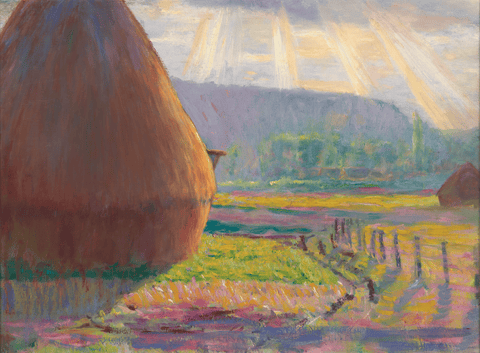
During his marriage, Butler’s work reflected the warmth of his domestic life, capturing intimate scenes of his family and the lush French countryside. His palette mirrored Monet’s, yet his brushwork also drew comparisons to the bold techniques of Paul Gauguin and the Nabis movement. Following Suzanne’s untimely death in 1899, Butler’s artistic focus shifted toward landscapes, with an increasing emphasis on Fauvist color principles.
The American Goes Home |
In 1900, Butler returned briefly to the United States for a solo exhibition in New York, during which Suzanne’s younger sister, Marthe Hoschedé, cared for his two children, Jimmy and Lilly. Upon his return to France, he married Marthe, further solidifying his connection to the Monet family.
Though Butler remained deeply tied to Giverny, he relocated his family to New York City in 1914, where he was commissioned to paint murals for financier William A. Paine. The outbreak of World War I delayed their return to France, keeping the Butler family at the heart of New York’s art scene until 1921. When he finally resettled in Giverny, Butler established his own gardens, a tribute to Monet’s influence, and continued painting landscapes infused with his signature vibrant palette and expressive brushwork.
Legacy |
A founding member of the Society of Independent Artists, Butler’s career bridged Impressionism and Post-Impressionism, reflecting a fearless evolution in style. His later works, with their energetic hues and dynamic compositions, aligned him with the Fauvist movement while maintaining the Impressionist reverence for nature. While once overshadowed by his contemporaries, Butler’s work is now recognized for its bold experimentation with color and brushwork, foreshadowing elements of Fauvism and Post-Impressionism. His paintings, housed in major collections worldwide, continue to captivate collectors and scholars.
Butler, Theodore Earl
1861 - 1936
Theodore Earl Butler was among the most innovative American artists of his time, renowned for his daring experiments with light and color. A key figure in the Impressionist movement, Butler formed deep artistic and personal ties with Claude Monet, marrying into the famed painter’s family and becoming a vital link between American expatriates and the French Impressionist circle.
Early Life |
Born in Columbus, Ohio, in 1861, Butler’s artistic journey began at Marietta College before continuing at the Art Students League of New York. In 1887, he moved to Paris to refine his craft, enrolling at the Académie Colarossi and Académie Julian, where he studied under the distinguished Émile Carolus-Duran. His talent quickly garnered recognition, and in 1888, he exhibited at the Paris Salon, earning an honorable mention for La Veuve (The Widow)—a rare distinction for an American artist in France.
Meeting with Monet |
Butler’s growing reputation led to a life-changing introduction to Claude Monet, the luminary of Impressionism. Monet, known for his exclusivity, welcomed Butler into his inner circle, granting him the rare privilege of painting alongside him in Giverny. It was in this idyllic setting that Butler fell in love with Suzanne Hoschedé, Monet’s stepdaughter and frequent muse. The couple married in 1892, with their nuptials famously depicted in Theodore Robinson’s painting The Wedding March.
Married Life |
During his marriage, Butler’s work reflected the warmth of his domestic life, capturing intimate scenes of his family and the lush French countryside. His palette mirrored Monet’s, yet his brushwork also drew comparisons to the bold techniques of Paul Gauguin and the Nabis movement. Following Suzanne’s untimely death in 1899, Butler’s artistic focus shifted toward landscapes, with an increasing emphasis on Fauvist color principles.
The American Goes Home |
In 1900, Butler returned briefly to the United States for a solo exhibition in New York, during which Suzanne’s younger sister, Marthe Hoschedé, cared for his two children, Jimmy and Lilly. Upon his return to France, he married Marthe, further solidifying his connection to the Monet family.
Though Butler remained deeply tied to Giverny, he relocated his family to New York City in 1914, where he was commissioned to paint murals for financier William A. Paine. The outbreak of World War I delayed their return to France, keeping the Butler family at the heart of New York’s art scene until 1921. When he finally resettled in Giverny, Butler established his own gardens, a tribute to Monet’s influence, and continued painting landscapes infused with his signature vibrant palette and expressive brushwork.
Legacy |
A founding member of the Society of Independent Artists, Butler’s career bridged Impressionism and Post-Impressionism, reflecting a fearless evolution in style. His later works, with their energetic hues and dynamic compositions, aligned him with the Fauvist movement while maintaining the Impressionist reverence for nature. While once overshadowed by his contemporaries, Butler’s work is now recognized for its bold experimentation with color and brushwork, foreshadowing elements of Fauvism and Post-Impressionism. His paintings, housed in major collections worldwide, continue to captivate collectors and scholars.

