

James, William
Introduction
Little is known about the life of British painter William James, yet the artist is credited with a substantial body of work that reflects the growing fascination with landscape, architecture and travel imagery during the Georgian period.
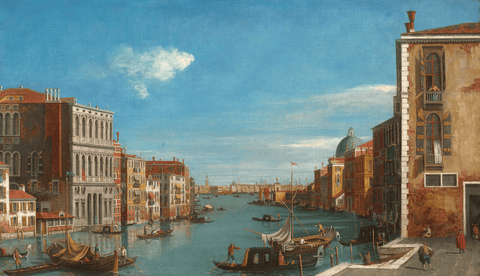
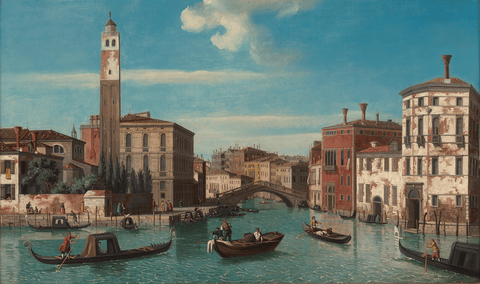
James specialized primarily in topographical scenes, including Venetian vedute, English landscapes and imaginative depictions of ancient Egyptian monuments. Though details of his personal life remain elusive, surviving exhibition records from both the Society of Artists of Great Britain and the Royal Academy of Arts confirm his activity in London during the mid-18th century.
Today, William James remains of particular interest to scholars and collectors for his rare Egyptian scenes and his reported connection to the great Venetian master Canaletto.
Shop in Covent Garden
William James was active in London from approximately 1754 to 1771, suggesting he was likely born during the early or mid-Georgian period.
The artist is believed to have lived and worked on Maiden Lane in Covent Garden, where he reportedly displayed paintings in his shop window. Contemporary records later list his address on nearby Bedford Street, leading scholars to speculate that these may have referred either to the same premises or to an expanded business location.
During the 18th century, Covent Garden was among London’s most vibrant artistic and commercial districts. Booksellers, engravers, print publishers, instrument makers and theater professionals all operated nearby, creating an environment deeply connected to the visual arts.
This setting would have provided James with direct access to prints, paintings and artistic materials while exposing him to the latest artistic developments circulating throughout London.
Assistantship with Canaletto
According to Edward Edwards’ Anecdotes of Painters (1808), James served as an assistant to Giovanni Antonio Canal — better known as Canaletto — during the Venetian master’s stay in England.
Canaletto relocated to London in 1746 amid strong demand from British patrons eager to acquire his celebrated architectural views of Venice.
Living only a short distance from Canaletto’s residence near Silver Street, James likely encountered the artist regularly through London’s tightly connected artistic community.
The exact nature of James’ role within Canaletto’s studio remains uncertain. He may have prepared materials such as pigments and canvases or participated more directly in the painting process itself, as was common among assistants working in major European studios.
Art historian Charles Beddington later suggested that Canaletto likely employed only a single assistant during his years in England. If James occupied this role, he would have gained exceptional firsthand experience studying under one of Europe’s foremost architectural painters.
Venetian Views and the Grand Tour
James’ surviving Venetian scenes reveal the clear influence of Canaletto’s compositions while introducing a more vivid and imaginative palette.
These paintings catered to the growing British fascination with Italy during the age of the Grand Tour, when aristocratic travelers commissioned views of famous European cities as souvenirs of their journeys abroad.
Though James became known for Venetian subjects, scholars generally believe he may never have traveled to Venice himself, instead working from prints, drawings and compositions by established masters.
The Society of Artists of Great Britain
Between 1761 and 1768, William James exhibited regularly with the Society of Artists of Great Britain, one of the earliest organized exhibition societies in Britain.
The Society was founded to provide a formal public venue for contemporary art exhibitions similar to the Paris Salon and became a major force within the London art world.
At the Society’s inaugural exhibition in 1761, James exhibited a summer evening landscape alongside a view of St. James’s Park. Over the following years, he continued presenting primarily English landscapes and architectural scenes.
Egyptian Subjects
By 1768, however, James dramatically shifted his focus toward depictions of ancient Egyptian monuments, including the Temple of Esna and the Temple of Serapis.
These works are among the earliest British artistic engagements with Egyptian architecture, predating Napoleon’s famous Egyptian expedition and its subsequent archaeological publications by several decades.
It is highly unlikely that James personally visited Egypt. Instead, he appears to have relied upon published travel accounts, engravings and antiquarian studies circulating throughout Britain.
Among the most important likely sources was Richard Pococke’s A Description of the East (1743–44), which introduced British audiences to detailed illustrations of Egyptian ruins and monuments.
At the time, Egypt occupied a fascinating place within the European imagination, associated as much with mythology, magic and mystery as with archaeology and historical scholarship.
The Royal Academy of Arts
In 1768, internal conflict within the Society of Artists contributed to the founding of the rival Royal Academy of Arts under the patronage of King George III.
Led by figures such as Joshua Reynolds and William Chambers, the new Academy quickly became Britain’s dominant artistic institution.
From 1769 to 1771, James exhibited with the Royal Academy, continuing his exploration of Egyptian architecture and ancient monuments.
The Academy’s 1769 exhibition catalog records detailed scenes of temples at Thebes in Upper Egypt, including depictions associated with Osiris, Isis and Ozymandias.
The remarkable specificity of these paintings demonstrates James’ close engagement with contemporary travel literature and antiquarian scholarship.
In 1770, James exhibited additional Egyptian scenes, including views of Medinet Habu and the Temple of Cous, while listing his address as May’s Buildings on St. Martin’s Lane.
St. Martin’s Lane held deep associations with London’s artistic culture and with the earlier St. Martin’s Lane Academy, an important precursor to the Royal Academy itself.
Artists frequently gathered nearby at Slaughter’s Coffee House, one of the city’s leading centers for artistic discussion and intellectual exchange.
James’ use of a St. Martin’s Lane address strongly suggests his close alignment with the Royal Academy’s artistic networks.
In 1771, James exhibited for the final time, presenting views of Westminster and Blackfriars Bridge. Following this final exhibition, the details of his life and career disappear from the historical record.
Legacy
Though much about William James remains uncertain, his surviving works provide valuable insight into the evolving artistic interests of 18th-century Britain.
His paintings reflect the period’s growing fascination with travel, classical antiquity, architectural spectacle and the emerging culture of public art exhibitions.
Today, James is remembered both for his rare Egyptian subjects and for his reported connection to Canaletto, one of the most influential view painters in European art history.
Collectors seeking exceptional examples of British and European fine art are invited to explore M.S. Rau’s curated collection of museum-quality paintings spanning centuries of artistic achievement.
Quick Facts
|
Continue Your ExplorationExplore works by William James and other masters of British and European painting through M.S. Rau’s curated collection of museum-quality fine art spanning centuries of artistic innovation and craftsmanship. |
James, William
Introduction
Little is known about the life of British painter William James, yet the artist is credited with a substantial body of work that reflects the growing fascination with landscape, architecture and travel imagery during the Georgian period.
James specialized primarily in topographical scenes, including Venetian vedute, English landscapes and imaginative depictions of ancient Egyptian monuments. Though details of his personal life remain elusive, surviving exhibition records from both the Society of Artists of Great Britain and the Royal Academy of Arts confirm his activity in London during the mid-18th century.
Today, William James remains of particular interest to scholars and collectors for his rare Egyptian scenes and his reported connection to the great Venetian master Canaletto.
Shop in Covent Garden
William James was active in London from approximately 1754 to 1771, suggesting he was likely born during the early or mid-Georgian period.
The artist is believed to have lived and worked on Maiden Lane in Covent Garden, where he reportedly displayed paintings in his shop window. Contemporary records later list his address on nearby Bedford Street, leading scholars to speculate that these may have referred either to the same premises or to an expanded business location.
During the 18th century, Covent Garden was among London’s most vibrant artistic and commercial districts. Booksellers, engravers, print publishers, instrument makers and theater professionals all operated nearby, creating an environment deeply connected to the visual arts.
This setting would have provided James with direct access to prints, paintings and artistic materials while exposing him to the latest artistic developments circulating throughout London.
Assistantship with Canaletto
According to Edward Edwards’ Anecdotes of Painters (1808), James served as an assistant to Giovanni Antonio Canal — better known as Canaletto — during the Venetian master’s stay in England.
Canaletto relocated to London in 1746 amid strong demand from British patrons eager to acquire his celebrated architectural views of Venice.
Living only a short distance from Canaletto’s residence near Silver Street, James likely encountered the artist regularly through London’s tightly connected artistic community.
The exact nature of James’ role within Canaletto’s studio remains uncertain. He may have prepared materials such as pigments and canvases or participated more directly in the painting process itself, as was common among assistants working in major European studios.
Art historian Charles Beddington later suggested that Canaletto likely employed only a single assistant during his years in England. If James occupied this role, he would have gained exceptional firsthand experience studying under one of Europe’s foremost architectural painters.
Venetian Views and the Grand Tour
James’ surviving Venetian scenes reveal the clear influence of Canaletto’s compositions while introducing a more vivid and imaginative palette.
These paintings catered to the growing British fascination with Italy during the age of the Grand Tour, when aristocratic travelers commissioned views of famous European cities as souvenirs of their journeys abroad.
Though James became known for Venetian subjects, scholars generally believe he may never have traveled to Venice himself, instead working from prints, drawings and compositions by established masters.
The Society of Artists of Great Britain
Between 1761 and 1768, William James exhibited regularly with the Society of Artists of Great Britain, one of the earliest organized exhibition societies in Britain.
The Society was founded to provide a formal public venue for contemporary art exhibitions similar to the Paris Salon and became a major force within the London art world.
At the Society’s inaugural exhibition in 1761, James exhibited a summer evening landscape alongside a view of St. James’s Park. Over the following years, he continued presenting primarily English landscapes and architectural scenes.
Egyptian Subjects
By 1768, however, James dramatically shifted his focus toward depictions of ancient Egyptian monuments, including the Temple of Esna and the Temple of Serapis.
These works are among the earliest British artistic engagements with Egyptian architecture, predating Napoleon’s famous Egyptian expedition and its subsequent archaeological publications by several decades.
It is highly unlikely that James personally visited Egypt. Instead, he appears to have relied upon published travel accounts, engravings and antiquarian studies circulating throughout Britain.
Among the most important likely sources was Richard Pococke’s A Description of the East (1743–44), which introduced British audiences to detailed illustrations of Egyptian ruins and monuments.
At the time, Egypt occupied a fascinating place within the European imagination, associated as much with mythology, magic and mystery as with archaeology and historical scholarship.
The Royal Academy of Arts
In 1768, internal conflict within the Society of Artists contributed to the founding of the rival Royal Academy of Arts under the patronage of King George III.
Led by figures such as Joshua Reynolds and William Chambers, the new Academy quickly became Britain’s dominant artistic institution.
From 1769 to 1771, James exhibited with the Royal Academy, continuing his exploration of Egyptian architecture and ancient monuments.
The Academy’s 1769 exhibition catalog records detailed scenes of temples at Thebes in Upper Egypt, including depictions associated with Osiris, Isis and Ozymandias.
The remarkable specificity of these paintings demonstrates James’ close engagement with contemporary travel literature and antiquarian scholarship.
In 1770, James exhibited additional Egyptian scenes, including views of Medinet Habu and the Temple of Cous, while listing his address as May’s Buildings on St. Martin’s Lane.
St. Martin’s Lane held deep associations with London’s artistic culture and with the earlier St. Martin’s Lane Academy, an important precursor to the Royal Academy itself.
Artists frequently gathered nearby at Slaughter’s Coffee House, one of the city’s leading centers for artistic discussion and intellectual exchange.
James’ use of a St. Martin’s Lane address strongly suggests his close alignment with the Royal Academy’s artistic networks.
In 1771, James exhibited for the final time, presenting views of Westminster and Blackfriars Bridge. Following this final exhibition, the details of his life and career disappear from the historical record.
Legacy
Though much about William James remains uncertain, his surviving works provide valuable insight into the evolving artistic interests of 18th-century Britain.
His paintings reflect the period’s growing fascination with travel, classical antiquity, architectural spectacle and the emerging culture of public art exhibitions.
Today, James is remembered both for his rare Egyptian subjects and for his reported connection to Canaletto, one of the most influential view painters in European art history.
Collectors seeking exceptional examples of British and European fine art are invited to explore M.S. Rau’s curated collection of museum-quality paintings spanning centuries of artistic achievement.
Quick Facts
|
Continue Your ExplorationExplore works by William James and other masters of British and European painting through M.S. Rau’s curated collection of museum-quality fine art spanning centuries of artistic innovation and craftsmanship. |

