

Quick Glance:
- Artists across cultures and centuries return to the sea as a powerful symbol
- The rise of naval power fostered the development of Dutch maritime art
- The term seascape came into widespread use in the late 18th century
- Artists such as Turner and Monet employ ocean scenes in innovative ways
- Artists such as Homer depict seaside communities with stoic realism
- Artists such as Dawson and Dews portray ships with striking precision
The Enduring Appeal of the Art About the Sea
Covering nearly three-quarters of our planet, it is no wonder water has inspired artists across cultures and centuries. An untamable muse, artworks of the sea explore themes of beauty and power, its vastness inspiring both awe and fear.

Bathers by Richard E. Miller. Early 20th century. Oil on canvas on board. M.S. Rau.
Humanity’s earliest depictions of water and boats appear in prehistoric carvings and ancient pottery. As seafaring cultures flourished with abundant resources and vital transportation routes, the sea remained a revered subject and was often a source of cultural identity.

The ship of Odysseus passing the Sirens. Red-figured stamnos. Circa 480 BCE-470 BCE. The British Museum.
During the Renaissance, the sea was often depicted as a topographical device or secondary setting, with Leonardo da Vinci demonstrating an early example of aerial perspective in 1515 with his bird’s-eye view of the Italian coastline. It provided a striking backdrop for mythological and historical subjects, as in Landscape with the Fall of Icarus by Pieter Bruegel the Elder. Over time, however, the sea evolved into a primary subject of independent artistic focus.

Landscape with the Fall of Icarus by Pieter Bruegel the Elder. Circa 1560. Oil on canvas. Royal Museums of Fine Arts of Belgium, Brussels. Source.
What Defines Ocean and Maritime Art?
Ships at sea became central subjects across maritime art during the 17th century, a period when naval power and global trade reshaped the political landscape. As the dominant maritime power on European waters, the Dutch created an extraordinary body of naval and marine paintings, documenting both everyday seafaring life and military might. They are widely credited with advancing the genre through natural, eye-level perspectives, which imbued scenes of life at sea with realism.
One of the most storied 17th-century seascapes is Rembrandt’s The Storm on the Sea of Galilee, his only known work in the genre. The painting depicts the biblical moment of Christ calming the storm, rendered with dramatic contrasts of light and shadow that heighten its emotional intensity. Rembrandt’s inclusion of a self-portrait among the disciples adds a layer of intrigue to this iconic composition. Stolen in 1990 from the Isabella Stewart Gardner Museum in the largest art heist in U.S. history, the work’s unresolved disappearance has only amplified its legend.

Christ in the Storm on the Sea of Galilee by Rembrandt. 1633. Oil on canvas. Whereabouts unknown since 1990. Source.
The term "seascape" came into wider use in the late 18th century to describe paintings that depicted the ocean and coastal vistas. More generally, this period saw artists gradually move beyond primarily religious and aristocratic patronage, exploring subjects that reflected their own sensibilities. The sea, with its shifting light and constant motion, offered an ideal subject for this freedom. Its dramatic and unpredictable character lends itself to painterly reflections on the complexity of life.

Santa Maria della Salute, Venice, with Gondolas attributed to William James. Mid-18th century. Oil on canvas. M.S. Rau.
Art History’s Greatest Maritime Painters:
Joseph Mallord William Turner
It can be argued that Joseph Mallord William Turner is the greatest seascape painter of all time, an artist whose vision of the ocean as an elemental force continues to define maritime painting. Through dramatic atmosphere and an extraordinary chromatic palette, Turner transformed water, light and sky into a dynamic, almost living presence on canvas.

Wreckers Coast of Northumberland by J.M.W. Turner. 1833-34. Oil on canvas. Yale Center for British Art, Connecticut. Source.
Born into a modest lower-middle-class family, Turner’s talent was recognized early. His father proudly exhibited his son’s drawings in his shop window, announcing that the boy was to be a painter. Yet his youth was marked by instability. His mother was confined to Bethlem Hospital with an unknown mental illness, where she died while Turner was still young.
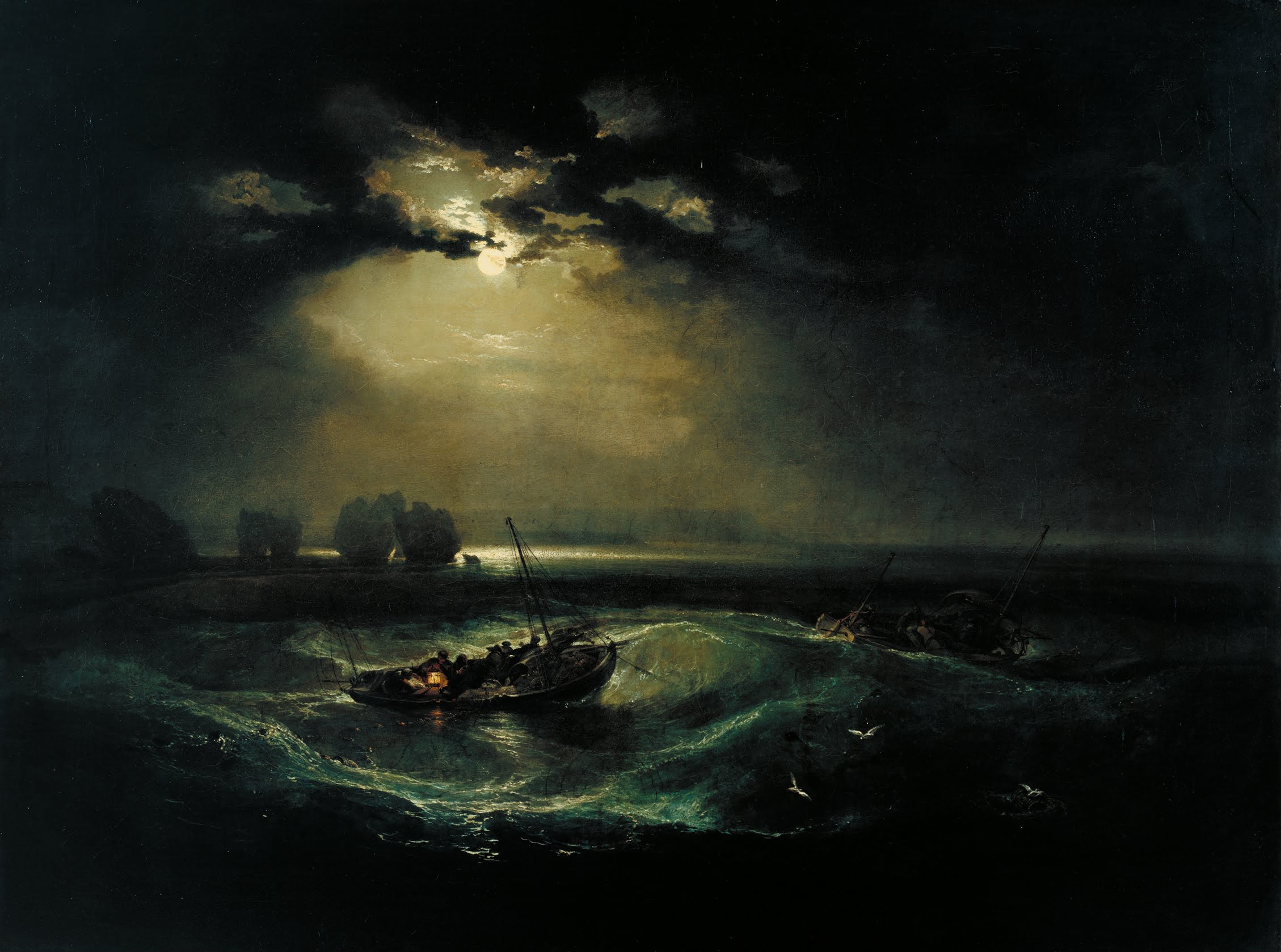
Despite hardships, he emerged as a child prodigy, enrolling at the Royal Academy of Arts at just fourteen and exhibiting his first work there at fifteen. His first exhibited oil painting, Fishermen at Sea, already revealed a deep fascination with the sea’s dangerous power, a theme that would become central to his career.

Fishermen at Sea by J.M.W. Turner. 1796. Oil on canvas. The Tate Gallery, London. Source.
As Turner matured, his intensely private, eccentric and increasingly reclusive personality, punctuated by bouts of depression, drew him ever more toward subjects that mirrored his own emotional volatility. Shipwrecks, storms and violent waters became his chosen imagery. Water, with its capacity for sublime beauty and annihilation, offered Turner a visual language for exploring forces beyond human control.

Snow Storm – Steam-Boat off a Harbour’s Mouth by J.M.W. Turner. 1842. Oil on canvas. The Tate Gallery, London. Source.
Turner was obsessed with the fragile limits of human mastery over nature, even claiming to have lashed himself to the mast of a ship during a storm to gather firsthand experience for Snow Storm – Steam-Boat off a Harbour’s Mouth. Whether fact or fiction, this story captures his ambition to feel the sea from within.

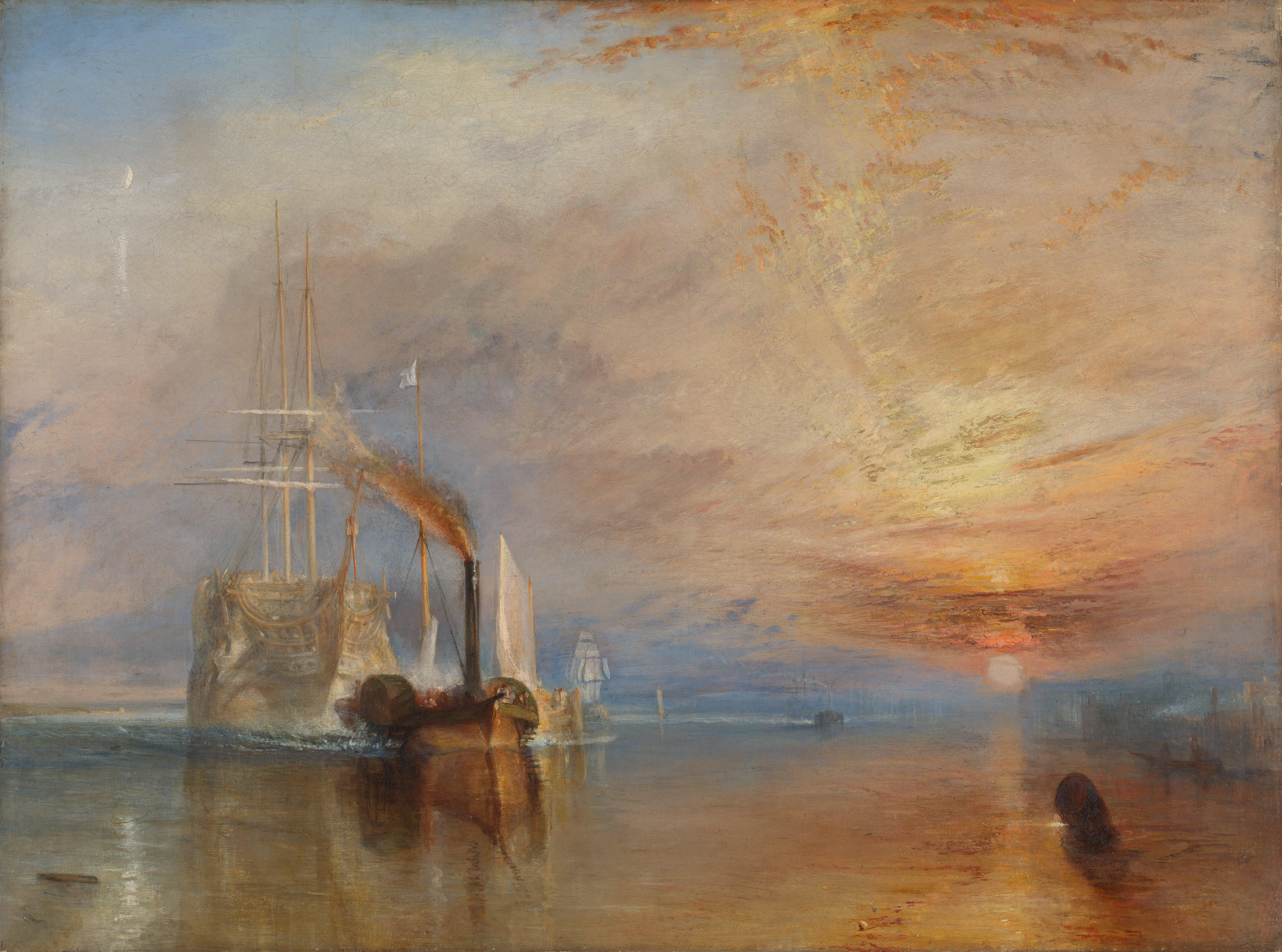
The Fighting Temeraire, tugged to her last berth to be broken up, 1838 by J.M.W. Turner. 1839. Oil on canvas. National Gallery, London. Source.
In works that brought him both fame and fortune during his lifetime, waves and sky dissolve into swirling color, immersing the viewer in the same disorientation and awe experienced by the figures within the scene. Though aligned with Romanticism early in his career, Turner ultimately bypassed Realism, and his later, increasingly abstract style became a significant precursor to both Impressionism and modern abstraction.
Claude Monet
While there are many undisputed masters of the seascape, few are as groundbreaking in their usage as Claude Monet. His Impression, Sunrise, depicting the port of Le Havre at dawn, actually gave the name to the Impressionist movement. His works challenge academic tradition by shifting the subject from physical form to the fleeting effects of light and atmosphere, beautifully on display by the shore.

Impression, Sunrise by Claude Monet. 1872. Oil on canvas. Musée Marmottan Monet, Paris. Source.
Nowhere is this ephemeral vision more fully realized than in Monet’s paintings of the Normandy coast, where he worked en plein air under harsh conditions. The cliffs and beaches of Étretat, closely connected to his youth, became his open-air studio, teaching him to capture the sea’s shifting moods across different hours and weather. Despite towering waves that he described as throwing him against the cliffs and scattering his materials, many of Monet’s most iconic seascapes were created as the artist stood fully immersed on the shoreline.

Falaises, temps gris by Claude Monet. Dated 1882. Oil on canvas. M.S. Rau.
Winslow Homer
Winslow Homer stands among the most important figures in American art and a defining voice in maritime painting. His ocean paintings are marked by stark realism, emphasizing survival and the precarious relationship between humanity and nature. Through these works, Homer forged a distinct American vision of the sea grounded in endurance, self-reliance and confrontation with the sublime.

Fisher Girls on the Beach, Cullercoats by Winslow Homer. 1881. Watercolor on paper. Brooklyn Museum, New York City. Source.
A pivotal period in Homer’s development came during his time in England from 1881 to 1882, particularly in the coastal village of Cullercoats. There, he closely observed life on the working waterfront, engaging with themes of labor and daily life. Adopting a more somber palette, Homer depicted working men and women as stoic and heroic figures, a focus he carried back to the United States, where it is evident in some of his most iconic works.

The Fog Warning by Winslow Homer. 1885. Oil on canvas. Museum of Fine Arts, Boston. Source.
Montague Dawson
Montague Dawson is widely regarded as the premier marine painter of the 20th century and the unrivaled master of the sailing ship. Celebrated as the “King of the Clipper Ship School,” Dawson brought extraordinary precision and realism to his depictions of historic vessels and naval engagements, reviving traditional maritime art. His paintings capture the full drama of the sea with wind-filled sails and rolling waves, while documenting the great clippers and warships of the 18th and 19th centuries with unmatched technical authority.

The Atlantic Packet Albion of the Black Ball Line by Montague Dawson. Painted 1947. Oil on canvas. M.S. Rau.
Dawson developed his lifelong connection to the sea through hours spent sailing on the Thames with his father, an avid yachtsman. Largely self-taught, he combined careful study of the Old Masters with firsthand maritime experience, revealing exceptional talent from an early age. His service as a naval officer during World War I proved formative, sharpening his eye for accuracy and drama. Dawson’s wartime illustrations from the First and Second World Wars, published in The Sphere, established his reputation for capturing complex naval scenes.

Refueling at Sea by Montague Dawson. Published April 11, 1942, in The Sphere. Oil on canvas. Sold at M.S. Rau.
John Steven Dews
Carrying forward the legacy of seafaring masters, John Steven Dews is regarded as one of the most accomplished living maritime artists. Renowned for his spectacular depictions of historic vessels, naval engagements and grand regattas, Dews combines dramatic atmosphere with extraordinary technical precision.

D-Day Landings by John Steven Dews. Oil on canvas. Sold at M.S. Rau.
Born in Yorkshire, Dews developed an early fascination with ships and the sea. Though initially unsuccessful in formal naval pursuits, he trained in technical graphics and illustration, skills that would later underpin his remarkable draughtsmanship. Drawing from photographs, ship plans, models and direct observation of sea and sky, Dews devoted himself to rigorous study. His first exhibitions in the mid-1970s sold out immediately, marking the start of an international career defined by consistent success.

Victory Breaking the Line - Battle of Trafalgar by John Steven Dews. Oil on canvas. Sold at M.S. Rau.
Over the decades, Dews has received a remarkable range of prestigious commissions from major corporations, museums and royal and yachting institutions. His monumental historical canvases have achieved record-setting auction results, cementing his position at the pinnacle of contemporary maritime art.
The Winds of Change
From ancient vessels etched into pottery to the atmospheric visions of Turner, Monet, Homer, Dawson, Dews and their successors, artists have returned to the ocean as a mirror of human ambition and imagination. Whether a setting for myth, a stage for commerce and conflict or an elemental force beyond control, the sea continues to inspire artistic innovation.
The seascapes’ enduring presence in art reflects humanity’s reliance on the ocean, and its profound capacity to evoke wonder, ensuring its place at the heart of artistic expression for generations to come. To explore more marine art, visit M.S. Rau!
Works Cited
Auricchio, Laura. 2004. “Claude Monet (1840–1926) - the Metropolitan Museum of Art.” Metmuseum.org. October 1, 2004.
“‘LANDSCAPE with the FALL of ICARUS.’” n.d. Google Arts & Culture.
Monks, Sarah. 2010. “‘Suffer a Sea-Change’: Turner, Painting, Drowning – Tate Papers.” Tate. 2010.
“Was J.M.W. Turner Britain’s Best Landscape Painter? National Gallery of Art.” 2014. National Gallery of Art. May 30, 2014.
Weinberg, H Barbara. 2004. “Winslow Homer (1836–1910) - the Metropolitan Museum of Art.” Metmuseum.org. October 2004.
Forbes. 2008. “The World’s Greatest Art Heists,” February 12, 2008.


#/media/File:Rembrandt_Christ_in_the_Storm_on_the_Lake_of_Galilee.jpg)



.jpg)
