

Long, Edwin
Introduction
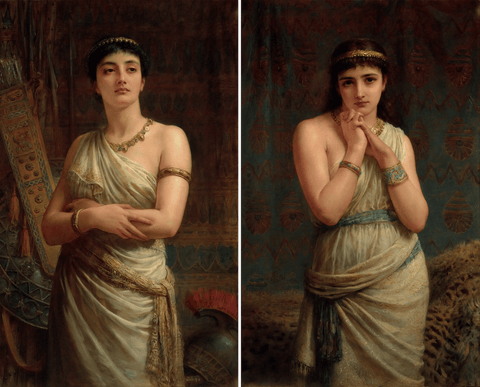
Edwin Longsden Long, RA (1829–1891), was among the most successful painters in Victorian Britain. During his lifetime, his monumental Orientalist and biblical scenes drew enormous crowds at the Royal Academy and sold for astonishing sums.
Long’s rise — from a young artist rejected twice by the Royal Academy Schools to a wealthy Royal Academician with a Bond Street gallery of his own — reflects both the possibilities and volatility of artistic fame in Victorian England.
Early Life
Edwin Long was born in Bath on July 12, 1829, the son of James Long, a hairdresser and perfumer from nearby Kelston.
After attending Dr. Viner’s School in Bath, Long moved to London in 1846 to study at James Matthew Leigh’s School of Art, an influential independent academy on Newman Street known for its distinguished roster of students.
During these early years, Long also spent considerable time studying antiquities at the British Museum — an experience that profoundly shaped the archaeological precision later associated with his mature paintings.
Long’s early academic progress was not without difficulty. He was rejected twice by the Royal Academy Schools because of weaknesses in his draftsmanship. These disappointments sent him back to Bath, where he established himself as a portrait painter and secured commissions from notable local figures, including Sir Hugh Gough and Lord Ebury.
In 1853, Long married Margaret Jemima Aiton, daughter of the director of the Royal Botanic Gardens. Two years later, he finally made his Royal Academy debut with three portraits.
The Influence of Spain
A decisive turning point came through John Phillip, RA — the Scottish painter nicknamed “Spanish Phillip” for his deep engagement with Spanish art and culture.
After Long began exhibiting in London, Phillip invited him to travel to Spain in 1857. The trip proved transformative.
Long immersed himself in the works of Diego Velázquez and Bartolomé Esteban Murillo, copying Old Masters and absorbing their dramatic realism and theatrical composition.
One of his copies after Velázquez’s Las Hilanderas entered the Royal Academy collection and received considerable admiration.
Spain fundamentally redirected Long’s artistic ambitions. Moving beyond portraiture, he turned increasingly toward historical and genre painting, producing works such as La Posada (1864), A Spanish Flower Seller (1867), Spanish Pottery Painters (1872) and The Suppliants: Expulsion of the Gypsies from Spain (1872).
These works sharpened his sense of narrative drama, atmosphere and elaborate theatrical staging — qualities that would define his mature career.
The Height of His Career
Another major transformation occurred in 1874, when Long traveled to Egypt and Syria. The journey deepened his fascination with biblical history, archaeology and the ancient Near East, supplying firsthand material for the paintings that would define his later oeuvre.
The Babylonian Marriage Market
Among his most celebrated works was The Babylonian Marriage Market, a monumental canvas inspired by a passage from Herodotus describing the sale of brides in ancient Babylon.
Long staged the composition with remarkable archaeological detail, drawing upon Assyrian reliefs, inscriptions, costume studies and museum artifacts while simultaneously heightening the scene’s theatrical spectacle.
The painting caused a sensation at the 1875 Royal Academy exhibition.
In 1882, collector Thomas Holloway purchased the work for the extraordinary sum of 6,300 guineas — then the highest price ever paid for a painting by a living artist. The work remains today at Royal Holloway, University of London.
|
“Long combined archaeological exactitude with Victorian theatricality.” Modern scholarship on Edwin Long |
The success of The Babylonian Marriage Market launched the most prosperous phase of Long’s career.
He was elected an Associate of the Royal Academy in 1876 and became a full Royal Academician in 1881.
Over the following decade, Long produced a series of ambitious and commercially successful paintings, including An Egyptian Feast (1877), The Gods and Their Makers (1878), Queen Esther, Diana or Christ? (1881), Anno Domini (1883) and Love’s Labour Lost (1885).
These monumental works shared many of the qualities that made Long so popular: imposing scale, elaborate archaeological detail, warm coloration, frieze-like arrangements of figures and narratives centered on moral, historical or religious drama.
By 1883, Long was successful enough to open his own gallery on Old Bond Street and commission homes in Hampstead designed by architect Richard Norman Shaw.
Few Victorian painters enjoyed such visible financial and institutional success during their lifetimes.
Orientalism and Archaeological Painting
Long is frequently associated with the archaeological school of Victorian painting alongside artists such as Lawrence Alma-Tadema and Edward Poynter.
Like these contemporaries, Long relied heavily on museum collections, antiquarian scholarship and archaeological publications to reconstruct scenes from the ancient world.
Yet his work remained highly distinctive.
While Alma-Tadema favored Greece and Rome, Long gravitated toward Egypt, Babylon and biblical narratives. His paintings were generally more theatrical and dramatic than Alma-Tadema’s polished classical interiors.
Similarly, whereas artists such as John Frederick Lewis based many Orientalist works on direct observation of contemporary Middle Eastern life, Long’s imagery was filtered through classical texts, scripture and archaeological study.
Death and Legacy
Edwin Long died on May 15, 1891, at his home in Hampstead, likely from pneumonia following influenza, at the age of 61.
The decline in his reputation was swift and severe. Paintings that had commanded immense sums during his lifetime sold for only fractions of those prices after his death.
Collectors such as Merton Russell-Cotes acquired important works inexpensively, and Long’s career became a striking example of how dramatically artistic taste can shift over time.
Today, Long’s paintings are receiving renewed scholarly attention and are represented in numerous public collections.
The largest holdings remain at Royal Holloway and the Russell-Cotes Art Gallery & Museum in Bournemouth, while additional works are held in collections in Bath, Blackburn, Melbourne, New York and elsewhere.
Modern art historians increasingly recognize Long’s significance within the broader context of Victorian classicism, Orientalism and 19th-century historical painting.
Collectors seeking exceptional examples of Victorian and Orientalist painting are invited to explore M.S. Rau’s curated collection of museum-quality fine art.
Quick Facts
|
Continue Your ExplorationExplore works by Edwin Longsden Long and other masters of Victorian and Orientalist painting through M.S. Rau’s curated collection of museum-quality fine art spanning the defining artistic movements of the 19th century. |
Long, Edwin
Introduction
Edwin Longsden Long, RA (1829–1891), was among the most successful painters in Victorian Britain. During his lifetime, his monumental Orientalist and biblical scenes drew enormous crowds at the Royal Academy and sold for astonishing sums.
Long’s rise — from a young artist rejected twice by the Royal Academy Schools to a wealthy Royal Academician with a Bond Street gallery of his own — reflects both the possibilities and volatility of artistic fame in Victorian England.
Early Life
Edwin Long was born in Bath on July 12, 1829, the son of James Long, a hairdresser and perfumer from nearby Kelston.
After attending Dr. Viner’s School in Bath, Long moved to London in 1846 to study at James Matthew Leigh’s School of Art, an influential independent academy on Newman Street known for its distinguished roster of students.
During these early years, Long also spent considerable time studying antiquities at the British Museum — an experience that profoundly shaped the archaeological precision later associated with his mature paintings.
Long’s early academic progress was not without difficulty. He was rejected twice by the Royal Academy Schools because of weaknesses in his draftsmanship. These disappointments sent him back to Bath, where he established himself as a portrait painter and secured commissions from notable local figures, including Sir Hugh Gough and Lord Ebury.
In 1853, Long married Margaret Jemima Aiton, daughter of the director of the Royal Botanic Gardens. Two years later, he finally made his Royal Academy debut with three portraits.
The Influence of Spain
A decisive turning point came through John Phillip, RA — the Scottish painter nicknamed “Spanish Phillip” for his deep engagement with Spanish art and culture.
After Long began exhibiting in London, Phillip invited him to travel to Spain in 1857. The trip proved transformative.
Long immersed himself in the works of Diego Velázquez and Bartolomé Esteban Murillo, copying Old Masters and absorbing their dramatic realism and theatrical composition.
One of his copies after Velázquez’s Las Hilanderas entered the Royal Academy collection and received considerable admiration.
Spain fundamentally redirected Long’s artistic ambitions. Moving beyond portraiture, he turned increasingly toward historical and genre painting, producing works such as La Posada (1864), A Spanish Flower Seller (1867), Spanish Pottery Painters (1872) and The Suppliants: Expulsion of the Gypsies from Spain (1872).
These works sharpened his sense of narrative drama, atmosphere and elaborate theatrical staging — qualities that would define his mature career.
The Height of His Career
Another major transformation occurred in 1874, when Long traveled to Egypt and Syria. The journey deepened his fascination with biblical history, archaeology and the ancient Near East, supplying firsthand material for the paintings that would define his later oeuvre.
The Babylonian Marriage Market
Among his most celebrated works was The Babylonian Marriage Market, a monumental canvas inspired by a passage from Herodotus describing the sale of brides in ancient Babylon.
Long staged the composition with remarkable archaeological detail, drawing upon Assyrian reliefs, inscriptions, costume studies and museum artifacts while simultaneously heightening the scene’s theatrical spectacle.
The painting caused a sensation at the 1875 Royal Academy exhibition.
In 1882, collector Thomas Holloway purchased the work for the extraordinary sum of 6,300 guineas — then the highest price ever paid for a painting by a living artist. The work remains today at Royal Holloway, University of London.
|
“Long combined archaeological exactitude with Victorian theatricality.” Modern scholarship on Edwin Long |
The success of The Babylonian Marriage Market launched the most prosperous phase of Long’s career.
He was elected an Associate of the Royal Academy in 1876 and became a full Royal Academician in 1881.
Over the following decade, Long produced a series of ambitious and commercially successful paintings, including An Egyptian Feast (1877), The Gods and Their Makers (1878), Queen Esther, Diana or Christ? (1881), Anno Domini (1883) and Love’s Labour Lost (1885).
These monumental works shared many of the qualities that made Long so popular: imposing scale, elaborate archaeological detail, warm coloration, frieze-like arrangements of figures and narratives centered on moral, historical or religious drama.
By 1883, Long was successful enough to open his own gallery on Old Bond Street and commission homes in Hampstead designed by architect Richard Norman Shaw.
Few Victorian painters enjoyed such visible financial and institutional success during their lifetimes.
Orientalism and Archaeological Painting
Long is frequently associated with the archaeological school of Victorian painting alongside artists such as Lawrence Alma-Tadema and Edward Poynter.
Like these contemporaries, Long relied heavily on museum collections, antiquarian scholarship and archaeological publications to reconstruct scenes from the ancient world.
Yet his work remained highly distinctive.
While Alma-Tadema favored Greece and Rome, Long gravitated toward Egypt, Babylon and biblical narratives. His paintings were generally more theatrical and dramatic than Alma-Tadema’s polished classical interiors.
Similarly, whereas artists such as John Frederick Lewis based many Orientalist works on direct observation of contemporary Middle Eastern life, Long’s imagery was filtered through classical texts, scripture and archaeological study.
Death and Legacy
Edwin Long died on May 15, 1891, at his home in Hampstead, likely from pneumonia following influenza, at the age of 61.
The decline in his reputation was swift and severe. Paintings that had commanded immense sums during his lifetime sold for only fractions of those prices after his death.
Collectors such as Merton Russell-Cotes acquired important works inexpensively, and Long’s career became a striking example of how dramatically artistic taste can shift over time.
Today, Long’s paintings are receiving renewed scholarly attention and are represented in numerous public collections.
The largest holdings remain at Royal Holloway and the Russell-Cotes Art Gallery & Museum in Bournemouth, while additional works are held in collections in Bath, Blackburn, Melbourne, New York and elsewhere.
Modern art historians increasingly recognize Long’s significance within the broader context of Victorian classicism, Orientalism and 19th-century historical painting.
Collectors seeking exceptional examples of Victorian and Orientalist painting are invited to explore M.S. Rau’s curated collection of museum-quality fine art.
Quick Facts
|
Continue Your ExplorationExplore works by Edwin Longsden Long and other masters of Victorian and Orientalist painting through M.S. Rau’s curated collection of museum-quality fine art spanning the defining artistic movements of the 19th century. |

