

Modigliani, Amedeo
Amedeo Modigliani is among the most recognizable artists of the 20th century. His elongated faces, swan-like necks and almond-shaped eyes form a visual signature that no other painter of his generation shares.
An Italian who spent nearly his entire career in Paris, Modigliani worked alongside Pablo Picasso, Brâncuși and Soutine yet belonged to no movement. He drew instead on the Italian Renaissance, African and Cycladic sculpture and the example of Cézanne to create a figurative art of quiet intensity.
He died at 35, leaving some 350 paintings and about 25 stone sculptures. Today his portraits and nudes hold places in the world's leading museums and rank among the most coveted works of modern art.
A Tuscan Beginning
Amedeo Clemente Modigliani was born on July 12, 1884, in Livorno, a cosmopolitan port on the Tuscan coast. He was the fourth child of Flaminio Modigliani and his French-born wife, Eugénie Garsin, both from Sephardic Jewish families.
The family's fortunes had collapsed with his father's business failure. His mother, a fiercely independent translator, supported the household and nurtured her son's interest in art.
Ill health shaped the young artist's youth. Bouts of pleurisy and typhoid, and later the tuberculosis that would follow him for life, interrupted his schooling for long periods.
From 1898 to 1900 he trained in Livorno under Guglielmo Micheli, a pupil of the Macchiaioli school of Tuscan open-air painting. Travels through Italy with his mother then exposed him to the Renaissance masters in Florence, Rome and Naples, giving him new purpose.
He enrolled at the Accademia di Belle Arti in Florence in 1902 and moved to Venice the following year. There he studied the old masters and first experimented with sculpture.
Paris and the Avant-Garde
Modigliani arrived in Paris early in 1906. He settled in Montmartre and enrolled at the Académie Colarossi, joining a circle that included Pablo Picasso, Max Jacob and Guillaume Apollinaire.
His early Paris work absorbed the lessons of Cézanne, Paul Gauguin, Henri de Toulouse-Lautrec and Steinlen. The 1907 Cézanne retrospective at the Salon d'Automne, where Modigliani also exhibited, left a lasting mark on his sense of composition and color.
Late in 1907, he met Dr. Paul Alexandre, a young physician who became his first patron. Alexandre bought his work steadily until the outbreak of the First World War and introduced him to the sculptor Constantin Brâncuși.
That same year Modigliani showed six works at the Salon des Indépendants and drew his first notice from the critic Louis Vauxcelles.
The Sculpture Years
In 1909 Modigliani took a studio at the Cité Falguière in Montparnasse, near Brâncuși. Inspired by the Romanian sculptor's commitment to direct carving, he devoted the next five years almost entirely to stone.
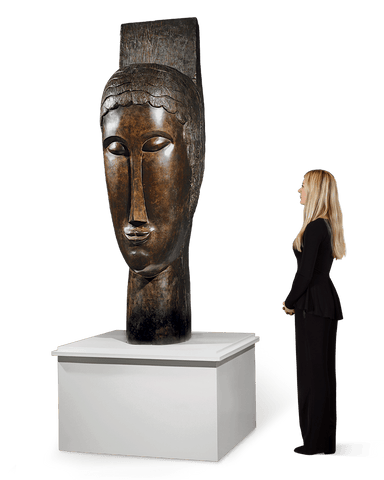
He produced about 25 sculptures, nearly all of them heads. Their elongated faces, slender necks and almond-shaped eyes drew on African, Cycladic, Egyptian and archaic Greek sculpture, which he studied in the museums and private collections of Paris.
Modigliani exhibited his sculpture only once. At the 1912 Salon d'Automne he showed seven heads as a "decorative ensemble." His dealer Paul Guillaume later recalled that the artist imagined them as columns in a temple of beauty that was never built.
Around 1914, ill health, poverty and the scarcity of materials during the war forced him to abandon carving. The forms he had developed in stone passed directly into his paintings and became his lasting signature.
Portraits and Nudes
In 1914, the young dealer Paul Guillaume began to buy Modigliani's work and encouraged his return to painting. In 1916 the Polish poet Léopold Zborowski became his dealer, supplying a room in his apartment, models, materials and a daily stipend.
The years from 1915 to 1919 produced nearly all of Modigliani's mature paintings. He painted the people around him: Picasso, Chaim Soutine, Max Jacob, Jean Cocteau, Jacques Lipchitz and his bride, and his dealers themselves.
His portraits share a distinctive grammar. Oval faces rest on columnar necks; eyes appear as blank almond shapes or with one pupil left unpainted; contours are drawn with a single, unbroken line against flat planes of color.
Scholars often place Modigliani in the line of Botticelli for his linear grace. His reclining nudes, meanwhile, continue a tradition that begins with Giorgione and Titian.
"What I am seeking is not the real and not the unreal, but rather the unconscious, the mystery of the instinctive in the human race." — Amedeo Modigliani
Between 1916 and 1919, he painted a celebrated series of about 22 reclining nudes. Frank, monumental and free of mythological pretext, they present the modern woman painted from life.
In December 1917, the dealer Berthe Weill mounted the only solo exhibition of his lifetime at her gallery on the rue Taitbout. Nudes displayed in the window drew a crowd, and police ordered them removed on grounds of indecency. The show sold little, but the scandal made Modigliani's name.
Final Years and Lasting Legacy
In 1917 Modigliani met Jeanne Hébuterne, a young art student who became his companion and one of his most frequent sitters. In the spring of 1918, the couple left wartime Paris for the Riviera, living in Nice and Cagnes until May 1919.
The southern light brought a warmer palette and a turn to fresh subjects: children, peasants, servants and shop girls. Their daughter, Jeanne, was born in Nice on November 29, 1918.
Recognition finally began to arrive. In August 1919, Osbert and Sacheverell Sitwell included nine of his paintings in an exhibition of French art in London, and that autumn he exhibited at the Salon d'Automne.
Modigliani died of tubercular meningitis in Paris on January 24, 1920, at the age of 35. Two days later, Hébuterne, pregnant with their second child, took her own life. He rests in Père Lachaise Cemetery.
His daughter, Jeanne Modigliani, later wrote one of the first serious studies of her father's life. His works now hang in the Metropolitan Museum of Art, the Museum of Modern Art, the Guggenheim, the National Gallery of Art, Tate and the Musée de l'Orangerie.
The market reflects the rarity of his output. In 2015 Nu couché (1917–18) realized $170.4 million at Christie's New York, a result we examine in Hammer Down: 10 of the Most Expensive Art and Antiques Ever Sold at Auction. In 2018 Nu couché (sur le côté gauche) brought $157.2 million at Sotheby's. Only about nine of the reclining nudes remain in private hands.
His sculpture is rarer still. A stone Tête realized $70.7 million in 2014, then a record for any work by the artist.
Modigliani, Amedeo
Amedeo Modigliani is among the most recognizable artists of the 20th century. His elongated faces, swan-like necks and almond-shaped eyes form a visual signature that no other painter of his generation shares.
An Italian who spent nearly his entire career in Paris, Modigliani worked alongside Pablo Picasso, Brâncuși and Soutine yet belonged to no movement. He drew instead on the Italian Renaissance, African and Cycladic sculpture and the example of Cézanne to create a figurative art of quiet intensity.
He died at 35, leaving some 350 paintings and about 25 stone sculptures. Today his portraits and nudes hold places in the world's leading museums and rank among the most coveted works of modern art.
A Tuscan Beginning
Amedeo Clemente Modigliani was born on July 12, 1884, in Livorno, a cosmopolitan port on the Tuscan coast. He was the fourth child of Flaminio Modigliani and his French-born wife, Eugénie Garsin, both from Sephardic Jewish families.
The family's fortunes had collapsed with his father's business failure. His mother, a fiercely independent translator, supported the household and nurtured her son's interest in art.
Ill health shaped the young artist's youth. Bouts of pleurisy and typhoid, and later the tuberculosis that would follow him for life, interrupted his schooling for long periods.
From 1898 to 1900 he trained in Livorno under Guglielmo Micheli, a pupil of the Macchiaioli school of Tuscan open-air painting. Travels through Italy with his mother then exposed him to the Renaissance masters in Florence, Rome and Naples, giving him new purpose.
He enrolled at the Accademia di Belle Arti in Florence in 1902 and moved to Venice the following year. There he studied the old masters and first experimented with sculpture.
Paris and the Avant-Garde
Modigliani arrived in Paris early in 1906. He settled in Montmartre and enrolled at the Académie Colarossi, joining a circle that included Pablo Picasso, Max Jacob and Guillaume Apollinaire.
His early Paris work absorbed the lessons of Cézanne, Paul Gauguin, Henri de Toulouse-Lautrec and Steinlen. The 1907 Cézanne retrospective at the Salon d'Automne, where Modigliani also exhibited, left a lasting mark on his sense of composition and color.
Late in 1907, he met Dr. Paul Alexandre, a young physician who became his first patron. Alexandre bought his work steadily until the outbreak of the First World War and introduced him to the sculptor Constantin Brâncuși.
That same year Modigliani showed six works at the Salon des Indépendants and drew his first notice from the critic Louis Vauxcelles.
The Sculpture Years
In 1909 Modigliani took a studio at the Cité Falguière in Montparnasse, near Brâncuși. Inspired by the Romanian sculptor's commitment to direct carving, he devoted the next five years almost entirely to stone.
He produced about 25 sculptures, nearly all of them heads. Their elongated faces, slender necks and almond-shaped eyes drew on African, Cycladic, Egyptian and archaic Greek sculpture, which he studied in the museums and private collections of Paris.
Modigliani exhibited his sculpture only once. At the 1912 Salon d'Automne he showed seven heads as a "decorative ensemble." His dealer Paul Guillaume later recalled that the artist imagined them as columns in a temple of beauty that was never built.
Around 1914, ill health, poverty and the scarcity of materials during the war forced him to abandon carving. The forms he had developed in stone passed directly into his paintings and became his lasting signature.
Portraits and Nudes
In 1914, the young dealer Paul Guillaume began to buy Modigliani's work and encouraged his return to painting. In 1916 the Polish poet Léopold Zborowski became his dealer, supplying a room in his apartment, models, materials and a daily stipend.
The years from 1915 to 1919 produced nearly all of Modigliani's mature paintings. He painted the people around him: Picasso, Chaim Soutine, Max Jacob, Jean Cocteau, Jacques Lipchitz and his bride, and his dealers themselves.
His portraits share a distinctive grammar. Oval faces rest on columnar necks; eyes appear as blank almond shapes or with one pupil left unpainted; contours are drawn with a single, unbroken line against flat planes of color.
Scholars often place Modigliani in the line of Botticelli for his linear grace. His reclining nudes, meanwhile, continue a tradition that begins with Giorgione and Titian.
"What I am seeking is not the real and not the unreal, but rather the unconscious, the mystery of the instinctive in the human race." — Amedeo Modigliani
Between 1916 and 1919, he painted a celebrated series of about 22 reclining nudes. Frank, monumental and free of mythological pretext, they present the modern woman painted from life.
In December 1917, the dealer Berthe Weill mounted the only solo exhibition of his lifetime at her gallery on the rue Taitbout. Nudes displayed in the window drew a crowd, and police ordered them removed on grounds of indecency. The show sold little, but the scandal made Modigliani's name.
Final Years and Lasting Legacy
In 1917 Modigliani met Jeanne Hébuterne, a young art student who became his companion and one of his most frequent sitters. In the spring of 1918, the couple left wartime Paris for the Riviera, living in Nice and Cagnes until May 1919.
The southern light brought a warmer palette and a turn to fresh subjects: children, peasants, servants and shop girls. Their daughter, Jeanne, was born in Nice on November 29, 1918.
Recognition finally began to arrive. In August 1919, Osbert and Sacheverell Sitwell included nine of his paintings in an exhibition of French art in London, and that autumn he exhibited at the Salon d'Automne.
Modigliani died of tubercular meningitis in Paris on January 24, 1920, at the age of 35. Two days later, Hébuterne, pregnant with their second child, took her own life. He rests in Père Lachaise Cemetery.
His daughter, Jeanne Modigliani, later wrote one of the first serious studies of her father's life. His works now hang in the Metropolitan Museum of Art, the Museum of Modern Art, the Guggenheim, the National Gallery of Art, Tate and the Musée de l'Orangerie.
The market reflects the rarity of his output. In 2015 Nu couché (1917–18) realized $170.4 million at Christie's New York, a result we examine in Hammer Down: 10 of the Most Expensive Art and Antiques Ever Sold at Auction. In 2018 Nu couché (sur le côté gauche) brought $157.2 million at Sotheby's. Only about nine of the reclining nudes remain in private hands.
His sculpture is rarer still. A stone Tête realized $70.7 million in 2014, then a record for any work by the artist.

