

Quick Look
- From poverty to prominence: Born Amy Lyon in 1765, Emma rose from domestic service to become Lady Hamilton and a celebrated figure at the court of Naples
- An artist’s muse: George Romney painted her in more than 70 canvases. She also sat for Joshua Reynolds, Elisabeth Vigée Le Brun and other leading artists
- Bringing antiquity to life: Her celebrated “Attitudes” used drapery, poses and expressions to recreate figures from classical art, connecting performance with the era’s fascination with ancient Greece and Rome
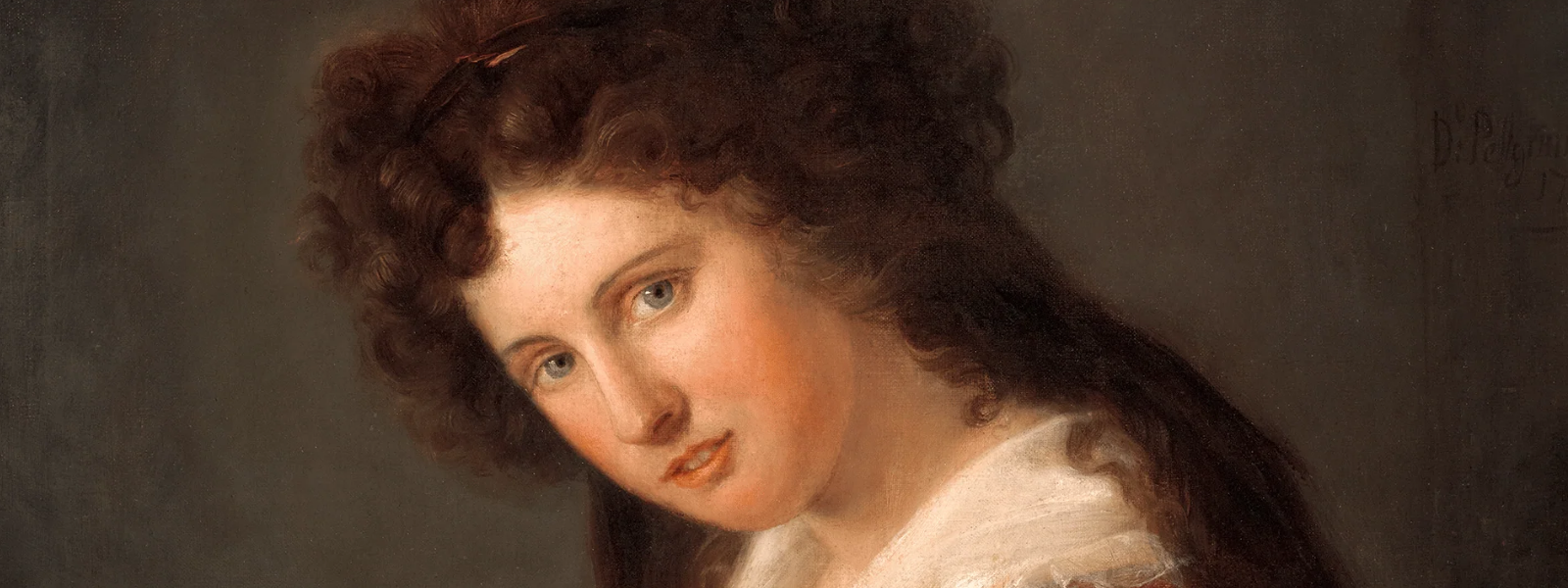
- A defining portrait: Domenico Pellegrini’s 1791 portrait captures Emma in the year she married Sir William Hamilton. Later owned by Admiral Nelson, it is now offered by M.S. Rau
- A famous, controversial romance: Emma’s relationship with Nelson began after his return to Naples in 1798. Their daughter, Horatia, was born in 1801
- Fame without lasting security: After Nelson died at Trafalgar in 1805, Emma faced mounting debts and imprisonment. She died in Calais in 1815
Muse, icon, tabloid sensation. Few women of the eighteenth century were as celebrated, or as thoroughly reviled and gossiped about, as Emma, Lady Hamilton (1765-1815). She is the ultimate rags-to-riches story, rising from poverty to the upper ranks of European society, helping set neoclassicism in motion and giving English history one of its most renowned love stories. In a world that revered her beauty but resented her ambition, she became one of the most scandalous women of her time.
Her life reads like a novel: a blacksmith’s daughter, a teenage maid turned courtesan, an artist’s obsession, an ambassador’s wife, an admiral’s great love. Jump into the true trials and tribulations of Emma, Lady Hamilton, and the ways her life intertwined with the era's greatest art movements.
From Amy Lyon to Emma
In 1765, she was born Amy Lyon in the village of Ness, Cheshire, the daughter of an illiterate blacksmith who died when she was only two months old. Raised in modest circumstances by her mother and grandmother, she had little in the way of formal education and even fewer prospects. By age 12, she began work as an under-nursemaid, a junior domestic servant in the nursery, for the local doctor John Thomas.
Like many young working-class women from rural areas, she and her mother left for London in 1777 in search of better pay and employment opportunities. Between her arrival in 1777 and 1781, little is known about then-Amy’s employment and whereabouts. While it is known for certain that she worked as a nursery maid for a short time, much of her early life in London is lost to history.
Then, in 1781, at fifteen or sixteen, she caught the eye of Sir Harry Fetherstonhaugh, a wealthy young landowner who installed her in a cottage on his country estate. This was her entry into the demimonde, the half-world of actresses, dancers and kept women who lived on the edges of polite society. In eighteenth-century England, a girl with no money, no family connections and no education had very few ways to rise, and entering the demimonde was one of them.
It was also precarious. A woman’s security lasted only as long as her protector’s interest, and Fetherstonhaugh’s did not last long. Within a year, Amy was pregnant, and he cast her off.

Portrait of the Hon. Charles Francis Greville by George Romney. Between 1781 and 1787. Oil on canvas. Sold at Christie’s, London, November 23, 2004.
With nowhere else to go, she appealed to his friend Charles Greville, a Member of Parliament. He agreed to take her in, with strings attached; Amy would have to give up her baby and bring only her mother. In exchange, he promised to provide for the child’s upbringing. It was a cold bargain, which she accepted, and demonstrates how little leverage a young woman in her position had.
In 1782, Amy Lyon disappeared, and Emma Hart took her place. The new name, which Greville chose for her, marked a clean break from the scandal of her past, polished enough for the drawing rooms she was to enter and free of the working-class associations of her old one.
Greville, collector and minor art dealer that he was, saw in Emma a beautiful object worth showing off. Hoping to profit from portraits of her, he introduced Emma to one of England's most fashionable painters, George Romney.
The Face Everyone Wanted to Paint

Lady Hamilton as Circe by George Romney. Circa 1782. Oil on canvas. Tate Britain, London.
From Emma’s first sitting for Romney in the spring of 1782, he was enchanted by her youthful beauty and ability to transform her whole expression on command. That first painting, where she posed as Circe, became the start of Romney’s nine-year obsession with painting her, his ultimate muse. Across more than 70 canvases and countless drawings, he depicted her as a nymph, a Bacchante, a penitent saint, a woman at her spinning wheel and more. In each, Emma seemed to instinctively understand what each character needed, and she stepped into the roles easily.
Prints of Romney’s portraits spread her image widely, and by her early twenties she had become a recognizable face in households that would have never welcomed her through the door before. Other painters took notice, too. Joshua Reynolds, Elisabeth Vigée Le Brun, Thomas Lawrence and Angelica Kauffmann are among the famous artists she posed for. Over the following years, she continued to be portrayed as a young, innocent girl and, later, as a mature woman at the height of her fame.

A Bacchante, after Joshua Reynolds and printed by John Raphael Smith. 1784. Mezzotint engraving. Carnegie Museum of Art, Pittsburgh.
A Portrait on the Threshold
Unlike the many mythological and theatrical guises that shaped so many of her previous portraits, Domenico Pellegrini’s Portrait of Emma, Lady Hamilton presents Emma as herself at this defining moment in her life. Dated 1791, the year she married and took the title of Lady Hamilton, the painting captures the very moment her life changed course.

Portrait of Emma, Lady Hamilton by Domenico Pellegrini. 1791. Oil on canvas. M.S. Rau.
Here is Emma at her most radiant, young and poised and fully aware of being looked at. The five years behind this portrait were anything but quiet. In 1786, Emma had arrived in Naples under the premise of a temporary stay, sent by Greville to the household of his uncle, Sir William Hamilton, Envoy Extraordinary to the Kingdom of Naples, so he could pursue a wealthy marriage of his own. Once the deception became clear, she had little choice but to build a life on this new ground.
Emma became Hamilton’s mistress, and then something more. Under his roof, she received the education she never had, absorbing the classical culture that filled his house. Their bond deepened as she grew, and Hamilton, a renowned antiquarian with an unmatched collection of ancient vases, came to see her as a rare companion.

The Attitudes of Lady Hamilton by Pietro Antonio Novelli. 1791. Pen and brown ink on laid paper. The National Gallery of Art, Washington, D.C.
It was also in these years that she developed her celebrated “Attitudes,” performances in which drapery, gesture and rapidly changing expressions evoked figures from ancient sculpture, painted vases, mythology and literature. These performances established her as an international celebrity and brought her into the circle of Queen Maria Carolina of Naples. That detail makes Pellegrini’s portrait even richer. The heavy drapery she wears closely resembles her performance costume, carrying a hint of the stage persona that made her famous.
Yet Pellegrini mainly sets the theater aside. Where other artists cast Emma as myth, his canvas concentrates on her character and physical presence. The dog she holds may reinforce this, perhaps symbolizing her new identity as Hamilton’s faithful wife.
Embracing Naples and Neoclassical Craze
When Emma and Hamilton married quietly in London in 1791, polite society was scandalized. An ambassador, 34 years older, no less, was expected to marry within his own rank. Yet the match worked wonderfully in Naples, where Emma’s standing at court only grew, and the couple returned to a city at the center of European fascination with antiquity.
The ground beneath Naples had been illuminating the ancient world for decades. Excavations at Herculaneum and Pompeii uncovered streets, frescoes and household objects just as Roman life had left them, and educated Europeans were hungry to see the results. Hamilton was perfectly placed to feed that appetite. As Britain’s envoy, he not only hosted visiting travelers and guided them to digs; he also paid local laborers to open ancient tombs across the Kingdom. Hamilton acquired the finest Greek and Roman vases that surfaced in the process and published them in lavish volumes that carried the look of the classical world to readers far away.
Emma’s household became the place where antiquity was discussed, collected and put on display. Further, she participated actively; her ‘Attitudes’ brought classical antiques to life. The German writer Goethe, who saw her perform in 1787, said of her: “In her, he [Hamilton] found all the antiquities...”

Italian Panel with Satyr and Nymphs. Circa 1800. Gouache and oil on canvas. M.S. Rau.
The objects travelers brought home from this world carried that same spirit, even if they weren’t ancient pieces themselves. The Italian Panel with Satyr and Nymphs draws on the mythological imagery commonly associated with ancient Greek pottery. Likely once displayed in the music room of an Italian villa, it is an exceptional example of its genre. The Hamiltons turned their home—the Palazzo Sessa—into an indispensable, obligatory stop on the European Grand Tour, but only for society’s most esteemed patrons.

View of the Grand Canal by William James. 18th century. Oil on canvas. M.S. Rau.
Scandal and Salvation: Emma Meets Nelson
Everything Emma had built in Naples might have made a complete story on its own. Instead, it was only the backdrop for the chapter that would define her. When Horatio Nelson arrived at the Palazzo Sessa, a scandal that followed her for the rest of her life began, along with the closest thing to true happiness she ever knew.
The two had met briefly in 1793, when Nelson, then a rising captain in the Royal Navy, passed through Naples on a diplomatic errand. By August of 1798, he was a rear admiral who won the victory that made him famous: at the Battle of the Nile, his fleet destroyed the French fleet at anchor off the Egyptian coast, halting Napoleon’s Mediterranean ambitions. Nelson returned to Naples a national hero, and a wounded one at that. The Hamiltons took him in, where Emma oversaw his care, and over those weeks admiration deepened into love.

Lord Nelson Singing Bird Box by Karl Griesbaum. Circa 1930. M.S. Rau.
Society was unforgiving. Nelson had a wife at home, and Emma had a husband, and the affair unfolded openly, with the three living in a ménage à trois arrangement that graced every London tabloid. Newspapers took aim while caricaturists drew them mercilessly. For a woman already judged for her beginnings, it was another trial by public opinion.
Yet, it was also the happiest time of her life. With Nelson, she was loved by someone who made no attempt to change her, or hide their love. The trio returned to England in 1800, and in January 1801 Emma gave birth to her and Nelson’s daughter, Horatia. Together, Emma and Nelson set up house at Merton Place, where the two shared a domestic life... with Hamilton in tow. Though Hamilton retained his own home in Piccadilly, he remained part of the trio’s life at Merton until 1803, dying with both Emma and Nelson at his side. Upon his death, he willed Lord Nelson a miniature of Emma painted by Elisabeth Vigée Le Brun.

Emma, Lady Hamilton, as Bacchante by Nicolas-François Dun, after a design by Elisabeth Vigée Le Brun. Circa 1798-1800. Watercolor on ivory. Royal Museums Greenwich, UK.
Emma’s Final Chapter
Sadly, Emma’s life did not have a fairy-tale ending. Nelson's death came on October 21, 1805, at the Battle of Trafalgar, in the hour of his greatest victory. The morning before the battle, he penned a codicil to his will asking the nation to provide for Emma and Horatia if he died. The government never honored it. When Nelson's effects were auctioned in 1809, Pellegrini's portrait of Lady Hamilton was sold with them, an esteemed provenance yet poignant loss deeply tied to Emma's life story.

Emma, Lady Hamilton by Johann Heinrich Schmidt. 1800. Pastel on paper. Royal Museum Greenwich, UK. Nelson hung this portrait in his cabin at sea, and it was with him when he died at Trafalgar.
Without Nelson or Hamilton, Emma was left with a lavish way of life and little means to sustain it. Merton Place, once the center of her domestic happiness, was sold, and her debts piled up until she was jailed for them. She eventually crossed the Channel with Horatia to escape her creditors and settled in Calais, where she died in January 1815.
Yet her ending is not the whole of her story, nor why we remember her. Emma’s rise from a blacksmith’s cottage to the court of Naples gave the age of Neoclassicism a living image. Painters, poets, travelers and naval heroes were drawn to her, and generations later she is just as compelling.
Works Cited
Colville, Quintin, and Kate Williams. Emma Hamilton: Seduction and Celebrity. London: Thames & Hudson, 2016.
"From Poverty to Painter's Muse: The Remarkable Life of Emma Hamilton." Art UK. Accessed October 7, 2026. https://artuk.org/discover/stories/from-poverty-to-painters-muse-the-remarkable-life-of-emma-hamilton.
Lewis Walpole Library. "Emma Hamilton Dancing." Yale University. Accessed October 7, 2026. https://walpole.library.yale.edu/sites/default/files/files/EmmaHamilton.pdf.
Maierhofer, Waltraud. "Goethe on Emma Hamilton's 'Attitudes': Can Classicist Art Be Fun?" Goethe Yearbook 9, no. 1 (1999): 222–52.
Russell, Jack. Nelson and the Hamiltons. New York: Penguin, 1972.


