

Quick Look
- Chagall’s Paris Opera ceiling is controversial because it covers Lenepveu’s original Second Empire ceiling painting.
- Chagall designed his ceiling to be removable, preserving Lenepveu’s work underneath.
- The debate reflects a larger question: whether the Palais Garnier should prioritize Garnier’s original vision or Chagall’s modern artistic intervention.
- The blog frames both ceilings as important layers of French art history.
 Ceiling of the Palais Garnier by Marc Chagall. 1963-1964. Canvas mounted on a plastic base.
Few ceilings spark as much passion as the one above the Palais Garnier, the historic 1,979-seat opera house in Paris built at the behest of Emperor Napoleon III. Since its 1964 unveiling, Marc Chagall’s luminous homage to fourteen great composers has crowned the Paris Opera’s auditorium. Yet it was controversial from the start because it covers Jules-Eugène Lenepveu’s original painting, Les Muses et les Heures du Jour et de la Nuit, which the original architect, Charles Garnier, commissioned for his Second Empire masterpiece.
Chagall knew how contentious his new ceiling commission would be. Thus, he forwent pay and designed 12 large canvases glued to a curved plastic shell, so they could be added or removed without ruining Lenepveu’s original work. Over six decades on, his piece remains in place.
Now, Lenepveu’s great-great-great-great-grandnephew, who leads the Friends of Lenepveu Society, is calling on French officials to uncover his ancestor’s historic artwork. His proposal is diplomatic: swap the two ceilings on a roughly ten-year cycle, so neither artist’s masterpiece is lost to the other.
This renewed debate over the Palais Garnier’s ceiling is revealing. Chagall’s ceiling still provokes fierce devotion, and just as many objections. What is it about his unique dreamlike style that makes people defend it so passionately, and why does his art continue to divide as much as it delights?
How Marc Chagall developed his distinctive style
Marc Chagall was born on July 7, 1887, in Liozna, a small town near Vitebsk in what is now Belarus. He was the eldest of nine children in an Orthodox Jewish household steeped in the deeply religious Hasidic tradition. Growing up in a shtetl, a small Jewish village, money was tight, and both parents worked to keep the family afloat. Art had no place in that world: his father spent days hauling herring barrels, while his mother kept the family’s small shop running.
Moreover, his faith, and the discrimination he experienced as a result, was the defining force of his early life. As a boy, he wrote, “I felt at every step that I was a Jew—people made me feel it.” This discrimination, coupled with growing up in a highly observant household defined by prayer, inspired Chagall to embrace his religious background as the basis of his identity as a Jewish artist.
Later in his life, that inheritance would surface constantly in his mature work. Fiddlers drawn from village celebrations, Torah scrolls, menorahs and rabbis wrapped in prayer shawls recur throughout his canvases. They appear alongside the cows, roosters and wandering figures that populated his childhood folklore. Chagall painted these as personal memory, weaving religious and folk imagery into dreamy scenes, especially following the devastation his hometown would endure later in his life.
Although his parents’ observance of Hasidic Judaism forbade depicting anything made in God’s image, Chagall felt called to art as a teenager and began studying under a local painter. Some turned away from him as he turned towards art; a pious uncle once refused to shake his hand.
 Portrait of Marc Chagall by Yury Pen. Circa 1914. Oil on canvas. National Arts Museum of the Republic of Belarus.
Chagall pressed on anyway. He grew dissatisfied with the academic portrait-painting school in Vitebsk, as it didn’t match the kind of art he wanted to create. In 1906, at age nineteen, he moved with a temporary passport to St. Petersburg, a city legally closed to Jews without special papers, and gained admission to the prestigious Imperial Society for the Protection of Fine Arts. There, he spent the first two years training in classical art, focusing on naturalistic landscapes and self-portraits.
After two years, he found that stifling, too. He switched to studying under Léon Bakst at the Zvantseva School of Painting, where he finally found support for his expressive approach to figurative art. Bakst, who had spent time in Paris with the likes of Henri Matisse and Paul Cézanne, introduced Chagall to modern art and the philosophy that artists should look inward to define their own style.
It was also during these St. Petersburg years, on a visit home to Vitebsk in 1909, that Chagall met Bella Rosenfeld, the woman he fell madly in love with and would later marry. Their courtship fed a growing idealism in his work, giving rise to the floating, embracing couples that became a touchstone motif. That romantic faith, paired with the ache of a family left behind, became the emotional foundation his art would return to for the rest of his life.
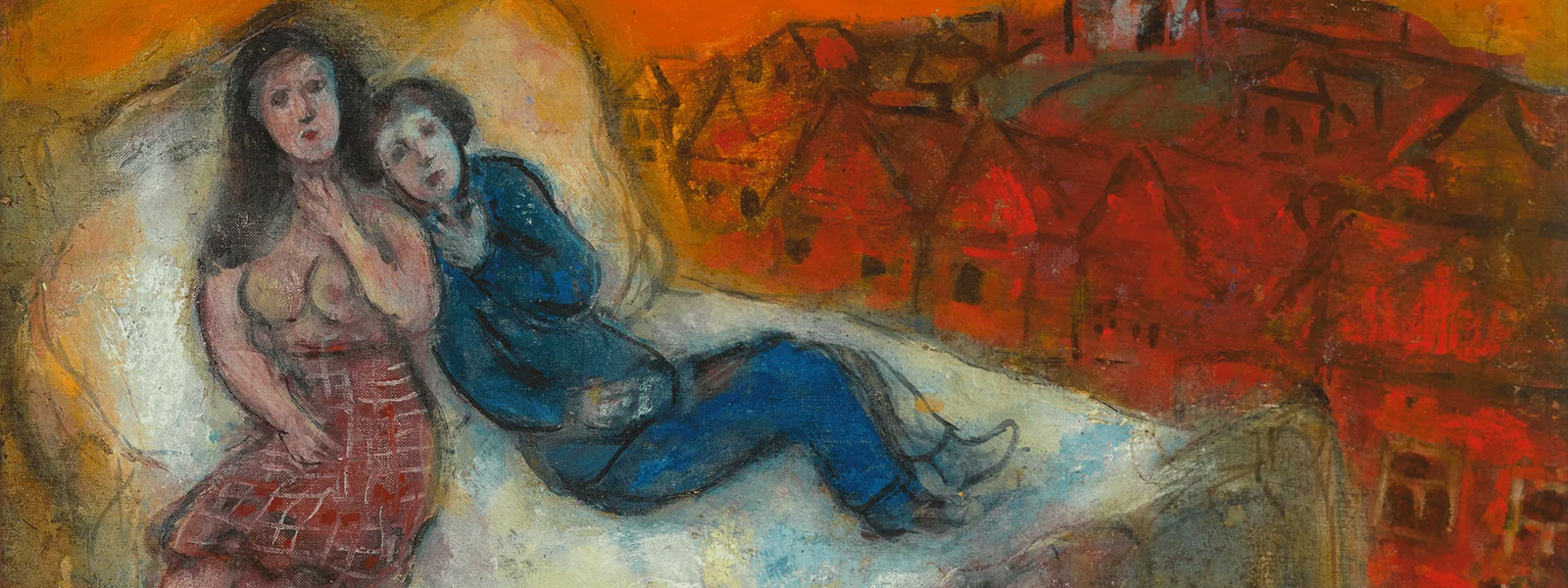
 Couple sur le lit by Chagall. Circa 1931-1952. Oil and India ink on canvas. M.S. Rau.
Chagall moved to Paris in 1911 after a member of the Duma, Russia’s state assembly, took a liking to 23-year-old Chagall and gave him a stipend to move across Europe. This first stretch in Paris, from 1911 to 1914, is considered Chagall’s most boldly creative and experimental, driven largely by his novel surroundings.
Chagall settled in La Ruche, the ramshackle artists’ colony in Montparnasse. Living alongside painters who became fixtures of the avant-garde of the 20th century, such as Amadeo Modigliani, gave him constant inspiration. His exposure to Fauvism at La Ruche pushed him to choose color over form, favoring emotional truth over faithful representation. A sky burned orange or a face turned blue were permissible, so long as it carried feeling. His early experiments in modern painting can be seen in I and the Village (1911), now in the Museum of Modern Art in New York.
War, exile and rebuilding
The two world wars repeatedly interrupted Chagall’s life, first delaying his return to France and later forcing him into exile.
In 1914, Chagall’s first real taste of recognition came when a Berlin gallery gave him a major exhibition, filling its walls with 40 canvases and 160 gouaches and watercolors. The show was a triumph, and should have marked the start of an easy ascent to artistic stardom. Coming off the heels of success, Chagall traveled home to Vitebsk soon after, planning only a brief stay to marry Bella before returning to France with her. Sadly, the border closed behind him; World War I had begun, and his short visit stretched into eight years of forced return.
Those years brought both hardship and momentum. Chagall exhibited in Moscow and St. Petersburg, showcasing paintings inspired by Vitebsk, married Bella in 1915, and watched the tsarist order collapse around him in the 1917 Revolution. As a newly recognized avant-garde figure, he was named a commissar of arts in his hometown and founded the Vitebsk People’s Art School there, even as daily life grew more difficult.
To support his new family, especially after his daughter Ida’s birth in 1916, he took whatever work he could find. He illustrated Yiddish books, taught drawing to Jewish children orphaned by pogroms and designed murals for a Jewish theater in Moscow. These commissions continued to strengthen his private vocabulary centered around Jewish life and folklore. By 1923, worn down by scarcity and a worsening famine, he secured an exit visa and brought his family to Paris for good.
 El Gallo by Chagall. 1928. Oil on canvas. Thyssen-Bornemisza National Museum, Madrid.
On the return journey, Chagall stopped in Berlin to recover paintings left behind before the war, only to find nothing; they were gone. The loss landed alongside a second, larger one. His departure from the Soviet Union was final, and choosing to make his home in France meant leaving his family and community behind. Grief for both losses—canvas and country—pushed him deeper into memory, and he spent the following years painting Vitebsk from a distance, blending its warmth with an undercurrent of sorrow for what could not be recovered.
That sorrow only sharpened as the decade wore on and the threat facing Jews across Europe grew impossible to ignore. That violence soon reached him directly. As Nazi Germany branded his paintings degenerate and the Vichy government took hold in France, Chagall understood the dangers facing his family and fled to the south. Inclusion on a list of artists considered at risk prompted an American rescue effort, and in 1941, he arrived in New York.
His savior voyage stripped him of French citizenship, repeating an exile from a country he had come to think of as his own. In the United States, Chagall worked on set design and costumes for the ballet Aleko (1942). He also contributed to the VVV Portfolio, published in New York in 1943, alongside André Breton and other artists.
Unfortunately, the years that followed were marked by everything he had lost: news of Vitebsk’s destruction, the systematic murder of Europe’s Jewish communities, and finally, in 1944, the devastating death of his beloved Bella. The shtetl world his paintings had preserved in memory no longer existed anywhere else.
 Couple devant buisson by Chagall. Circa 1949-1950. Gouache, India ink and graphite on paper. M.S. Rau.
Painted just a few years later, Couple devant buisson (ca. 1949-1950) captures that shift. Chagall’s embracing couple floats against a night sky, enveloped in an electric burst of flowers, in a return to the lovers-in-flight motif of his and Bella’s early passion. Rather than dwelling on his grief following her passing, Chagall embraced vivid, emotive colors and surreal settings to express the complexities of his experience. What had once been nostalgia became elegy.
Chagall never stopped longing for France, even from New York. After the war, in 1948, he returned for good, eventually settling along the Côte d’Azur, alongside Pablo Picasso and Henri Matisse. Arriving there, he described the sensation in his own words:
"As I got nearer to the Côte d'Azur, I experienced a feeling of regeneration, something I hadn't felt since childhood. The smell of flowers, a sort of new energy poured through me... Perhaps I am feeling the years, but anyway this place has become to me like my hometown Vitebsk. As if I was rejuvenated, and that I was waiting for something. And this flower-filled world colored my new life."
 Peintre à la veste rouge et le nu vert
(Painter with the Red Jacket and the Green Nude) by Chagall. Circa 1960. Pastel, India ink and graphite on paper. M.S. Rau.
His new home became the backdrop for his “Mediterranean Renaissance,” as depicted in Peintre à la veste rouge et le nu vert (ca. 1960). In this vibrant work, Chagall depicts himself as the painter in a vivid red jacket, surrounded by the signature symbols of his unique visual language: a lush bouquet of florals, a floating nude, the yellow-headed goat and the rooftops of his beloved birthplace of Vitebsk. In the luminous light and color of the south, Chagall found something close to the Vitebsk that war had erased, fusing the two in his imagination for the rest of his life.
Even in his seventies, Chagall showed no sign of slowing; if anything, his output only grew more prolific. His own arc, from devastating loss to renewal and artistic adulation, mirrored what played out across France, as the country still pieced its identity back together in the long shadow of occupation and war. His later commissions extended this use of color into stained glass windows, including America Windows (1977) at the Art Institute of Chicago.
The story behind Chagall’s Paris Opera ceiling
In 1960, the same year as his self-portrait, France’s Minister of Cultural Affairs, André Malraux, made the bold and very public gesture of asking Marc Chagall to paint a new ceiling for the Palais Garnier. The idea reportedly grew out of Malraux’s own uninspiring experience at a performance, and he wanted to shake off the Opera’s stuffy image and make it fashionable again. The academic, bombastic Second Empire style was no longer in favor with the masses, and Malraux aptly saw that if the Opera were to become more egalitarian, it would need a refresh.
Chagall was also, in Malraux’s eyes, more than a famous name. Here was an artist who, twice exiled and twice returned, had chosen France as home. Hiring one of the era’s most beloved painters, one so visibly loyal to France at that, promised to restore the Opera’s glamour and put it back at the center of Parisian conversation. The press coverage was undoubtedly an added bonus, giving the Opera plenty of free marketing.

Marc Chagall with the finished ceiling at the Palais Garnier.
Chagall’s terms for the commission were remarkably generous. He took no payment, and the state covered only his materials. He also built in a safeguard: by mounting his canvases on a separate plastic shell, Lenepveu’s earlier picture remained untouched underneath. As an artist himself, Chagall seems to have understood the need to protect Lenepveu’s artistic legacy, an instinct likely shaped by his experiences of displacement and rebuilding.
Purists and traditionalists were alarmed all the same. To understand why, it helps to know the man behind the building. Charles Garnier (1825-1898) was an École des Beaux-Arts-trained architect in his mid-thirties when his design won the 1861 competition for the city’s new opera house. The new opera was one of the marquee projects for Emperor Napoleon III’s sweeping reinvention of Paris, led by Baron Haussmann.
 The Grand Foyer of the Palais Garnier.
Garnier’s design proposal was an unapologetically theatrical building in the neo-Baroque manner of Napoleon III’s sophisticated Paris. His interiors ran on the principle of opulence as spectacle: marbles in every color, gilded stucco, mosaic, bronze and velvet were layered so the building’s spaces were one glittering production.
 Detail of the staircase at the Palais Garnier.
Garnier, who wrote a treatise on theater design, envisioned the public as part of the show. The Grand Staircase, with its wide marble steps, was built like a stage so arriving patrons could see and be seen. He also enlisted the leading artists of the Second Empire, including Jean-Baptiste Carpeaux for the façade sculpture and Lenepveu for the auditorium dome. He expected every element of his creation to answer to the same vision.
Against that backdrop, it made sense why Chagall’s ceiling came as a shock. In Garnier’s opera house, nothing was meant to stand apart, so a burst of twentieth-century color from a living Modernist struck critics as a direct contradiction of the architect’s founding principle.
Two Ceilings, One History
The case for bringing Lenepveu back into view is easy enough to understand. It certainly would align with Garnier’s original vision for the architectural plan. But Chagall’s ceiling was never meant to be an act of erasure. Its very existence as a removable piece tells France's history in a nutshell: an old guard giving way to a new one, artistic tradition bending to make room for creative progress. Garnier and Lenepveu built a monument to their century, while Chagall built one that could hold theirs and his own at once. Perhaps the real lesson of this debate is that art doesn't have to choose one generation over another. Like works of fine art in private collections, two masterpieces can live side by side, each enjoyed for their place in history.
Works Cited
- Benzine, Vittoria, “Decades-Old Feud Reignites Over Painting Hidden Beneath Chagall’s Paris Opera Ceiling,” Artnet, September 1, 2026, https://news.artnet.com/art-world/chagall-garnier-opera-paris-lenepveu-2805723.
- Biscottini, Paolo, et. al, Marc Chagall: Rétrospective 1908-1985, exh. cat. (Brussels: Musée Royaux des Beaux-Arts de Belgique, 2015).
- Fontaine, Gérard, “Le Plafond de Marc Chagall,” in Opéra de Charles Garnier. Architecture et décor intérieur (Paris: Éditions du Patrimoine, 2004).
- Grand Palais, “Chagall à Paris: La Ruche,” May 13, 2013, https://www.youtube.com/watch?v=ysLZwDQOZlI.


