

Quick Look
- Modern art is a historical period, broadly spanning the 1860s through the late 20th century, rather than a synonym for art that appears current.
- An original may be a unique painting or work on paper, an artist-authorized sculpture or an original print made through a recognized printmaking process.
- Before acquiring a work, examine authorship, provenance, condition, legal title and its importance within the artist’s career.
Modern art changed how artists constructed, and viewers understood, a work of art. From the late 19th century through the postwar decades, artists treated color as structure, fragmented perspective and questioned whether a picture should describe the visible world at all. Our guide to 20th-century art movements provides a broader overview.
Collectors searching for original modern art for sale soon discover that visual appeal is only the beginning. Authorship, provenance, condition, rarity and a work’s place within an artist’s development all affect its historical and market standing.
What Qualifies as Original Modern Art?
 Lucioles by Alexander Calder. Painted 1972. M.S. Rau.
“Modern art” describes a historical period, not a label for anything that looks current. It is generally traced to the 1860s and 1870s, when painters challenged Academic conventions, and extends through much of the 20th century. Its endpoint varies by scholar and movement.
“Original” requires a medium-specific definition. A painting or drawing is ordinarily unique. Sculpture may exist in an edition, making the casting date, foundry, edition number and authorization central to its assessment. An original print is made through a process such as etching, lithography or screenprinting; it is not a reproduction of another artwork. See our complete guide to collecting fine art for further guidance.
Major Movements in the Modern Art Market
Modern art did not develop in a straight line. Its movements overlapped and frequently influenced one another. Make sure you’re well-versed in these movements before you make a high-ticket modern art acquisition decision.
Impressionism

La Seine à Port-Marly–Voiliers by Pierre-Auguste Renoir. Circa 1890. M.S. Rau.
Impressionism rejected Academic finish and prescribed subjects in favor of modern life, visible brushwork and changing light. This landscape, painted by Pierre-Auguste Renoir circa 1890, constructs the river from strokes of blue, violet, green and ochre. Its history begins with Ambroise Vollard, who acquired it directly from Renoir, and the painting is recorded in published Renoir scholarship. Compare it with works in our Impressionist collection.
Cubism and Picasso
Beginning around 1907, Pablo Picasso and Georges Braque dismantled the single-point perspective that had governed Western painting since the Renaissance. Objects could be fractured and presented from multiple viewpoints in one composition.
Guitare sur un guéridon by Pablo Picasso. Painted 1920. M.S. Rau.
Picasso continued to revisit Cubism throughout his career. His 1920 gouache Guitare sur un guéridon joins a guitar and bowl of fruit through flattened planes and balanced geometric forms. Created while Picasso was testing the relationship between Cubism and Neoclassicism, it shows modernism advancing through revision as much as rupture.
Expressionism and Surrealism
Expressionist artists placed emotional and psychological force above naturalistic description. This approach informed German groups including Die Brücke and Der Blaue Reiter and artists such as Paul Klee.

King of Swords by Salvador Dalí. Circa 1971. M.S. Rau.
Surrealism formally coalesced around André Breton’s 1924 manifesto and its call to free art from purely rational thought. Dreams, chance and unexpected combinations became methods for reaching the unconscious. Salvador Dalí joined the Paris Surrealists in 1929 and brought precise draftsmanship to subjects governed by dream logic. His later tarot imagery, including King of Swords, demonstrates how he adapted Surrealist transformation to an established symbolic system.

Couple sur le lit by Marc Chagall. Circa 1931-1952. M.S. Rau.
Marc Chagall absorbed the innovations of Cubism, Fauvism and Surrealism without ever submitting fully to a single movement. Begun in 1931 and completed in 1952, Couple sur le lit revisits the lovers’ embrace that endures as one of the defining motifs of his career. Bold color and dreamlike intimacy unite in a composition unmistakably his own.
Pop Art and Warhol’s Legacy
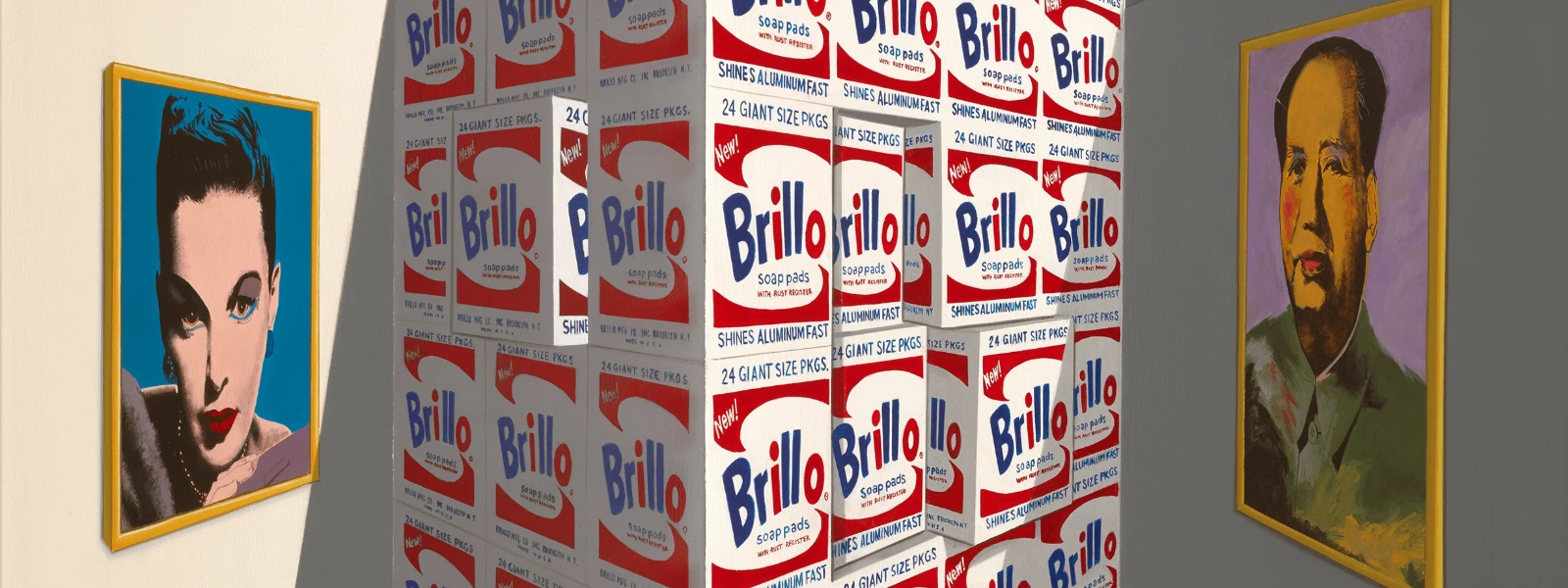
Pop Art emerged in Britain and the United States during the 1950s and 1960s, bringing advertising, celebrity imagery, commercial printing and consumer packaging into fine art. Andy Warhol became its most influential American practitioner by treating repetition and mechanical reproduction as both subject and method. His Brillo Boxes, celebrity portraits and screenprints challenged established distinctions between singular artworks and mass-produced images.

Warholed by Patrick Hughes. 21st Century. M.S. Rau.
Patrick Hughes addresses that legacy in Warholed, an oil-on-panel construction based on his “reverspective” method. Projecting planes appear to recede as the viewer moves, while Brillo packaging and portraits associated with Warhol invoke Pop Art’s familiar vocabulary. Hughes converts Warhol’s imagery into an optical and spatial problem. For more context, read The Power of Post-War Art.
How to Evaluate an Original Modern Artwork
Authorship and Authenticity
Examine signatures, inscriptions, dates, labels and stamps, but treat each as evidence rather than conclusive proof. A catalogue raisonné entry, an opinion from a recognized scholar or authentication authority, documented gallery records and technical analysis may carry greater weight. The appropriate standard depends on the artist, medium and date. Our interview with an art authenticator and restoration specialist explains how specialists approach these questions.
Provenance and Legal Title
Provenance is the documented history of ownership. Invoices, auction records, exhibition labels and correspondence may support that history, but the links between owners must be substantiated. Works that moved through continental Europe between 1933 and 1945 require particular scrutiny.
Provenance and legal title are related but distinct. Provenance can support authenticity and historical importance; clear title establishes the seller’s right to transfer ownership. Provenance and the Art Market examines restitution, archival research and due diligence in greater depth.
Condition, Rarity and Significance
Condition should be assessed in relation to medium, age and technique. Paintings require examination of the support, paint layer and restoration. For works on paper, consider fading, foxing and mounting. Sculpture may present casting flaws, repairs or altered patination. A qualified conservator can clarify previous treatment.
Date, subject, scale, medium and relationship to the artist’s recognized periods also determine standing. A characteristic example that embodies an artist’s central achievement occupies a different market position from a peripheral work bearing the same name. Comparisons should involve works of similar date, medium, dimensions, subject, condition and quality.
Paintings, Works on Paper, Sculpture or Prints?
Works on paper and prints may provide access to major artists at a different price level from paintings. Medium alone does not determine significance. Compare the current paintings, drawings and pastels and sculpture collections.
Questions to Ask Before Purchasing Modern Art
- What evidence supports the attribution?
- Is the work recorded in the relevant catalogue raisonné?
- What is its complete documented ownership history?
- Does the seller warrant authenticity and clear title in writing?
- What conservation has been completed, and is a current condition report available?
- For sculpture or prints, what are the edition, state, date, foundry, printer and publisher?
- How does the price compare with genuinely similar works?
When assessing original modern art for sale, documentation deserves the same disciplined examination as the object itself.
Find a Work of Enduring Significance
The strongest acquisitions combine visual authority with documented historical importance. Explore M.S. Rau’s curated collection of original modern art and paintings, or contact one of our fine art specialists for assistance.


