

Earlier this year, a picker hunting for vinyl records at a Kalamazoo, Michigan, estate liquidation spotted a small still life of seashells. He turned the canvas over, recognized the name on the back and paid $30 for it. On October 1, 2026, Freeman's sold the picture, Gertrude Abercrombie's Alderman Merriam's Shells (1951), for $1.35 million. No work by Abercrombie had ever brought more at auction.

Alderman Merriam's Shells by Gertrude Abercrombie. 1951. Freeman's Auction.
The name on the back caught the picker's eye, but its authentication set the price. Abercrombie gave the canvas to a Kalamazoo physician in 1952 in exchange for medical care, and it hung in exhibitions in New York, Chicago, Milwaukee and Evanston before it dropped out of sight in 1953. Scholars could also date it to a turning point in her work: it is the first canvas in which she painted the cracked seashell that recurs in her later pictures.
Few collectors will find a masterpiece next to a crate of records. The story still holds a lesson for anyone looking for original paintings by famous artists. Many collectors first meet Monet or Renoir on a museum wall and later want a canvas of their own. Often, it is the artist's name that starts that search. The individual painting's authorship, ownership history, condition and place in the artist's career decide whether it belongs in a collection and what it should cost. Join us as we explore how experienced buyers weigh each of those points.
Where Can You Buy Paintings by Famous Artists?
Most paintings by famous artists change hands in one of three ways: through an established gallery, at auction or by private treaty. The three channels differ in price transparency, in the research a buyer can see and in the protection that follows the purchase.
Established galleries. A reputable gallery may own the paintings it offers or sell them on consignment, so its staff has researched attribution, provenance and condition before a canvas goes on the wall. Buyers can stand in front of the work, read the file at their own pace and question a specialist about the artist or piece. The asking price is the price; no bidding contest pushes it up, and no premium is added at the end. The better galleries also put their promises in writing and provide white-glove installation services.

One can see Christie’s cost calculator displaying the added fees for this winning bid. 2026.
Auction houses. Sotheby's, Christie's and regional houses such as Freeman's publish their estimates and results, which gives the market a public record of prices. Auctions also reward speed. Previews usually last a few days, condition reports typically come as a courtesy with no warranty attached, and two determined bidders can carry a lot far past its estimate. The winning bidder then pays a buyer's premium on top of the hammer price. In February 2026, Sotheby’s raised its buyer’s premium to 28% on the first $2 million of the hammer price in New York. A painting hammered at $500,000 therefore costs $640,000 before tax and shipping.
Private treaty. Auction houses, dealers and advisors also arrange private transactions between owners and buyers. These give a buyer privacy and time to investigate, though the terms vary from one intermediary to the next. Before committing, a collector should find out who holds title, who warrants authenticity and what recourse exists if a problem comes to light later.
How Is a Painting's Authenticity Established?
No single document proves that a painting is authentic. Specialists build an attribution from several kinds of evidence, and the most secure attributions draw on all of them.

This is Degas’ signature on Danseuse en Rose. Circa 1877–1880. M.S. Rau.
Signatures. A signature is the most visible evidence and, taken alone, the weakest. Forgers can add them, and many genuine works have none. Renoir usually signed in full, yet some of his late studies carry only a monogram or a stamp his estate applied after his death. Specialists compare a signature's placement, pigment and brushwork with the rest of the canvas.
Expert opinion. For many major artists, one authority or foundation issues the opinion the market accepts. The Wildenstein Plattner Institute, for instance, compiles the digital catalogues raisonnés for Monet, Renoir and other of the world’s most famous artists. A painting that committee declines to support can be hard to place, signed or not.

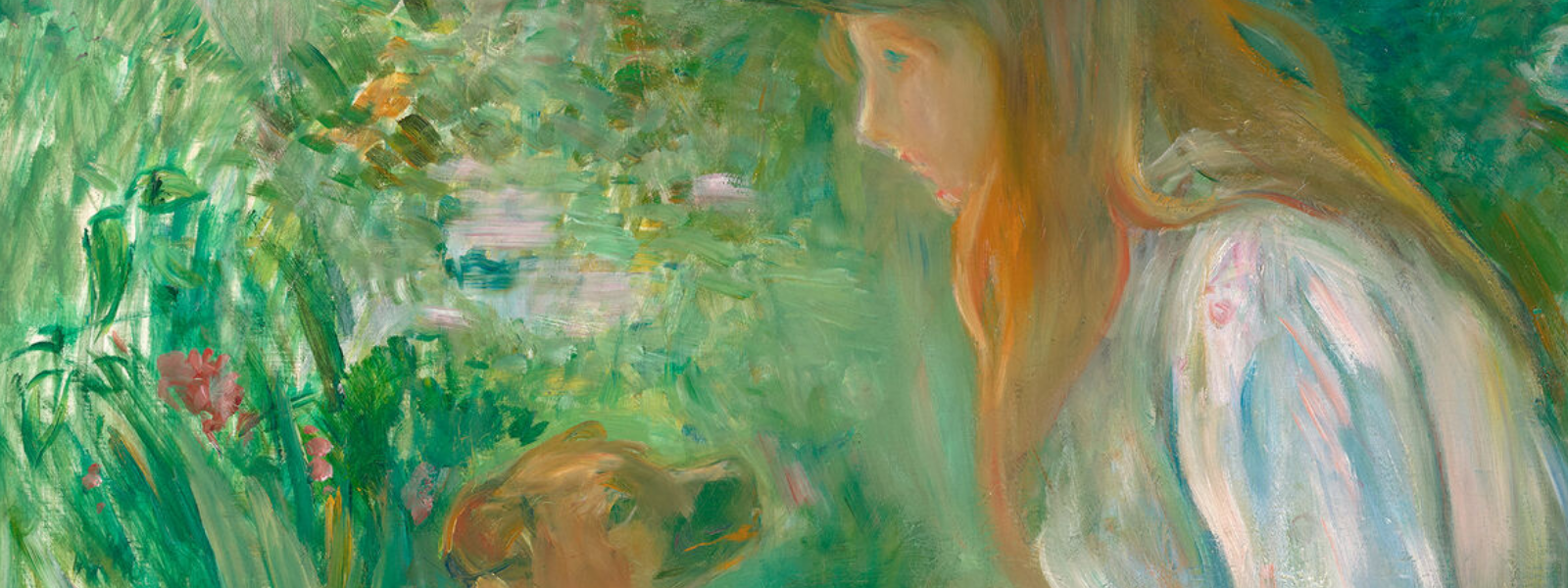
Jeune fille au chien by Berthe Morisot. Painted 1892. M.S. Rau.
The catalogue raisonné. A catalogue raisonné is a scholarly record of every known work by an artist. A typical entry gives the title, date, medium, dimensions, provenance, exhibitions and literature. Inclusion is the best evidence of authenticity a collector can obtain. Daniel Wildenstein's Monet catalogue lists almost 2,000 paintings across five volumes.

Jeune fille au chien pictured in J. Rewald’s The History of Impressionism, New York, 1961, p. 573.
How much each kind of evidence counts depends on the artist. Some artists have one accepted catalogue; others have rival scholars or no catalogue at all. Renoir has multiple catalogue references, including the Bernheim-Jeune volumes compiled by the Dauberville family and the forthcoming digital catalogue from the Wildenstein Plattner Institute.

Le bassin d'Argenteuil by Claude Monet. Dated 1875. M.S. Rau.
An example from M.S. Rau.
Claude Monet’s Le bassin d’Argenteuil demonstrates how several forms of documentation support a painting’s attribution and history. Signed and dated “Claude Monet 75,” it is illustrated as no. 371 in Daniel Wildenstein’s Monet: Catalogue raisonné, vol. II (1996), p. 153. Its provenance traces it through Galerie Bernheim-Jeune and the collection of Oscar Schmitz, with loans to Kunsthaus Zürich and Kunstmuseum Basel.

Le bassin d’Argenteuil illustrated in Daniel Wildenstein’s Monet, vie et œuvre, vol. I (1974).
The painting also appears in Paul Hayes Tucker’s Monet at Argenteuil (1982) and was exhibited at the Phillips Collection in 1996–97. Together, the catalogue raisonné entry, published scholarship, provenance and exhibition history provide a substantial documentary record.
Why Provenance Matters
Provenance is a painting's ownership history, traced as far as possible from the artist's studio to the present owner. A complete record supports the attribution, confirms that the seller holds good title and shows how earlier collectors regarded the work.
The Monet’s ownership history also shows how provenance can be checked against physical evidence and public records. A label on the reverse bears Galerie Bernheim-Jeune’s inventory number, 12161, giving researchers a specific record to consult, even where later private collectors remain unnamed.

Falaise en Normandie by Gustave Caillebotte. Circa 1880. M.S. Rau.
This painting moved from the estate of the artist, to a private collection in France, where it was held for generations.
Researchers piece together this kind of history from three main sources:
- Dealer records. Stock books kept by Durand-Ruel, Bernheim-Jeune, Ambroise Vollard and other firms record when they bought a painting from an artist and to whom they sold it. Auction houses still cite the Durand-Ruel archives to date a Renoir's departure from the artist's studio.
- Labels and inscriptions. Dealer, collector and exhibition labels on the stretcher or frame tie a canvas to its past. A Vollard inventory label with its stock number, for example, links a painting directly to that dealer's ledgers.
- Archival documents. Invoices, letters, insurance schedules, wills and photographs fill the gaps between dealer entries.
Ownership history and exhibition history are separate records. Provenance tells you who owned a painting; exhibition history tells you where the public saw it. Abercrombie's Alderman Merriam's Shells left public view for seven decades, yet its 1952 and 1953 exhibition appearances helped scholars identify it when it resurfaced. A showing at a respected institution also adds scholarly weight, since curators and critics examined the work at the time.
What Determines a Painting's Value?
Two paintings by the same artist can differ in price several hundredfold. Five characteristics explain most of the gap.
- Period. Most artists have a peak period that scholars and collectors prize above the rest. For Renoir, it is the Impressionist decade of the 1870s; for Monet, the Argenteuil years and the major series.
- Subject. Signature subjects bring the highest prices. A Renoir portrait of a young woman or a Monet water lily painting draws far more bidders than a minor still life or sketch.
- Medium. Oil on canvas generally leads, followed by pastel, watercolor and drawings. This is a general trend rather than a fixed rule, as some artists defy these patterns.
- Dimensions. A large, fully resolved canvas usually brings more than a small study by the same hand, though size by itself adds little.
- Condition. Paint loss, overpainting, relining and abrasion can all lower the price. A canvas with its original surface and color intact commands a premium.
Choosing the Right Painting for Your Collection

Pilote de la Meuse by Paul Signac. Painted 1924. M.S. Rau.
An avid sailor, Paul Signac had a particular affinity for sailboats, which rank among his most sought-after subjects.
Start with four questions before looking at individual works:
- What draws you? A defined interest in a movement, region or subject gives a collection coherence. Collections built around a theme tend to mean more to their owners and to later scholars.
- What do you already own? A good addition complements the works you have in period, palette or scale and avoids repeating them.
- Where will it hang? Measure the wall and check the light. Direct sun fades pigments, and swings in humidity strain canvas and panel.
- What is your budget? Set a ceiling that covers framing, insurance, shipping and any applicable taxes.
Questions to Ask Before Buying
- What documentation supports the attribution? Ask whether the painting appears in the catalogue raisonné and request the volume and entry number. If the catalogue is still in preparation, ask for the committee's letter or certificate. Check that every document describes this canvas by title, date and dimensions.
- Is a condition report available? A professional report notes any relining, inpainting, varnish or surface loss, ideally with ultraviolet photographs. Ask when the painting was last treated and by whom.
- What is known about its ownership and exhibition history? Request the full provenance and literature, and ask how each link was documented.
- What is included in the purchase price? At auction, the hammer price excludes the buyer's premium and taxes. At a gallery, ask whether the price covers the frame, shipping, transit insurance and installation.
- What purchase protections does the seller offer? Ask whether the seller warrants authenticity in writing, for how long and with what remedy. M.S. Rau guarantees the authenticity of every work it sells and will buy back any piece proven otherwise for 125% of the original price.
Explore Original Paintings by Famous Artists
Finding a painting you love is part of collecting. Understanding its history helps you buy with confidence. We are here to help with every question at every step of your acquisition process, complete with a 125% Guarantee. To find your next great painting, read our profiles of Claude Monet and Paul Gauguin, or explore Five Important Considerations When Buying Fine Art and our Buy with Confidence policies.
Works Cited
Capon, Alex. “Sotheby’s Raises Buyer’s Premium to 28% at the Lower Tier.” Antiques Trade Gazette, February 18, 2026.
Gazette Drouot. “Great Auctions for Little Pleasures.” June 18, 2026.
HENI. “Pierre-Auguste Renoir Work Sells for $1.22m but Delivers a 47% Negative Return.” March 6, 2026.
Koller Auktionen. “Pierre-Auguste Renoir: Étude de jeune fille.” Accessed October 12, 2026.
Tenenbaum, Sara, and Sara Machi. “Long-Lost Painting by Chicago Artist Gertrude Abercrombie Found at Estate Sale Sells for $1.35 Million at Auction.” CBS News Chicago. Updated October 1, 2026.
Thierry B. “An Unseen Renoir Soon to Go Under the Hammer at Drouot.” Artprice. Accessed October 12, 2026.
Wildenstein Plattner Institute. “Claude Monet.” Accessed October 12, 2026.


