

Quick Look
- Norman Rockwell (1894–1978) painted more than 320 covers for The Saturday Evening Post over 47 years.
- He built each painting in stages, from posed photographs and charcoal drawings to color studies and the final oil.
- The Four Freedoms (1943) toured sixteen cities and raised $133 million in war bonds and stamps.
- In 1963, he left the Saturday Evening Post for Look magazine and turned his brush to civil rights.
- Only a work from Rockwell's own hand is an original. Signed prints and collotypes are reproductions.
- Saying Grace (1951) set his auction record at $46 million in 2013.
Town meetings, soda fountains and a young runaway at a diner counter: Norman Rockwell made familiar American settings the subjects of some of the country’s most recognizable paintings. His magazine covers reached millions of readers, though his association with commercial illustration long complicated his critical reputation. Major museum exhibitions and auction results have since brought greater attention to the original paintings behind those printed images.
For collectors, originals offer a close view of his methods. His drawings and color studies record changes in composition, while the finished oils reveal details easily lost in reproduction.
A Prodigy in New York
Rockwell was born in New York City in 1894 and began his artistic training as a teenager. At 14, he enrolled at the New York School of Art. He later left high school to study at the National Academy of Design and then the Art Students League. While still a teenager, he became the art director of Boys’ Life, the Boy Scouts’ magazine, beginning a relationship with the Scouts that lasted more than six decades.
In 1916, at 22, Rockwell sold his first cover to The Saturday Evening Post. The magazine reached millions of homes each week, and its cover was among the most coveted commissions in American illustration. Its leading artist was J.C. Leyendecker, whom Rockwell admired. Over the next 47 years, Rockwell painted more than 320 covers for the publication.
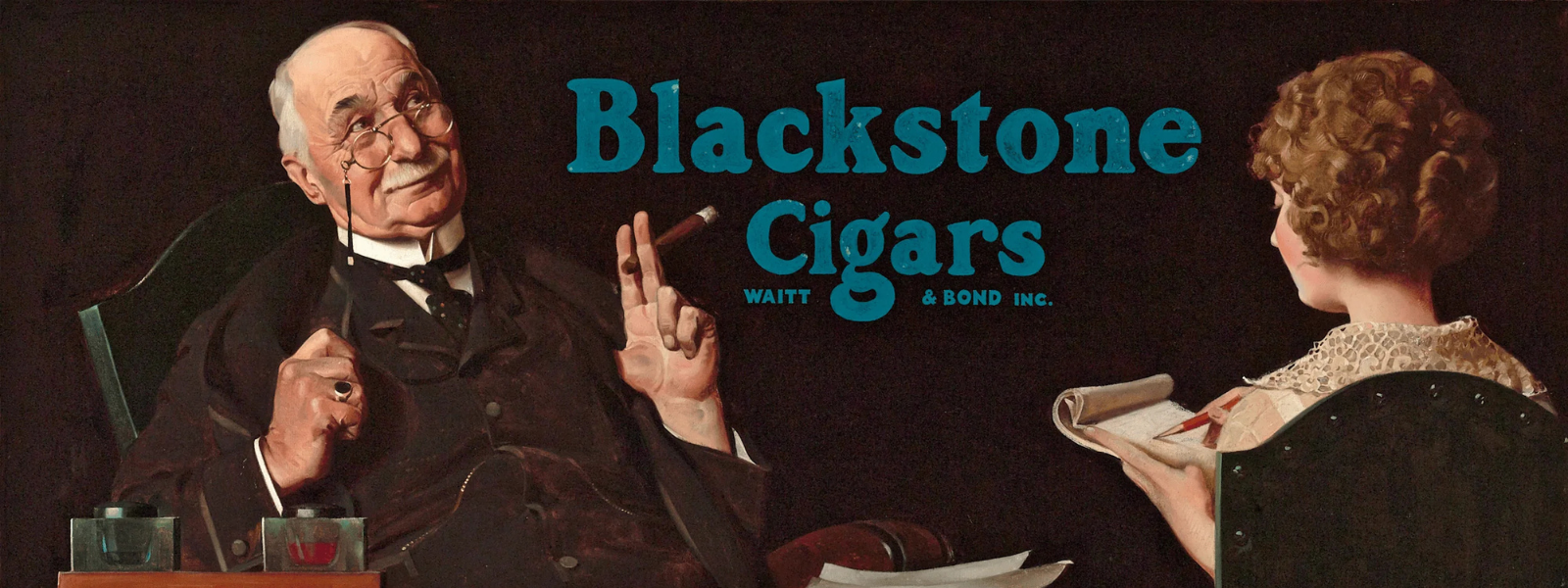
Advertisers wanted him as much as editors did. His commercial clients included Jell-O, Coca-Cola, General Motors, Ford and Post Cereals. Around 1921, the cigar maker Waitt & Bond commissioned him to design a billboard. The resulting painting shows a businessman smoking a Blackstone cigar while his secretary takes dictation. The company returned for two further designs: a hunting scene in 1922 and a fishing scene in 1923.

Blackstone Cigars by Norman Rockwell. Circa 1921. Oil on canvas. M.S. Rau.
Camera, Charcoal and Canvas
Rockwell’s apparently spontaneous scenes required extensive preparation. He began with rough sketches, cast models and arranged their poses, expressions and props. Photography became an important part of this process. He directed models through numerous sittings, then used the photographs to develop a detailed charcoal drawing.
Color studies allowed him to test the composition before beginning the finished oil. He sometimes painted directly onto a photographic print of the charcoal drawing or onto clear acetate placed over it. Working at a smaller scale helped him assess how the image would read on a magazine cover.

Shuffleton’s Barbershop by Norman Rockwell. 1950. George Lucas Museum.
These studies also document changes. In the color study for Shuffleton’s Barbershop (1950), the composition lacks the window frame that appears in the finished painting. Its addition places the viewer outside the shop, looking through the glass at the musicians gathered inside.
Rockwell worked across several supports during these preparatory stages, including photographic paper. These studies were working tools: he used them to test colors, adjust poses and resolve details before beginning the finished painting. A study may concentrate on a single figure or explore the entire composition, often with looser brushwork and less detail than the final version. It is an original work by Rockwell’s own hand, distinct from a printed reproduction. For collectors, these studies and his pencil and charcoal drawings offer a closer look at how he developed an image, including ideas he later changed or abandoned.
Four Freedoms for a Nation at War
In 1939, Rockwell moved his family to Arlington, Vermont. Local residents became his models, and a town meeting helped inspire one of his best-known paintings, Freedom of Speech.
In his January 1941 address to Congress, President Franklin D. Roosevelt identified four freedoms: freedom of speech, freedom of worship, freedom from want and freedom from fear. Rockwell interpreted them through scenes of ordinary life. The Saturday Evening Post published the four paintings in consecutive issues beginning February 20, 1943, each accompanied by an essay.
The original paintings subsequently toured sixteen cities in a campaign that raised $133 million in war bonds and stamps.

Freedom of Speech by Norman Rockwell. 1943. Norman Rockwell Museum.
During the war, Rockwell also continued his longstanding work for the Boy Scouts. For the organization’s 1943 calendar, published by Brown & Bigelow, he painted A Scout Is Friendly, in which a Scout helps an elderly couple consult a city map while a younger boy watches. In his autobiography, Rockwell recalled that his Arlington studio caught fire the same day he shipped a Boy Scout painting to Brown & Bigelow. The blaze destroyed many of his earlier paintings, along with costumes and other working materials. A Scout Is Friendly remained in the Boy Scouts’ collection before its eventual acquisition by M.S. Rau.

A Scout is Friendly by Norman Rockwell. 1943. M.S. Rau.
Stockbridge and the Art of the Small Detail
In 1953, Rockwell settled in Stockbridge, Massachusetts, where he lived for the rest of his life. Residents of the town posed for paintings, including in The Runaway (1958), where a boy sits at a diner counter beside a Massachusetts state trooper. His bundle of belongings rests on the floor, identifying him as a runaway without a written explanation. The trooper and counterman lean toward him, their attention giving the encounter its reassuring tone.
Stockbridge resident Richard “Dick” Clemens modeled for the trooper. Rockwell photographed him repeatedly and retained details from the sitting, including the memo book protruding from his back pocket.

The Runaway by Norman Rockwell. 1958. M.S. Rau.
Rockwell applied similar attention to his own image in Triple Self-Portrait. Published on the Saturday Evening Post cover of February 13, 1960, it introduced the first of eight excerpts from his autobiography. The artist looks into a mirror as he paints a more youthful version of himself on the canvas. Reproductions of self-portraits by Albrecht Dürer, Rembrandt, Picasso and Van Gogh are pinned to his easel. Other details draw on his personal history, from the smoke rising from a brass bucket, recalling the hazards of pipe ash and painting materials in the studio.

Triple Self-Portrait by Norman Rockwell. 1960. Norman Rockwell Museum.
His calendar paintings offered more domestic subjects. In Tender Years: Moth Holes, made for Brown & Bigelow’s Four Seasons series, an older couple discovers damage to their stored winter clothing. The husband holds up red long underwear perforated by moths while his wife examines the contents of the trunk. Their expressions, somewhere between alarmed and amused, and the damaged garments supply the humor.

Tender Years: Moth Holes by Norman Rockwell. 1957. M.S. Rau.
A Harder Truth: Rockwell at Look
In 1963, Rockwell ended his association with the Post and began working for Look. His commissions for the magazine addressed racial injustice and other subjects that had seldom appeared in his earlier cover illustrations.
The Problem We All Live With depicts six-year-old Ruby Bridges entering William Frantz Elementary School in New Orleans on November 14, 1960. As the first Black student to attend the previously all-white school, Bridges required the protection of federal marshals. Look published Rockwell’s painting on January 14, 1964. Lynda Gunn, a young Stockbridge resident, modeled for Ruby.
Rockwell places the viewer near the child’s eye level and crops the marshals so that their faces remain outside the composition. Ruby’s white dress contrasts with the wall behind her, where racist graffiti and a splattered tomato convey the hostility she faced. Her upright posture and steady forward gaze convey her courage and resilience, placing the young civil rights icon at the center of the painting.

The Problem We All Live With by Norman Rockwell. 1963. Norman Rockwell Museum.
In 1975, The Problem We All Live With became the first painting purchased by the Norman Rockwell Museum. It was displayed at the White House in 2011, for the fiftieth-anniversary school year of Bridges’ integration.
Rockwell’s later commissions for Look continued to address public life. His study for The Right to Know (1968) shows figures with lowered eyes. In the finished painting, they face the viewer directly, a change that makes their demand for information more explicit.
Original, Study or Print
Original Norman Rockwell paintings and drawings were executed by the artist himself. This category includes finished illustrations, oil studies and charcoal drawings. A study may differ from the finished work and can provide a particularly useful record of his working process.
Rockwell also approved limited-edition reproductions, some bearing his pencil signature. That signature does not make the printed image an original painting. Even when their color and detail closely resemble the source work, collotypes are photographic reproductions. Buyers should distinguish a signature applied by hand from one reproduced as part of the image.
For an original work, provenance deserves close attention. Confirm the medium and support, compare the dimensions with published records and trace ownership toward the artist or commissioning client wherever possible. Publication history is also useful: establish whether the image appeared as a magazine cover, calendar illustration or advertisement.
Laurie Norton Moffatt’s two-volume Norman Rockwell: A Definitive Catalogue (1986) is a standard reference. As a catalogue raisonné, it documents the artist’s known body of work rather than a selection of highlights, connecting individual works with their commission and publication histories. A Scout Is Friendly, for example, is recorded as catalogue number A63.
The Illustrator Who Outlasted His Critics
In 1977, Rockwell received the Presidential Medal of Freedom, the nation’s highest civilian honor. The Smithsonian American Art Museum’s 2010 exhibition Telling Stories brought together 57 paintings and drawings from the collections of George Lucas and Steven Spielberg, examining his methods as a visual storyteller.
In December 2013, Saying Grace sold for $46 million at Sotheby’s, more than three times his previous auction record. The result demonstrated the demand for a major, widely recognized composition.
For collectors, the appeal extends beyond familiarity with the published image. An original preserves Rockwell’s brushwork, scale and handling of light, as well as the details that made his illustrations effective. Explore works by Rockwell and other American artists in our paintings collection.
Works Cited
"A Brief Biography." Norman Rockwell Museum.
"Frequently Asked Questions." Norman Rockwell Museum Store.
Moffatt, Laurie Norton. Norman Rockwell: A Definitive Catalogue. 2 vols. Stockbridge, MA: Norman Rockwell Museum, 1986.
"Norman Rockwell's Four Freedoms." Norman Rockwell Museum.
"Norman Rockwell's Saying Grace Sells for $46 Million at Auction." KPBS, December 4, 2013.


