

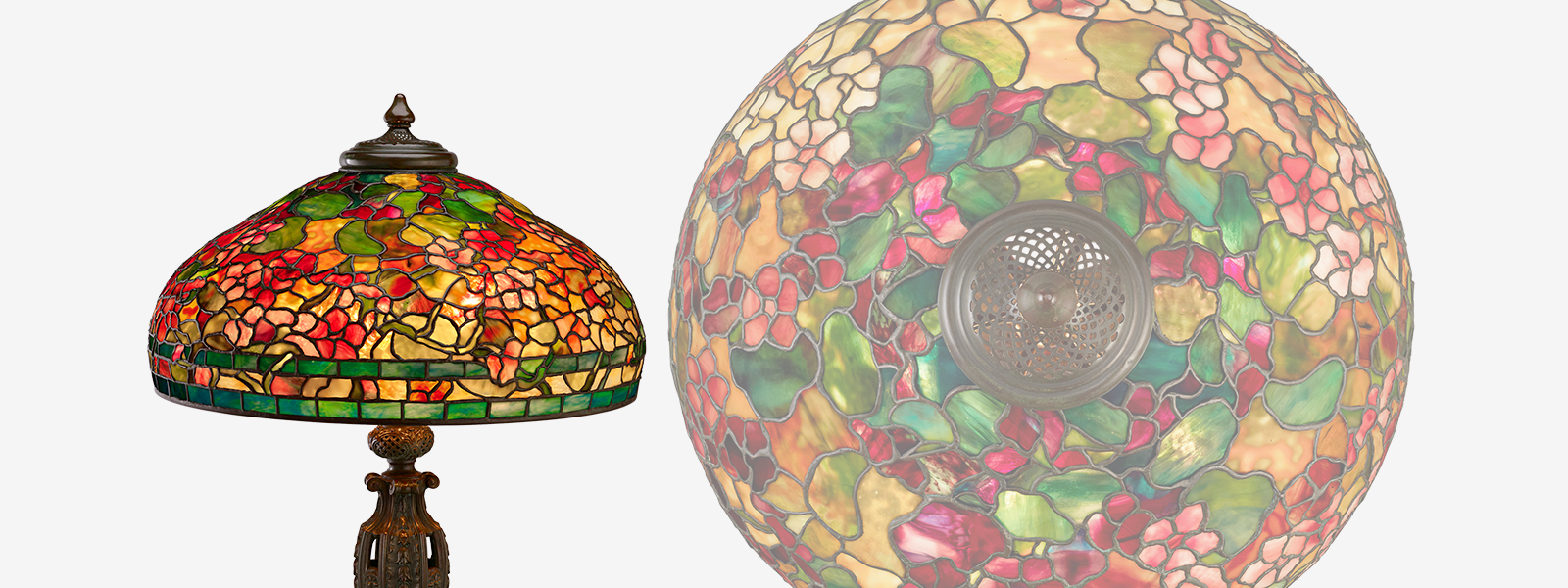
Have you ever wondered whether the lamp you found at the antique store was a genuine Tiffany lamp or just a reproduction? Although it may seem that any lamp with a stained-glass top is called “Tiffany,” the name is more precisely tied to the style popularized by Louis Comfort Tiffany’s studio.
A Tiffany-style lamp is any modern or vintage stained-glass lamp made by another manufacturer that copies or draws heavily on the aesthetic of Tiffany's studio. Much like a painting described as “after” a more famous artist, Tiffany-style lamps are mass-produced or contemporary artisan pieces rather than original period antiques.
To understand the distinction further, it is helpful to become acquainted with the original maker.
A genuine antique Tiffany lamp was designed and handcrafted in the studio of Louis Comfort Tiffany (1848-1933), a New York-born artist who began glassmaking in 1875. Trained first as a painter, Tiffany first found success in interior design, where he brought his painterly eye to wallpaper, furniture and stained glass. This included decorating the White House during Chester Alan Arthur’s presidency in 1882.
In 1885, Tiffany incorporated the Tiffany Glass Company, which was renamed Tiffany Glass and Decorating Company in 1892 and, finally, Tiffany Studios in 1902. The company's leaded-glass lamps emerged from this glassmaking enterprise, with an early example shown at the 1893 World's Fair in Chicago. At its peak, the company operated its own glassworks in Corona, Queens, and employed nearly 200 artisans. Alongside the namesake owner, several of these artisans, whose contributions have only recently been fully credited, created the patterns that collectors prize today.
Identifying an Authentic Tiffany Studios Lamp
Because so many imitations exist, it’s helpful to know what separates a genuine lamp from a convincing copy. Here are six important factors that can help determine the authenticity of a potential Tiffany Studios stained-glass lamp:
Marks and Signatures

Marks on the Fleur-de-Lis Lamp by Tiffany Studios. Circa 1900. M.S. Rau.
True Tiffany Studios lamps will feature a signature on a metal ring soldered inside the lower rim of the shade. The mark may vary depending on the name of the company at the time of the lamp’s creation, but it is most common to see “TIFFANY STUDIOS NEW YORK,” occasionally followed by a three-to-four digit mold number, which reflects the shade design. A key aspect of this mark is that the text must be die-stamped and hand-tooled in the metal, which often leaves uneven lettering. Perfectly uniform text from a stamp or paper stickers is an indicator that the shade is not original.

Signature on the Tiffany Studios Daffodil Table Lamp Shade. M.S. Rau.
Unlike the shade, authentic bronze bases do feature a separate “TIFFANY STUDIOS NEW YORK” stamp followed by a four-to five-digit inventory number. The stamp appears on the base’s underside or near the light socket.

Signature on the Daffodil Table Lamp Base. M.S. Rau.
Marks alone, however, are not proof. Signatures are an important aspect of authenticating a Tiffany Studios lamp, but they should be treated as one data point among several, not a final verdict.
Glass Quality
Louis Comfort Tiffany experimented extensively with the glass techniques used in the iconic Tiffany Studios shades. In fact, he patented his own type of glass in 1894, known as Favrile. The core principle behind any authentic Tiffany Studios shade is that the color is mixed, layered and folded into the molten glass. If the color merely sits on the surface, or is painted on, it is not a Tiffany Studios shade.
Tiffany himself described Favrile as “iridescent like the wings of certain American butterflies, the necks of pigeons and peacocks, the wing covers of various beetles”(Tiffany 1914, p. 26). Artisans at Tiffany Studios achieved these effects by manipulating the glass while still molten: adding colored glass, then folding and stretching it to create internal color striations and introducing metallic oxides into the mixture to produce an uneven, shimmering surface. Each sheet was entirely unique, with variations in color, density and texture that no two batches fully replicated.

Pomegranate Lamp by Tiffany Studios. Circa 1905. M.S. Rau.
Favrile glass falls into further categories. Drapery glass had deeper grooves between layers, creating more three-dimensional striations. By adding fluorine to the glass, artisans created ripple glass, a dimple-textured glass that resembles sunlight dappling through trees. Confetti glass was made by pouring molten glass over colored glass pieces or by sprinkling colored glass shards into hot glass, resulting in a scattered effect.
Once assembled, the individual glass pieces in a genuine shade are joined with hand-soldered copper foil, which leaves lead lines that are slightly irregular and faintly wavy. Reproductions soldered by machines tend to have lines that are too uniform in shape and thickness. Combined with the glass's supreme color and light-catching qualities, an authentic piece may look different depending on the angle and light source, while a painted reproduction reads flat by comparison.
Bronze Bases
Most Tiffany Studios lamps employed a bronze base—not brass or spelter—which should feel weighty when held. Although most genuine bases are hollow, a heavy lead ring is set into the bottom, anchoring the glass shade and creating the impression of a dense bronze base.

Base of the Counterbalance Floor Lamp by Tiffany Studios. M.S. Rau.
The bases were treated with a signature chemical finish on the bronze, called “Tiffany green” or Verdi-brown patina, first formulated by artisans at the Queens factory in 1897. The technique relied on immersing the bronze bases in a cyanide copper solution for up to four hours, then stippling a hand-mixed chemical solution onto the bases to create the mottled, deep, earthy green and brown oxidation effects. Another patina employed by Tiffany Studios on the bronze is known as “statuary patina.” This technique resulted in a smoother, muter gray-brown finish.
Some less common bases feature gold finishes, the result of electroplating the base with 24K gold. Both smooth finishes and a speckled golden texture, known as doré, are seen in the Tiffany Studios’ œuvre.
Construction and Period Components
Beyond the glass itself, the construction and period components of a Tiffany Studios lamp offer clues to its authenticity. Because all Tiffany Studios lamps feature lead glass, the glass should be rigid and not flex when pressed lightly with a finger. Further, the favored on-off switch for a genuine lamp was a turn-paddle knob socket. Only rarely were pull chains employed.
Every component of the lamp should belong to the same era as the lamp itself: the socket hardware, the wiring channel, even the felt pads on the base’s underside. However, a rewired cord does not automatically disqualify a lamp as authentic. Rewiring can occur for safety, as can be expected for a century-old object. But mismatched hardware elsewhere—a replaced base plate, feet that look newer than the rest of the piece—is worth flagging, as it can significantly decrease the lamp’s value.
Shade and Base Compatibility
Luckily for collectors today, Tiffany Studios catalogued the intended pairing for specific shades and bases. While mismatches on the market today are common, some did happen innocently, whether lamps were separated, damaged or reassembled from spare parts over the many decades since its creation.

Counterbalance Desk Lamp by Tiffany Studios. Circa 1900. Favrile glass and patinated bronze. M.S. Rau.
The Counterbalance Desk Lamp, made around 1900, is a great example of a matching set. The hand-blown Favrile shade with the rare original patinated bronze base is documented in Alastair Duncan’s Tiffany Lamps and Metalware, a compendium of authentic pairings that confirm this is not an assembled or “married” example.
Tiffany Studios used two separate numbering systems. The number stamped on the shade’s rim ring is a mold or design number tied to the shade pattern, while the number stamped on the base is a separate inventory number from the stockroom system. A shade and a base can each be entirely authentic and accurately documented, yet not have matching numbers. Confirming an original pairing means cross-referencing both numbers against documented design and price records, including finding a matching example in a museum collection.
Provenance
Last but not least, a documented chain of ownership can carry real weight in identifying authentic lamps, especially for rarer or higher-value patterns. This may include known family names, auction records, gallery invoices, or a full history that traces back to the lamp’s original sale. Provenance can help connect a lamp to a specific collection, a notable owner, or an important moment in Tiffany’s history, adding a layer of significance or value beyond the object itself.
The absence of provenance does not prove a lamp is fake. Plenty of authentic lamps changed hands quietly over the decades: collectors preferring to keep their names private, passing lamps down to family, or other avenues that didn’t leave a paper trail. But a lamp with a documented, traceable history offers real reassurance to a buyer, and it tends to command a premium at auction for exactly that reason.

Tiffany Studios Lantern for the Vanderbilt Mansion by Louis Comfort Tiffany. Circa 1881. M.S. Rau.
Few examples illustrate this better than the Lantern for the Moorish Smoking Room in the Cornelius Vanderbilt II Mansion. Created by Louis Comfort Tiffany, circa 1881, the lantern was one of eight designed for the smoking room at Vanderbilt’s Fifth Avenue Mansion, considered one of the most significant interior design spaces in the country at the time. When the mansion was demolished in 1926, the lantern passed to Loew’s State Theater in Syracuse. The documented chain of ownership runs from Vanderbilt himself, acquired directly from Tiffany, through Loew's State Theatre, and across several private collections before arriving with M.S. Rau.
What Makes One Tiffany Lamp More Valuable Than Another?
Even if you are able to determine that a lamp is indeed an original, not all Tiffany Studios lamps are created equal in value. Prices can range enormously— at M.S. Rau, our current inventory spans roughly $28,500 to $298,500, along with several exceptional pieces with prices available upon request. To determine the value, appraisers consider several factors, such as pattern rarity, complexity, condition, scale and artistic importance.
Patern rarity arguably plays the most outsized role. While stylized geometric models like the Fleur-de-Lis Table Lamp represent an upper-tier collectible standard, they were produced in larger quantities over many years. On the other hand, highly complex floral designs were crafted in far smaller runs.
Intricate floral masterpieces like the Pink Lotus or Magnolia shades required thousands of individually hand-cut glass pieces, thus limiting production cycles. Consequently, these rare designs command extraordinary sums, including the Magnolia Floor Lamp, which realized $4.4 million at Sotheby’s in 2025, setting the all-time record for a leaded Tiffany Studios lamp.

Fleur-de-Lis Table Lamp by Tiffany Studios. Circa 1900. Favrile glass and bronze base. M.S. Rau.
Complexity compounds this effect, as the rarer patterns are also usually the most intricate. A shade built from hundreds of individually cut pieces of glass arranged into a naturalistic motif reflects a far greater investment of skilled labor than a simpler geometric design. The glass itself matters too. Shades that showcase particularly striking or unusual Favrile techniques, whether through vivid color combinations or dramatic drapery, or mottled glass, tend to be more desirable, since much of a Tiffany lamp's individuality lies in the glass.

Nasturtium Lamp Shade by Tiffany Studios. Circa 1900. M.S. Rau.
Scale factors in as well. Larger lamps, particularly substantial floor lamps, required more glass, more time and greater skill to produce, and that scale is often reflected in both rarity and price. The Nasturtium Lamp, circa 1900, illustrates this well. Measuring 25 inches in diameter across the shade and 33 5/8“ high, its broad, sweeping leaded glass shade features vibrant red and pink nasturtiums unfurling across a radiant golden ground, interwoven with delicate leaves and vines that twist with naturalistic rhythm.
A shade of this substantial diameter demanded a much larger volume of hand-cut glass and a more expansive bronze base to support it. Combined with the complex artistry required to execute its illuminated garden scene across such a large canvas, this scale places the piece’s value well above that of a standard-sized lamp in a simpler pattern.
Artistic importance can elevate a lamp beyond what its size or condition alone would suggest, and the distinctions behind a specific pattern a lamp was made in, and the designer behind it, can significantly increase a lamp’s value.
The Tiffany Lamp Designs Collectors Know
Some designs hold a special place in Tiffany Studios’ history for their innovation or association with the designers behind them. Few names matter more here than Clara Driscoll (1861-1944). Driscoll led the women’s glass-cutting department at Tiffany Studios and is now credited as the designer behind many of the firm’s most celebrated patterns, including the Wisteria and Dragonfly lamps once attributed to Louis Comfort Tiffany himself. Her authorship went largely unrecognized for most of the last century, until her letters detailing her time at Tiffany Studios were rediscovered in the 1990s. A lamp tied to a known Driscoll design carries this history, thus increasing value.

Poppy Lamp by Tiffany Studios. Circa 1910. M.S. Rau.
Certain patterns by Driscoll have become so closely associated with Tiffany Studios that collectors seek them out by name. The Poppy Lamp, almost certainly designed by Driscoll, is a coveted Tiffany floral display, with delicate, lace-like bronze filigree layered over a brilliant red, amber and green leaf glow, which heightens the shade's incredible naturalistic effect. Similar examples of this Poppy Lamp are held in important museum collections, such as the Cleveland Museum of Art, and the design drawing for this famed shade belongs to the Metropolitan Museum of Art.
The Acorn Lamp is one of Tiffany Studios’ most recognizable geometric-meets-nature designs, placing a frieze of stylized acorns and foliage within a banded geometric structure. The dappled hues of lush green and citrus yellow from the glass emit a lustrous glow, and the elegant bronze five-footed harp base with the free-standing shade further mimics an acorn top. It’s a pattern that’s on the market enough to be familiar to collectors, yet it garners exceptional results at auction.

Acorn Lamp by Tiffany Studios. Circa 1900. M.S. Rau.
A striking case in point sold at Christie’s in 2025, when an Acorn Table Lamp carried a pre-sale estimate of $15,000 to $20,000 and ultimately realized $163,800, more than eight times its high estimate. Results like this are a reminder that well-known patterns can command dramatic premiums when a particular example stands out for its condition or quality of execution.

Pair of Four-Light Lily Table Lamps by Tiffany Studios. Circa 1905. M.S. Rau.
The Lily pattern is among Tiffany Studios’ more restrained floral designs, drawing on the two-dimensional Japanese woodblock prints for sculptural subtlety. M.S. Rau’s Pair of Four-Light Lily Table Lamps, circa 1905, is a beautiful example of this design. Each lamp features elongated, trumpet-shaped Favrile shades with a green pulled-feather motif evoking the flower’s form. The flowers rise from bronze bases whose winding, asymmetrical stems reflect Art Nouveau's guiding principle of graceful and curving lines.
This form won a grand prize at the International Exposition of Modern Decorative Art in Turin, Italy, in 1902. Due to its popularity, Tiffany Studios created lamps with a wide variety of bulbs, including this rare matching pair. Examples of Lily Lamps are held in many museum collections today, including those of the Art Institute of Chicago and the Fine Arts Museums of San Francisco.
Genuine Tiffany Studios lamps like these are becoming harder to find with each passing year. M.S. Rau’s collection features an extensive selection of genuine, documented Tiffany Studios lamps, from rare geometric patterns to museum-caliber floral designs. Our current inventory carries documented provenance and even includes examples owned by Louis Comfort Tiffany himself. Explore our collection today and find a piece of history for your own home.
Works Cited
Tiffany, Louis Comfort, The Art Work of Louis C. Tiffany (New York: Doubleday Page and Company, 1914), p. 26.


