

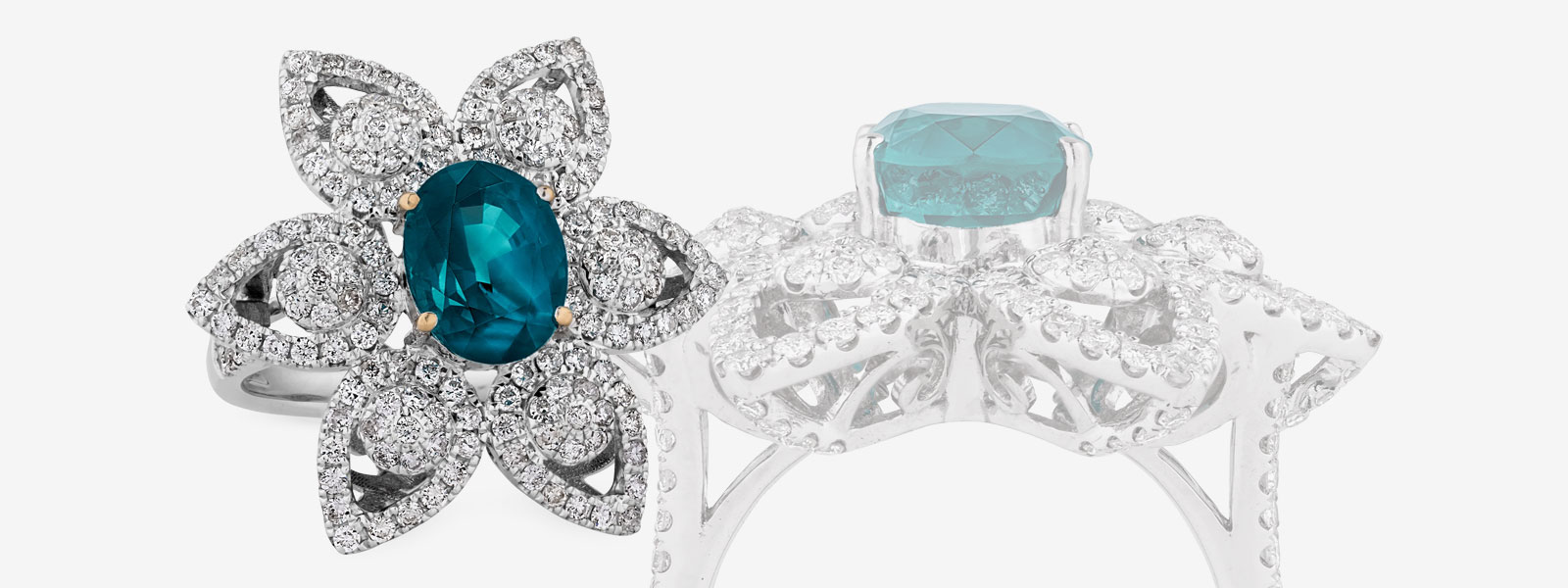
Quick Look
- Color change is an optical phenomenon caused by how a gemstone absorbs and transmits different wavelengths of light
- Alexandrite is the standard by which all other color-change gems are measured, prized for its shift from green to red
- Color-change sapphires, garnets and spinels exist but remain very rare
- Trace elements such as chromium and vanadium are typically responsible for the effect
- The strength and completeness of the color shift is a primary factor in a stone's value
- Daylight and incandescent light reveal two distinct personalities within a single gem
Some gemstones do something that seems, at first glance, impossible: they change color. A stone that glows blue-green in the afternoon sun can shift to a deep purplish-red the moment it is carried indoors. This is not an illusion or a trick of memory. It is a measurable optical phenomenon, and it occurs in only a small number of gem varieties on Earth.
Color-changing gemstones occupy a distinct category in gemology, separate from stones that display a range of colors across their species. This behavior belongs to a broader family of gemstone phenomena that also includes asterism and play-of-color, though color change remains among the rarest. Join us as we explore some of the most celebrated examples of these rare gemstones, and the science behind the magic.

Brazilian Alexandrite Ring, 6.67 Carats. M.S. Rau.
Why Do Gemstones Change Color?
Color change begins with light. Daylight and incandescent light emit different balances of wavelengths: daylight is comparatively rich in blue and green wavelengths, while incandescent light, such as that from a warm household bulb, skews toward red and orange. Most gemstones absorb a fairly constant set of wavelengths regardless of the light source, so their color reads as stable.
A color-change gemstone behaves differently. Trace elements embedded in its crystal lattice, most often chromium and vanadium, create two separate transmission windows in the visible spectrum, one in the blue-green range and another in the red range, while suppressing the yellow-green band in between. Under daylight, the eye favors the blue-green window. Under incandescent light, the balance tips and the eye favors the red window. Gemologists formalize this comparison using standardized light sources, CIE illuminant D65 for daylight and CIE illuminant A for incandescent light, allowing color change to be measured rather than simply described.
This is worth distinguishing from pleochroism, a related but separate phenomenon in which a stone shows different colors depending on the viewing angle rather than the light source. Some color-change stones, including alexandrite, exhibit both properties at once, which only deepens their complexity. For a broader look at how trace elements shape a gem's appearance, see our comprehensive guide to gemstone colors.
Color Change Alexandrite

(Blue-Green Version) Color Change Russian Alexandrite Ring, 1.31 Carats. M.S. Rau.
Alexandrite was found in the Ural Mountains in the early 1830s, decades before Edison's light bulb. The discovery is usually credited to the Finnish mineralogist Nils Gustaf Nordenskiöld, who was initially examining the stone as a suspected emerald. He grew suspicious of that identification because the mineral tested far harder than emerald on the Mohs scale, and while inspecting it further, he happened to look at it by candlelight in the evening. That's when he saw it flash from green to red. He recognized it as a new variety of chrysoberyl (he actually proposed the name "diaphanite," which never caught on), and the stone was formally named alexandrite shortly after, in honor of the young Alexander II.
Because its green and red hues echoed the colors of Imperial Russia, alexandrite was soon adopted as the nation's official gemstone. The original Russian deposits are now largely exhausted, which has pushed collectors toward material from Brazil, Sri Lanka and East Africa. No two types of alexandrite are exactly the same, though. Brazilian alexandrite, for instance, typically shifts from bluish-green to a rich purple rather than red, a distinction collectors learn to recognize.

(Notice the Red-Blue changes from the picture above) Color Change Russian Alexandrite Ring, 1.31 Carats. M.S. Rau.
Fine natural alexandrite is exceptionally scarce. Only a small fraction of chrysoberyl rough yields material with facet-grade clarity, and stones displaying a complete, high-saturation shift in both directions are rarer still. Size compounds the rarity, since large alexandrites of strong color change are seldom found in any deposit. Read more about this history in our guide to the alexandrite gemstone, or browse a selection of natural alexandrites among our many colored gemstones.
Color Change Sapphire
Color-change sapphire is corundum's answer to alexandrite, though it appears far less frequently. Where alexandrite typically shifts along a green-to-red axis, color-change sapphire more often moves between blue and violet or purple, with rarer examples shifting from green to a reddish-brown. The effect stems from trace amounts of vanadium, sometimes accompanied by chromium, within the corundum structure.

Ceylon Color-Change Sapphire Ring, 5.67 Carats. M.S. Rau.
Collectors evaluating a color-change sapphire look for the same qualities that matter in any fine sapphire: saturation, clarity and cut, but weigh them alongside the strength of the transformation itself. A weak or partial shift is common; a complete, vivid change between two well-saturated colors is not, which is why fine examples command serious attention among colored stone collectors.
Color Change Garnet and Spinel

(Blue) Color-Change Spinel Ring, 5.97 Carats. M.S. Rau.
Garnet is best known for deep, static reds, which makes its color-change varieties, chiefly pyrope-spessartine garnets colored by chromium and vanadium, particularly striking. Fine specimens shift from a bluish or vivid green under daylight to an intense purplish-red under incandescent light, a transformation strong enough to be mistaken for alexandrite by an untrained eye.
A landmark 1998 discovery in the Bekily region of Madagascar produced garnets that appeared genuinely blue in daylight, a color gemological texts had previously held to be impossible in garnet. Our garnet collection includes demantoid and other rare varieties for collectors drawn to this often-overlooked gem family.

(Purple) Color-Change Spinel Ring, 5.97 Carats. M.S. Rau.
Color-change spinel is rarer still. Spinel was mistaken for ruby and sapphire for centuries before mineralogists recognized it as a distinct species in the eighteenth century, a history explored further in our guide to the "imposter" spinel gemstone. Its color-change variety, most often shifting between blue and violet-purple, remains an uncommon find in any size.
Stones exceeding a single carat are considered a genuine rarity within an already scarce category. Compared with alexandrite, both color-change garnet and color-change spinel tend to show less complete transformations and smaller available sizes, which is precisely what keeps them firmly in specialist territory rather than mainstream collecting.
Chameleon Diamonds
The chameleon diamond stands apart: it is the only natural colored diamond capable of a genuine color change. Where alexandrite, sapphire, garnet and spinel shift with light source, chameleon diamonds respond to heat and darkness, an effect gemologists classify as thermochromism and photochromism.

Chameleon Diamond Ring, 1.73 Carats. M.S. Rau.
Under normal conditions, a chameleon diamond typically reads grayish yellowish-green or olive. Gently heated, around 150 degrees Celsius, or left in darkness, it temporarily turns golden or orangey yellow, reverting once light and room temperature return. The cause is unsettled, but the effect is generally attributed to hydrogen and isolated nitrogen atoms interacting within the crystal lattice, a structure that cannot be replicated through treatment.
What Makes a Color Changing Gemstone Valuable?
Several factors determine the worth of any color-change gemstone.
- Strength and completeness of the color change. A full, vivid shift between two distinct colors outranks a partial or muted one.
- Quality of both colors. Each color the stone displays should be attractive and well-saturated in its own right, not merely present.
- Size, clarity and cut. As with any gemstone, larger stones with fewer inclusions and skilled proportioning command a premium, particularly since color change intensifies or fades depending on a stone's depth.
- Natural origin and documentation. Certification from a recognized laboratory such as the Gemological Institute of America confirms both natural origin and the presence of true color change, distinguishing it from more common color shift.
How to View Color Changing Gemstones
For alexandrite, sapphire, garnet and spinel, compare the stone under natural daylight, ideally indirect, and then under warm incandescent light, moving the gem between the two rather than relying on memory. A chameleon diamond calls for a different approach: its transformation depends on heat and darkness, reverting within minutes to hours once conditions return to normal.
Photographs and screens rarely capture the full effect, since digital displays do not reproduce the spectral qualities of true daylight or incandescent light. Serious collectors generally insist on viewing a color-change gemstone in person before purchase.
FAQ
What gemstones change color in different light? Alexandrite is the most recognized, but color change also appears in select sapphires, garnets and spinels, and occasionally in diamonds, zircon and tourmaline.
Why do gemstones change color? Trace elements such as chromium and vanadium create two separate windows of transmitted light within the stone. Daylight and incandescent light emphasize different windows, producing two distinct colors from a single gem.
What color does alexandrite change to? Fine alexandrite typically shifts from bluish-green in daylight to purplish-red under incandescent light, though Brazilian material often shifts toward purple rather than red.
Is color change sapphire rare? Yes. Color-change sapphire is considerably rarer than standard blue or fancy-color sapphire, and stones with a strong, complete shift are especially scarce.
Is color change garnet natural? Genuine color-change garnet occurs naturally through chromium and vanadium content, though buyers should confirm natural origin through laboratory certification, since the effect can be mimicked by other treated or synthetic materials.
Works Cited
- "Gemstones that change color: nature's optical illusion." Jewelers Mutual Group, September 11, 2025.
- Sun, Ziyin, Aaron C. Palke and Nathan Renfro. "Blue-Green Pyrope-Spessartine Garnet with High Vanadium." Gems & Gemology, Fall 2017.
- "The Connoisseur's Guide to Loose Alexandrite Gemstones: Rarity, Value, and the Color-Change Effect." AfricaGems.
- "Alexandrite: The Science of Color Change and Optical Phenomena." Gem Ritual, June 18, 2026.
- Breitzmann, Heidi, Ziyin Sun and Aaron C. Palke. "Color-Change Spessartine Garnet: A First Report." Gems & Gemology, Summer 2019.


