

Jan van Huysum, the celebrated 18th-century Dutch still life painter, was renowned for his seemingly “impossible” bouquets. Because many of the flowers he depicted bloomed in different seasons, they could never have appeared together in a single arrangement. His compositions could therefore take years to complete, with Huysum returning to the same canvas season after season. In his hands, the fleeting beauty of flowers became a lasting subject of artistic fascination.

| A Delft Vase with Flowers, Jan van Huysum, Source. |
Floral motifs remain among the most enduring subjects in both fine art and jewelry. Though flowers themselves change with the seasons, our fascination with their beauty doesnot. Their familiar forms also offer artists extraordinary freedom for interpretation, appearing in styles that span centuries.
At M.S. Rau, our collections of floral jewelry and fine art reveal this remarkable versatility. From blossoming brooches by celebrated jewelers to vibrant paintings spanning generations, these works demonstrate the enduring power of nature as artistic inspiration.
Flowers in Jewelry
The appeal of botanical jewelry extends from antique masterpieces to contemporary designs, a testament to the timelessness of the floral form.

| Unheated Burma Ruby and Diamond Floral Necklace. M.S. Rau. |
This floral necklace presents 8.50 carats of untreated Burmese rubies and 20.00 carats of brilliant- and baguette-cut diamonds. The delicate flowers are centered by rubies confirmed by GIA as unheated and originating from Burma, while glittering diamonds form their petals and accentuate the necklace’s graceful design

| Fabergé Sapphire Floral Brooch. M.S. Rau. |
Dating from the Art Nouveau era, this delicate Fabergé brooch demonstrates how dramatically jewelers can reinterpret the natural world. Rather than relying primarily on gemstones, Fabergé sculpts the flower almost entirely from 14K yellow gold, accented by a 1.00-carat sapphire stamen, an antique-cut diamond and a pearl.
Flower brooches can be particularly expressive when designed for movement. In en tremblant settings, blossoms and gemstones gently tremble as the wearer moves, lending the jewel an extraordinary sense of life.

| Victorian Diamond Brooch. M.S. Rau. |
Movement immediately draws the eye in this Victorian brooch. A 1.21-carat cushion-cut white diamond rises above the surrounding vines and leaves in an en tremblant setting. Mounted on a fine wire spring, the diamond moves with the wearer, continually catching and reflecting the light.

| René Boivin Opal Floral Brooch. Sold at M.S. Rau. |
Botanical brooches can also function as miniature works of sculpture. Their format gives jewelers remarkable freedom for artistic experimentation while remaining entirely wearable. In this René Boivin creation, the floral form becomes a vehicle for bold design rather than a literal imitation of nature.
Because flowers lend themselves so readily to stylization, jewelers can transform gemstones and precious metals into petals, leaves and blossoms. Different cuts, colors and textures allow the same familiar subject to take on entirely new personalities.

| Oscar Heyman Pink Sapphire and Yellow Diamond Floral Ring. M.S. Rau. |
Oscar Heyman takes a more dazzling approach to the floral motif in this exceptional ring. A total of 6.17 carats of pink sapphires and 1.17 carats of fancy golden yellow diamonds form the petals around a 1.75-carat round brilliant-cut white diamond, translating the exuberance of a flower in bloom into precious gemstones.
Raymond Yard and Nature-Inspired Design
Raymond Yard recognized the appeal of nature-inspired motifs early in his career, incorporating them into designs that became hallmarks of the Yard name. The firm’s sophisticated interpretations transformed familiar botanical forms into enduring jewelry icons.
One such design, a jeweled flower basket first created in 1964 shortly after Raymond Yard’s retirement, was remade in 1999—a testament to the lasting appeal of the motif.

| Raymond Yard Multicolor Basket Brooch. Sold at M.S. Rau. |
Yard transforms sapphires, rubies, diamonds and emeralds into a jewel that evokes the abundance and color of a freshly gathered bouquet. The flowers emerge from an intricately worked 18-karat gold basket whose metalwork recreates the delicate texture of woven wicker.

| Raymond Yard Carved Gemstone Floral Bracelet. Sold at M.S. Rau. |
This inventive bracelet demonstrates the creativity behind Raymond Yard’s designs, blending botanical imagery with Art Deco elegance. Carved tourmaline, aquamarine and citrine blossoms emerge among emerald and diamond leaves, creating a garden of gemstones that encircles the wrist.
Flowers in Art
Flowers have a longstanding place in fine art, particularly in still life painting. Their visual versatility, rich symbolism and familiarity have allowed artists to use them to explore themes ranging from beauty and abundance to transience and mortality. Even the choice of a particular blossom can reveal something about an artist, sitter or patron.
Perhaps most remarkably, floral subjects transcend artistic movements. From the meticulous naturalism of the Old Masters to Fauvist experimentation and contemporary imagery, generations of artists have continually reinvented the same timeless forms.

| Still Life with Flowers by Jean-Baptiste Monnoyer. Sold at M.S. Rau. |
Jean-Baptiste Monnoyer approaches the floral still life with extraordinary precision. His elaborate arrangement unfolds against a detailed landscape, with each blossom rendered with striking naturalism. The meticulous composition exemplifies the academic tradition of floral painting before the 18th century.

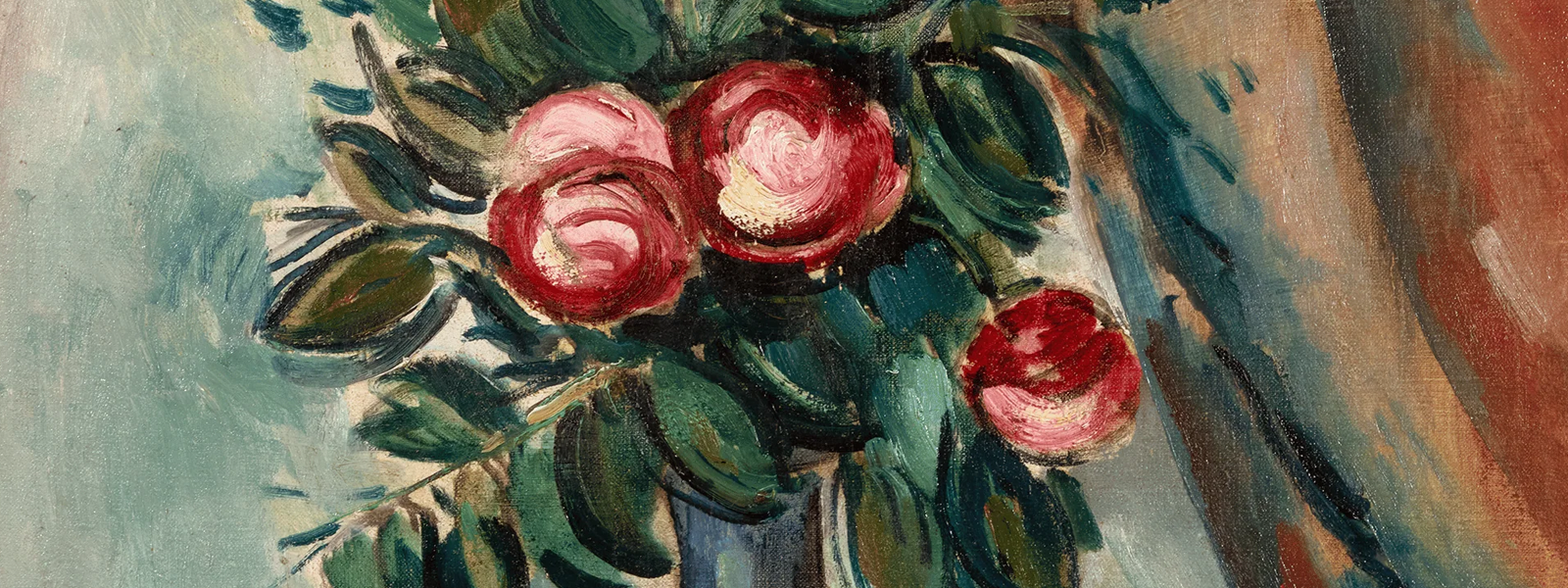
| Bouquet of Peonies in a Blue Vase by Maurice de Vlaminck. M.S. Rau. |
Nearly 250 years later, Maurice de Vlaminck approaches a similar subject through an entirely different artistic language. His Fauvist bouquet favors expressive color and simplified form over exact naturalism, demonstrating how readily the floral still life could be reinvented for the modern age.

| Desert Flowers Blooming by Louis Carreon. M.S. Rau. |
More than a century after Vlaminck, Louis Carreon again reimagines the timeless floral motif, this time through a contemporary lens and unconventional materials. His use of spray paint demonstrates just how far the subject can evolve while remaining instantly recognizable.

| Spring Day in the Forest by Peder Mork Monsted. Sold at M.S. Rau. |
Flowers also play a quieter but equally important role in landscape painting. In Peder Mork Monsted’s Spring Day in the Forest, small white blossoms and emerging green leaves signal the woodland’s renewal after winter. Rather than dominating the composition, these subtle botanical details help tell the larger story of the changing season.

| Paysage au Printemps by H. Claude Pissarro. Sold at M.S. Rau. |
H. Claude Pissarro captures spring at its exuberant peak. Pastel foliage fills the landscape, flowers blanket the ground and blossoms reflect in the stream below. Through his Impressionist handling of color and light, Pissarro transforms the familiar spring landscape into a celebration of abundance and renewal.
Why Collectors Continue to Love Florals
Floral motifs are visually immediate yet symbolically rich, making them enduring additions to any collection. They cross centuries, movements and mediums with remarkable ease, appearing as everything from meticulously painted bouquets to sculptural gemstone jewels. Especially resonant in spring yet timeless throughout the year, floral works continue to offer artists—and collectors—an inexhaustible source of beauty and inspiration.
Sources
“The Impossible Bouquet.” Prairie Girl Flowers, February 21, 2019. https://www.prairiegirlflowers.com/journal-1/2019/2/19/the-impossible-bouquet.


