Casanova and Canaletto: Venice's Most Notorious Prisoner and the Paintings That Immortalized His World
As the clock struck midnight on All Hallows' Day, 1756, Venice’s most infamous provocateur climbed through the roof of the Prisons of San Marco and vanished into the night. Nearly a decade earlier, the city’s most technical and celebrated artist had immortalized the same scene.

| The Prisons and the Bridge of Sighs by Canaletto. This painting depicts the infamous prisons in which Casanova was held. Circa 1746. For sale at M.S. Rau. |
The Story of His Life
“One who makes no mistakes makes nothing.”
―Giacomo Casanova

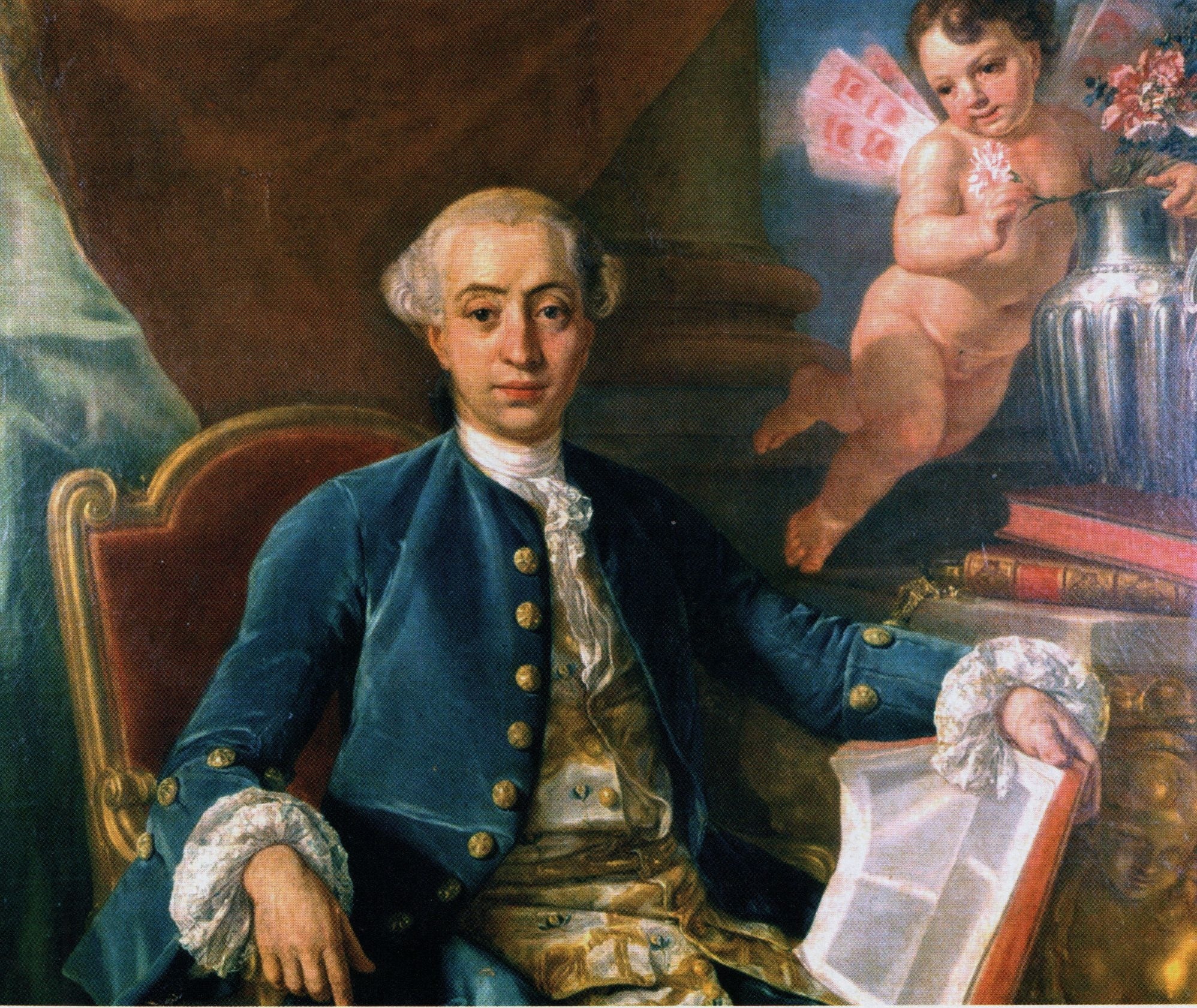
| Giacomo Casanova by Francesco Narici. Circa 1760. Source. |
Born in Venice in 1725, Giacomo Casanova was far more than the libertine lover history remembers. He was a writer, traveler and self-styled sorcerer whose life was filled with duels, disguises, forbidden affairs and bold escapes. A gifted conversationalist, Casanova moved fluidly through Europe’s courts, salons and backrooms, adopting aristocratic aliases like the Chevalier de Seingalt and Count Farussi. Though born into modest means, his charm, wit and intellect opened doors to Europe’s elite, including nobles, popes and even Catherine the Great, whom he tried to persuade to launch a Russian state lottery. His scandals, however, ensured that those doors often slammed shut just as quickly.

| Erotic Snuff Box. Circa 1840. M.S. Rau. |
Casanova’s posthumously published memoir, Histoire de ma vie (The Story of My Life), remains one of the most vivid and salacious literary portraits of Enlightenment Europe. Casanova wrote with a sensational and witty flair; the work is both a confession and a cultural document, revealing the social customs, shifting social dynamics and courtship rituals of the time without restraint. Like the artist Canaletto, Casanova employed artistic license to heighten the drama and romanticism of his subjects, portraying Venice as a city of theatrical excess and decadent possibility.
The Painter of Venice
“He paints with such accuracy and cunning that the eye is deceived and truly believes it is the real thing it sees, not a painting.”
―G.P. Guarienti

| The Church of Il Redentore by Canaletto. Circa 1746. For sale at M.S. Rau. |
While Casanova was coming of age amid the intrigue of Enlightenment Venice, another master was already at work defining the city’s image. Giovanni Antonio Canal, known as Canaletto, was a Venetian painter born in 1697 and celebrated for his luminous vedute, meticulously detailed cityscapes that captured the grandeur of 18th-century Venice.
Trained by his father, a scene painter for the theater, Canaletto brought a dramatic sense of perspective with architectural detail so accurate has been studied as a historical record, often employing a camera obscura for accuracy. Occasionally, he composed capricci, imaginative views combining real and invented elements. Hugely popular among Grand Tourists, particularly British aristocrats, his paintings became coveted souvenirs and shaped the enduring image of Venice.
Legends Intertwined
Though one worked with paint and the other with prose, Canaletto and Casanova were chroniclers of the same world. Each reality remains a vital source for historians, detailing the city. In the 18th century, Venice was known as the pleasure capital of Europe, a city of masked carnivals, gambling halls and courtesans. This excess was governed paradoxically by political and religious conservatives and Venetian nobility, who tolerated such indulgences to encourage tourism.

| On the Steps of the Salute, Venice by Félix-François Georges Ziem. Late 19th-century. M.S. Rau. |
The contemporaries also shared a connection to one of their city's most haunting landmarks: the Prisons of San Marco. One captured it, the other was held captive in it.
Condemned for Curiosity
On July 26, 1755, at the age of 30, Giacomo Casanova was arrested by the Venetian Inquisition on charges of “affronts to religion and common decency.” These accusations stem more from his provocative lifestyle than any concrete crime. Known for his fascination with the occult and possession of banned books on summoning elemental spirits, Casanova used his controversial texts to astonish and unsettle aristocrats. But they also marked the young man as a threat to the established moral order. Casanova later admitted, “Those who were aware that I possessed these books took me for an expert magician, and I was not sorry to have such a reputation.”
Without trial or formal explanation, he was sentenced to five years in The Leads, a notorious attic prison connected to the Doge’s Palace reserved for political prisoners and high-profile offenders.
The Prisons of San Marco
Part of the Prisons of San Marco, The Leads take their name from the lead sheeting that lined the roof. The prisons were among the first European prisons integrated into a civic and judicial center. The complex is connected to the Doge’s Palace by the Bridge of Sighs, so called for the sighs of prisoners glimpsing Venice one last time before confinement.
The prison was divided into two main areas: The Leads or Piombi, where Casanova was held, and The Wells or Pozzi, subterranean cells infamous for their damp, rat-infested conditions and flooded floors. While the attic cells were brutally hot in summer and bitterly cold in winter, they were a relative privilege compared to the filth and suffering below.
The Great Escape
“I confess to a feeling of vanity, not because I eventually succeeded—for I owed something to good luck—but because I was brave enough to undertake such a scheme in spite of the difficulties which might have ruined my plans and prevented my ever attaining liberty.”
―Giacomo Casanova
Casanova vowed to escape the Prisons of San Marco, something that had never been done before. He smuggled an iron bar into his cell, sharpened it into an eight-sided blade and hid it in his armchair, intending to dig through the floor beneath his bed. Knowing the guards regularly swept the room, he feigned a harsh cough and blamed the kicked-up dust. The guards grew suspicious and began thoroughly sweeping his cell. Casanova staged a violent coughing fit, even staining a handkerchief with blood to sell the illusion. The performance was convincing enough to fool the prison doctor, and the sweeping ceased.

| Concealed Dagger Cane. M.S. Rau. |
Over three weeks, he sawed through three two-inch floorboards, only to encounter terrazzo, a hard cement mixed with marble chips. Drawing on his readings of Hannibal’s Alpine crossing, Casanova used vinegar to weaken the surface, pulverizing it within four days. Just as he was ready to make his move, he was abruptly transferred to a new cell. Though this one was tall enough for him to stand and had windows, the change was a crushing setback. His tunnel was soon discovered, and guards ransacked his new cell in fury. Miraculously, they overlooked the tool still hidden in the base of his chair.
A Second Attempt
For a week, Casanova was left in filth, given only putrid meat and stale bread to eat as punishment. He shuddered in fear of being sent below to the infamous Wells. The guards began “sounding” his walls daily, tapping for hollow spots and searching every inch, except the ceiling. Fortunately for Casanova, the gaoler chose not to report the escape attempt, hoping to avoid blame for the oversight.
All hope was not lost. Casanova began exchanging books with a neighboring prisoner, the disgraced priest Father Balbi. They passed hidden notes in Latin, and soon, a daring plan took shape. Since Casanova’s cell was under too much scrutiny for him to resume digging, Balbi would tunnel down from above, covering the hole with devotional prints of saints. But to start, Balbi needed Casanova’s 20-inch iron tool.
Casanova told the gaoler he wanted to send Balbi a gift to thank him for all the books he had lent, an elaborate platter of macaroni and cheese for St. Michael’s Day, which Casanova insisted on preparing himself. The real purpose was to smuggle his tool to Balbi. Casanova requested the gaoler bring him the largest serving dish he could find.

| Silver Soup Tureen by Paul de Lamerie. Hallmarked London, 1741. M.S. Rau. |
The iron pike was too long to conceal completely within a book, so Casanova slipped it into the binding of a large Bible, allowing it to protrude slightly. To divert attention, he used the Bible as a serving tray, placing the heaping, buttery dish of macaroni and cheese directly on top. The gaoler, struggling to keep the slippery platter steady, focused entirely on not spilling melted butter onto the sacred text, never thinking to inspect the book beneath.
The ruse worked; Balbi received the tool and a delicious dinner. He was able to chip away at his own ceiling and into Casanova’s from above. The escape was nearly ready.
All Hallows’ Eve
As All Hallows’ Eve approached, Casanova turned to a personal favorite, Orlando Furioso, for a sign. In writing, he posed a question to the book itself: In what canto of Ariosto should I find the day of my deliverance? Taking the numerical values of the letters in his question, he arranged them into a reversed pyramid to determine the canto, stanza and verse that might hold the answer.
When he turned to the indicated passage, it read: "Between the end of October and the beginning of November." It was the perfect omen. With the Inquisitors away for several days for All Saints’ Day, the gaoler would drink heavily at night and sleep well into the morning. The moment to escape had arrived.
Balbi broke through, and together they climbed through the prison’s rafters at exactly midnight. Using knotted sheets as ropes, they descended the outer walls, navigated the rooftops and finally broke into the floor below. The drop to the canal was too great, so Casanova pried open a dormer window, broke the glass and found a ladder and more sheets to lower themselves into the room 25 feet below. At dawn, they changed clothes, snuck through the palace corridors, and, posing as guests accidentally locked in overnight, convinced a guard to let them out.
At 6:00 a.m., Casanova and Balbi stepped into a gondola and into freedom. To this day, they remain the only people known to have escaped the Prisons of San Marco.

| Coucher de soleil, quai des Esclavons by Félix Ziem. Late 19th century. M.S. Rau. |
Venetian Legacy

| The Molo: Looking West, Ducal Palace Right by Canaletto. Circa 1730s. Collection of The El Paso Museum of Art and previously on view at the MFA Boston’s Casanova’s Europe: Art, Pleasure, and Power in the 18th Century. Source. |
Whether captured on canvas or bound in pages, Venice has enchanted imaginations for generations. At M.S. Rau, we were thrilled to uncover this fascinating connection between two giants of Venetian history and to dive deeper into the lives of these iconic figures.
For a closer look at the 18th-century capital of pleasure, explore M.S. Rau’s collections of Italian fine art, antiques, Grand Tour souvenirs and even erotica!